• Coursework and Dissertation Help
  • About the author…
    • #missinghistories
    • Independent Educator: Research-driven Education and Training
    • Writing and Research
    • Independent Researcher

framingthequestion

~ Reflections on memory, history, photography and culture

framingthequestion

Tag Archives: history

Keep Mentioning the War?

27 Sunday Sep 2026

Posted by jaimeashworth in The Holocaust: Representations and Meanings

≈ 1 Comment

Tags

AfD, Alternative fur Deutschland, Auschwitz, fascism, germany, history, HMD, HMD2027, Holocaust, Holocaust Education, Holocaust memory, No Place for Prejudice, politics, representation, Stolperstein, Stolpersteine
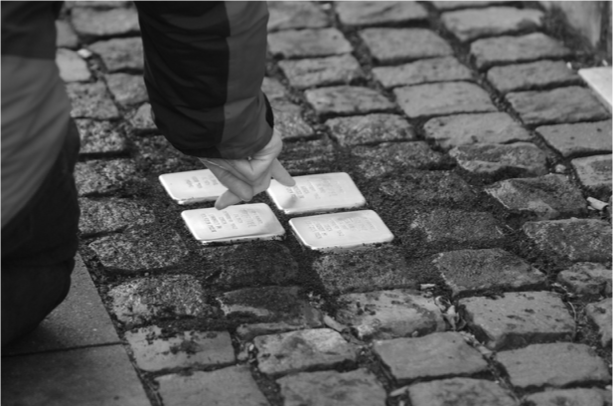
The grandson of a Holocaust survivor points to the Stolperstein for his great-grandmother, killed in Treblinka, 1942. Photo: Jaime Ashworth.

The Stolpersteine project by artist Gunther Demnig is perhaps the most successful memorial project in Holocaust commemoration. The nature of the individual plaques within a network (now numbering well over 100,000 across Europe) makes them an incredibly powerful symbol of and vehicle for Holocaust memory. And, as I described in 2019, laying the stones themselves is an incredibly powerful means of, if not closure, then ensuring that otherwise bottomless grief can perhaps be somewhat contained.

The decision by a new Alternative für Deutschland (AfD) administration in a small town in Saxony to forbid further installation of Stolpersteine should therefore be something that alarms us intensely. That it has done so in coalition with members of the CDU, the backbone of postwar German democratic politics, raises those concerns even further. The German word for the constitution is Grundgesetz (literally “ground law) and in so many ways this move seems an assault on the Grund of postwar assumptions about Holocaust memory, German wartime culpability, and the postwar order itself.

German rehabilitation into the European family of nations was based on a rejection of Nazism, if also on an incomplete acknowledgment of “ordinary” German support for and involvement in Nazi crimes. The attempt by the Allies to draw a line under the Nazi era at Nuremberg was largely successful, though it belied the problems of denazification more widely. The fact that Wilhelm Stuckart, the architect of the Nuremberg Laws and a participant in the 1942 Wannsee Conference, was classed as a “fellow traveller” of the regime and sentenced to time already served, is a much better (or rather, much worse) indicator of the process overall. Many of the defendants in the Auschwitz trial in the 1960s were living with brass plaques displaying their names at the end of the driveway, confident that they did not need to conceal themselves. And only those twenty two defendants were tried from the thousands of “rank and file” who manned the camp – and womaned it as well. Typists, secretaries and others were just as significant to the functioning of the camp as the guards (male and female) and doctors.

It was not a mere publishing flourish that led Gerald Reitlinger to title his book The SS: Alibi of a Nation in 1956. In so many ways, this is the story of the postwar era. The continued defence of the Wehrmacht as merely fighting a brutal war rather than being complicit in a concerted campaign of racialised killing and demographic engineering is a problem in Germany and elsewhere. The irony of David Mitchell’s character in Peep Show asking “Are we the baddies?” while dressed in SS uniform is clearly lost on the surprising (and scary) number of people who “re-enact” battles waged in continental Europe on British soil, ostensibly as education.

If these people are a tragedy waiting to happen, we have long since acted out the problem as farce. In the Fawlty Towers episode, ‘The Germans’ (first broadcast in October 1975) we are encouraged to sympathise with the tourists at the mercy of Basil’s progressively more awful antics. But the one German actor involved, Willy Bowman, was born in 1915. While I don’t know his individual story at all, his generation was exceptionally likely to have been drawn to Nazism and been involved in its crimes at some level. Basil’s insinuation was not entirely without foundation, even if it also betrayed the casual racism that was ignored by fetishising Nazi histrionics through impersonation of Hitler and reference to other high-ranking Nazis. The other driver of the plot, Basil’s racism towards a black doctor, is much less well-remembered than his frantic aside to Polly: “Don’t mention the war! I mentioned it once, but I think I got away with it!” That tabloid appeals to the memory of World War Two during (for example) football tournaments have diminished the resonance of what actually happened is a separate set of ironies.

Helmut Walser Smith has written of the changing “vanishing points” of German history, in the sense of moments or questions which focus the perception of onlookers to the point of distortion. Initially, the moment was the Nazi “seizure of power” in 1933, with the question about how Germany could allow such a thing to happen – as though immense popular support from a broad swathe of German society were not the answer, however culpable the actions of a few aristocratic schemers may have been in the practical outcome of Hitler’s appointment as Chancellor. Since the 1960s, however, the focus has been more and more on how the Holocaust happened. This creates distortions of its own, not least accentuating the tendency to see Nazi antisemitism as sui generis rather than as a central plank in an ideology which labelled many others as “social outsiders” condemned to awful punishment if not outright extermination. The late Sybil Milton, moreover, noted that attention should be given to those “social outsiders” against whom the Nazis did not direct the propaganda offensive which they did to German Jews. Ordinary Germans seem to have needed little persuasion, for example, to countenance the effective ghettoisation of Roma in German cities from 1936 – something the regime never felt confident in doing to German Jews, who were deported to be killed “offstage” in occupied Poland and the Baltic States. As the continued British struggle to reckon with the legacy of empire demonstrates, local memory is at its most potent when the actions remembered were local as well.

A lot of books in the last few years have described the parallel trajectories of memories relating to other groups targeted by the Nazis. Ari Joskowicz on the Roma, Dagmar Herzog on the disabled, and Anna Hajkova on sexualities have illustrated that the terms in which the crimes of the Nazis are framed has been the result of persistent prejudice against some victims. All of them illustrate (following Tony Kushner) the failure of the liberal imagination to encompass certain groups in the category of “deserving” victims. German postwar governments did not recognise the Roma as victims until 1982 arguing until then they had been punished as criminals not persecuted racially – and thus tacitly endorsing the Nazi conception of “hereditary criminality” underlying Roma persecution. Herzog describes how surviving disabled people were left in institutions in which they were victimised, sometimes with the same staff in charge. Anna Hajkova has movingly demonstrated in People Without History Are Dust how the persecution of homosexuals and others with sexualities still deemed “deviant” by postwar society, and marginalised queer histories within established narratives and individuals. The theme for Holocaust Memorial Day next year, No Place for Prejudice, will be an interesting site for these issues to be raised.

Why, though, is all of this provoked by a single action in a small town? Setting aside the unwisdom of regarding abroad in general as “a small country of which we know nothing” there are specific concerns. The late Tony Judt described Holocaust memory as the “entry ticket” to European society. Holocaust Memorial Day is the only pan-European commemoration I’m aware of. The persecution and murder of European Jewry is the Grund on which all kinds of social and memorial progress is founded. Even Nigel Farage seems to have recognised that the accusations that he sang Nazi songs as a teenager is politically embarrassing (if not catastrophic, bewilderingly). Saying “thus far and no further” to the memory of the war and its victims is a very scary development and surely a portent of change in other areas. As events close to home have reminded us the last couple of weeks, local decisions and measures can have important and damaging effects on the climate of opinion and lead to “copycat” measures which acquire their own momentum. Intervention is required from as many places as possible.
Not wanted here? Piddington and Cumulative Radicalisation

16 Wednesday Sep 2026

Posted by jaimeashworth in Uncategorized, The Holocaust: Representations and Meanings, Heritage Politics

≈ 1 Comment

Tags

cumulative radicalisation, fascism, germany, history, HMD2027, Holocaust, Holocaust memory, Migration, No Place for Prejudice, politics

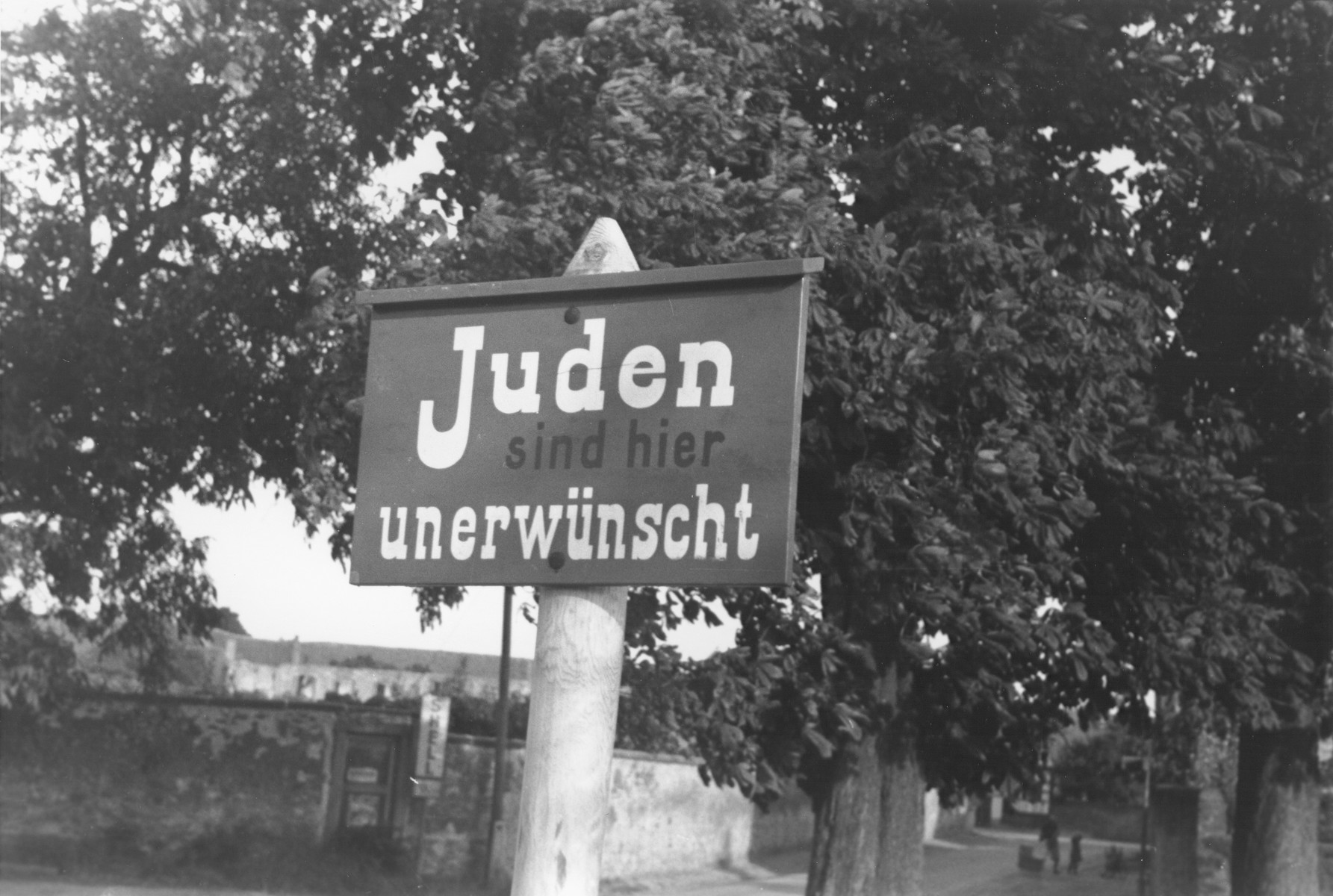
“Jews not wanted here” sign, Germany 1937 (Julien Bryan/USHMM #64416)

The decision by the Oxfordshire village of Piddington to vote to leave the UK over “concerns” about proposed immigrant housing nearby has drawn attention today. Equally predictably, much of the coverage has taken a fairly lighthearted approach, echoing the 1949 Ealing comedy Passport to Pimlico, in which documents are unearthed which establish that the district is a possession of the House of Burgundy and thus exempt from post-war rationing. 

A desire for boutique accommodations with reality is perhaps an inevitable product of modern society. So much is curatable, modifiable and personalised that some people lose sight altogether of the social, political and economic ties of which society actually consists. This mentality produced Brexit and even permeated its opponents in the form of proposals for secondary EU citizenships. But I want to highlight something much darker than desperate attempts to square a circle. 

Passport to Pimlico was directed by Henry Cornelius. Born in Cape Town in 1913 to a German-Jewish family, he spent the late 1920s and early 30s in Berlin. Following the rise of Nazism he came to London. He then spent four years in South Africa in the Government Film Unit, before returning to London in 1943. As with many “typically English” cultural products, Passport to Pimlico was realised by someone who had seen the nature of oppression up close. One assumes that he saw the ironies of self-dispossession and “internal emigration” in a more complex way than the villagers of Piddington. Though I suspect that sets the bar quite low. 

One of the things that Cornelius was probably aware of when he left Germany was the degree of spontaneous conformity to the Nazi regime. Scholars still debate the extent of German support for Nazism though after what Neil Gregor termed “the voluntarist turn” there is a clear recognition that it is redundant to suggest a model of the Third Reich that does not include considerable activity “from below”. For example, the local administration of Preussich-Friedland was given permission as early as July 1933 to forbid Jews from the local public baths as long as they could “specify in precise detail who is to be regarded as a Jew with the resolution, in order to ensure the proper implementation”. This was two years before the Nuremberg Laws, which created offences (such as “being friendly with Jews”) which were only enforceable with public complicity. As we know from lockdown and hosepipe bans, the authorities need the public to act on these things. 

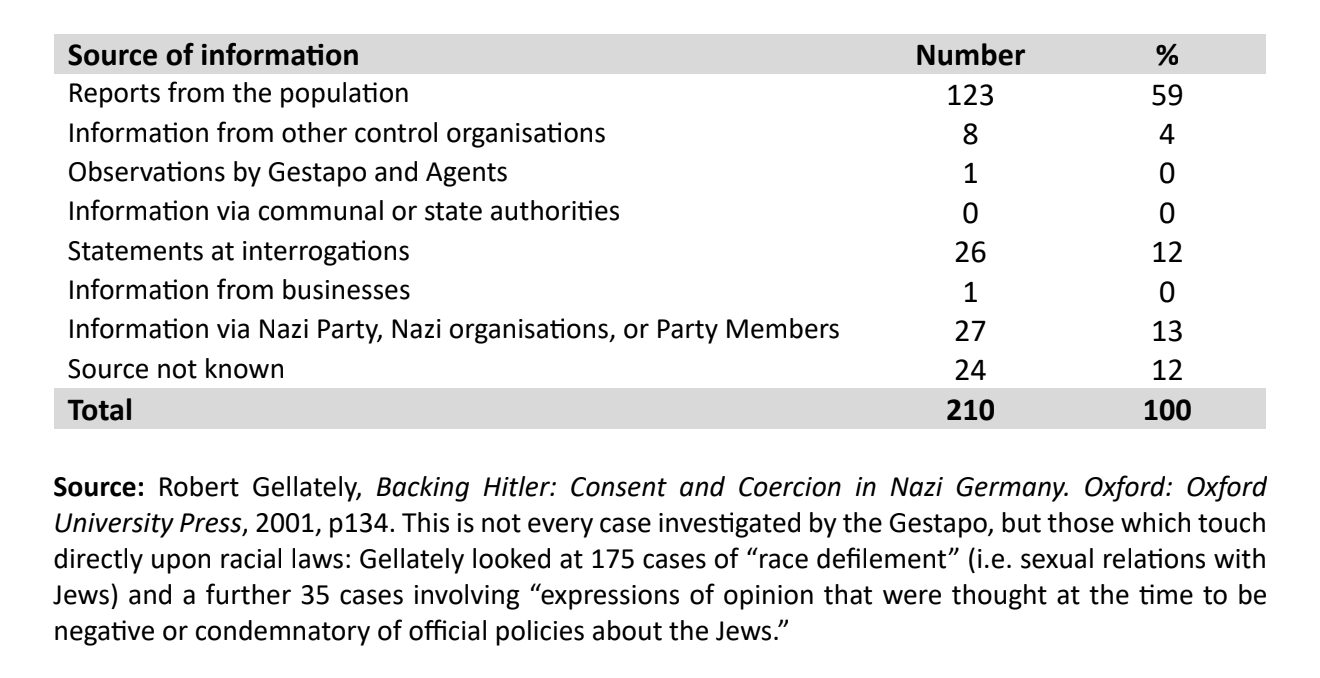
And act the German public did. Robert Gellately looked at Gestapo records from Lower Franconia and made two important discoveries. Firstly, that reports from the public were the vast majority of instigators for investigations. Secondly, that in region of around 850,000 people, the Gestapo assigned just 25 or so investigators. 

Gellately also noted the rapid spread of signs and placards (such as the one at the top) telling Jews they were not welcome in particular businesses or even towns and districts. This became so prevalent that local police were forced to clarify that there was no legal basis for them. 

Eventually of course there was more and more legal basis for the segregation and marginalisation of Jews. But the Nuremberg Laws were a codification of existing practice by the population rather than a departure. In some respects in fact they represented an amelioration of the existing order, since those of “mixed” descent were somewhat less affected than under the earlier “Aryan Paragraph”. 

All of this dynamic exchange between periphery and centre, from above and below, was termed cumulative radicalisation by the German historian Hans Mommsen. The regime and the people virtually competed to achieve a result that wasn’t quite defined by anyone but somehow understood by all. A minister in the Reich Ministry of Agriculture, Werner Willikens, termed this process “Working Towards the Führer” in 1934 and it is central (if, inevitably, disputed) to understanding Nazi society and policy in all areas. 

How is this relevant to the UK in 2026? Or am I just breaking/confirming Godwin’s Law, and making this about my field? To answer, I defer to Rev. Dr. Jo Kershaw (@mthjro) who pithily said this morning: 

Ironically there are “legitimate concerns” you could have about warehousing the unfortunate asylum seekers on a rural military base – it’s not suitable accommodation and will do nothing for their wellbeing or integration or the local community- but acting as if they’re a danger is gutter racism.

We are at a point where British society has internalised the idea that migrants are a problem. Stunts like the vote in Piddington are both symptom and further cause. Unless we reframe the discussion urgently to highlight the humanity of the people involved, we may continue racing down a very dark road indeed. 

Pseudohistory

22 Sunday Mar 2026

Posted by jaimeashworth in Culture and Politics, The Holocaust: Representations and Meanings

≈ Leave a comment

Tags

Auschwitz, Dagmar Herzog, David Irving, Disability, eugenics, Euthanasia program, history, Holocaust, Holocaust Denial, Holocaust Education, Holocaust memory, Josef Mengele, NotoAI, Pseudohistory, representation, T4 program

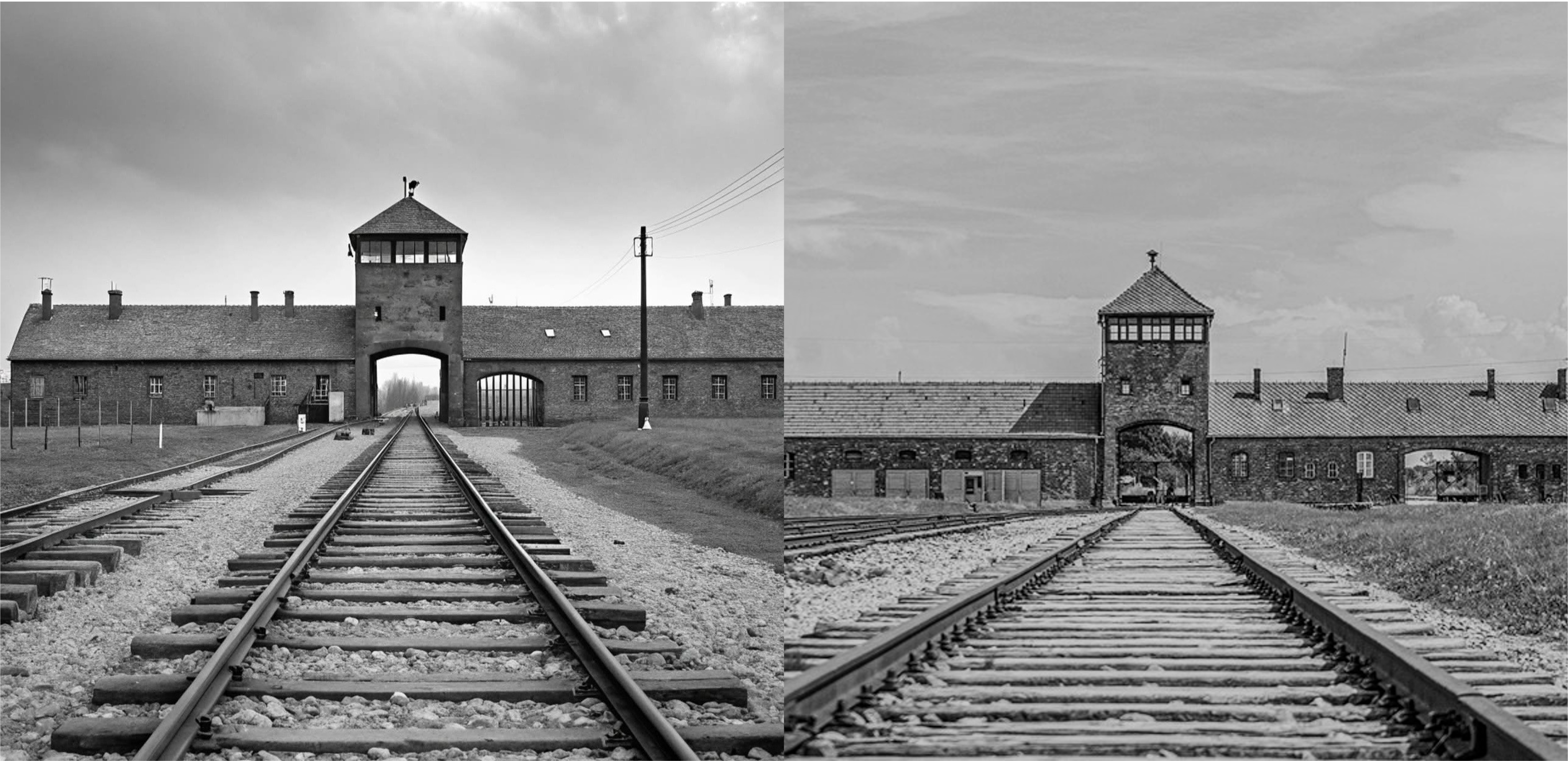
Two images, both purporting to be of the site of Auschwitz II-Birkenau. The one on the left, however, is an AI-generated fabrication posted to Facebook earlier this month. One depicts a reality, the other is a fake. This is not negotiable.

I once had an interesting discussion about whether it was possible to deny the historical truth of the Holocaust without being antisemitic. I quipped at the time that I thought it was perhaps theoretically possible, but that I’d never seen it done. 

For the avoidance of doubt, I believe that denying the Holocaust (including “softer” forms of denial now classed as Holocaust distortion) is inherently wrong and offensive to all Jews everywhere. But it is especially offensive to survivors and their descendants who have to endure the reduction of their suffering to a side issue in an attempt to “debate” what should be incontestable. Namely, that the Nazis and their collaborators across occupied Europe killed six million men, women and children ideologically defined as Jews.

This is on my mind because, as is the way sometimes of social media, I have spent far too much time this weekend defending the right to term eugenics (in the present) a pseudoscience. The spur was a post by Dr. Aparna Nair (a historian of disability and colonialism who can be followed at @disabilitystor1.bsky.social) on Bluesky, which ran:

It is entirely possible and easy to disavow the ideas and ideologies of eugenics and scientific racism etc without reifying the idea that these are not part of the ‘legitimate’ histories of science.

I agree. And to show I agree, I posted the following :

I would distinguish between people who believed in them historically, to whom they had the power and legitimacy of science, and those who persist with them now, who should know better. For the latter, I think “pseudoscience” fits.

Since I think they’re wrong, but possessed of good intentions, I’m not going to quote or identify my two subsequent interlocutors here. But I will say that they seemed very concerned that I understood the following:

Firstly, that eugenics was by no means absent from modern science, especially medicine. And that this translates into persistent negative outcomes based on gender and ethnic background. 

I’m well aware of this, as well as of the undeniable crimes committed as a result. For example, Josef Mengele is notorious for his experiments on inmates in Auschwitz II-Birkenau. Among many other hideous things, particularly in relation to twins, he was responsible for the obtaining of “samples” (i.e. body parts from prisoners) to support the work of his doctoral supervisor, Otmar von Verschuer, then head of the Kaiser Wilhelm Institute of Anthropology, Human Heredity, and Eugenics in Berlin. Verschuer’s predecessor was Professor Eugen Fischer, with whom Verschuer conducted research (funded by the Rockefeller Foundation) on twins in 1932. Fischer, who in 1938 individually interviewed mixed-race German children and signed off on their sterilisation, had started his career with a 1913 study entitled The Rehoboth Bastards; about the mixed-race offspring of German men and African women in German South-West Africa (now Namibia). Between 1904 and 1908, German forces carried out a genocide against the Herero and Nama peoples. In 1924, the then-standard textbook in anthropology and eugenics co-authored by Fischer (partly due to the success of his work on Namibia) was one of the books sent by his publisher to another prospective author: Adolf Hitler, in jail following the attempted Munich Putsch. For these and many other reasons, I am extremely aware of the ways in which scientists can perform atrocities. That they believed these ideas to be “scientific” does not change their guilt. 

Moreover, while recently reading Dagmar Herzog’s superb The Question of Unworthy Life: Eugenics and Germany’s Twentieth Century, I was really moved by the idea of a “fascism in the head” with which we must still struggle. Herzog illustrates how a consensus on “unworthy life” crystallised shortly after WW1 out of eighteenth- and nineteenth-century attempts to (mostly compassionately) institutionalise people with a broad range of psychological, psychiatric and learning disabilities. Combined with eugenic thought, this resulted in the still insufficiently understood (and insufficiently taught) murder of the inhabitants of these institutions under the Nazis. Finally, though, Herzog demonstrates how conditions and even staff in many of these places persisted post-war. The murder of at least 300,000 people (see Alex Kay’s Empire of Destruction, 2021) should have been enough to change things. But it wasn’t, in either East or West Germany, because the inhabitants of institutions were still “unworthy” of life and dignity. 

The horrors of WW2 weren’t even enough to shift attitudes about disability in the UK. The treatment of thalidomide-affected babies included (as movingly depicted in Call the Midwife) leaving them to die alone in cold rooms. If you question whether this is an appropriate citation in this context, in response to a recent query by email to the Thalidomide Trust, I was directed to the still mostly sealed testimonies in their oral history project. (https://wellcomecollection.org/works/d32pgtn4 ) There will be a reckoning at some point, but not yet. But for now let us acknowledge that fascism was not just present in German heads. 

Secondly, however, there seemed to be concern about the feelings of those still espousing eugenics or denying the Holocaust today. Was it fair, someone asked, to dismiss them with a single word? 

Yes, was my response. And in the case of Holocaust deniers, that word would be “pseudohistorians,” because while they claim to be talking about the past, they do not subscribe to the practical or ethical standards which constitute the craft of the historian. For example, you cannot, as the late and unlamented Robert Faurisson claimed, read a document only in reference to itself. You cannot, as David Irving did, wilfully mistranslate documents to change their meanings.* Just as a eugenicist is no longer “doing science” by importing discredited and racialised value judgements, these people are not “doing history”  – which is always engaged in constructing an account of the past based on the traces (plural) of that past as they relate to and inform each other. Instead, Holocaust deniers are intent on attacking the dense web of evidence and source material that makes the fact of the Holocaust incontrovertible. To do so, paraphrasing Mr. Justice Gray in his judgment against David Irving, Holocaust deniers “persistently and deliberately misrepresent and manipulate historical evidence” for their own ideological reasons.

Do bad questions and problematic assumptions sometimes produce bad history? Absolutely. There are many historians whose work proceeds from problematic and controversial premises, with a resulting weakness of conclusions. Because those premises almost always result in problems with their selection and analysis of sources. In other words, it may be bad history, but it’s still history, and open to critique on those grounds. (And yes, of course, most of those I criticise would disagree with my disagreements. That is very much how and why historical conferences exist.)

As for those who parrot these views (whether the pseudoscience of eugenics or the pseudohistory of Holocaust denial) can we dismiss them so easily? 

It is of course possible to be misinformed and misled in good faith. It is also entirely possible to be unaware that such beliefs are offensive – though I would question how one could be unaware of this now. There is too much evidence, too many books, films, plays and every cultural product imaginable to say “I didn’t realise” without also admitting that one’s education has fallen short. (And I acknowledge that there are many other areas where this may be true of me: I’m the product of an education system which specialises far too soon, as well as temperamentally someone who knows a lot about relatively few things.) What is decisive is whether people acknowledge their mistakes and concede that others may have invested considerable effort in constructing their understanding for themselves. 

In my own case, I’ve spent my adult life teaching and learning about the Holocaust. I’ve conducted primary research on some issues, and rely on the work of other scholars for the rest. In the last year, I’ve noticed how many of my responses to Holocaust distortion in AI-fabricated “historical images” have been countered with the argument that my Ph.D. in Holocaust Studies is less important than “what really happened.” But as historians we do not have “what really happened” available to us. We have knowledge of the sources and how they combine to create an understanding of the past. Since AI is being used to fabricate “documents” it is my duty as a historian and responsible citizen to challenge them. If that makes people uncomfortable or embarrassed at having been fooled, I’m sorry. But the integrity of the historical sources is not negotiable. Or else we will slide into a mire of illusion and false enchantment which will make meaningful discussion almost impossible. From pseudo-sources there will only come pseudohistory. 

*See Richard Evans, Telling Lies About Hitler and Robert Jan van Pelt, The Case for Auschwitz, for superb explorations of Irving’s malfeasance, the evidence he ignored and/or manipulated, and his ultimate inability to sustain his pretensions to historical truth.

Note: I’m now registered with Buy Me a Coffee: if you found this post useful or interesting, please consider sending me a small amount to help me do more. Thank you! https://coff.ee/jaimeashworth

Recent Posts

  • Keep Mentioning the War?
  • Not wanted here? Piddington and Cumulative Radicalisation
  • Clean Up on Aisle 3
  • The Medium and the Message
  • Pseudohistory

Archives

  • September 2026
  • May 2026
  • March 2026
  • September 2025
  • July 2025
  • June 2025
  • February 2025
  • January 2025
  • November 2024
  • February 2024
  • January 2023
  • January 2022
  • October 2021
  • September 2021
  • June 2021
  • August 2020
  • July 2020
  • March 2020
  • January 2020
  • January 2019
  • November 2018
  • January 2018
  • September 2017
  • August 2017
  • February 2017
  • January 2017
  • August 2016
  • March 2016
  • August 2015
  • August 2014
  • June 2013
  • May 2013
  • April 2013
  • February 2013
  • January 2013

Categories

  • Antisemitism
  • Book Reviews
  • Culture and Politics
  • Heritage Politics
  • missinghistories
  • Photography and Visual Culture
  • The Holocaust: Representations and Meanings
  • Uncategorized

Meta

  • Create account
  • Log in
  • Entries feed
  • Comments feed
  • WordPress.com

Blog at WordPress.com.

  • Subscribe Subscribed
    framingthequestion
    Join 25 other subscribers

    Have a WordPress.com account? Log in now.

  • framingthequestion
    View site in Reader
    Manage subscriptionsSign upLog in
    Report this content
    Collapse this bar
Loading Comments...