
Tags
AfD, Alternative fur Deutschland, Auschwitz, fascism, germany, history, HMD, HMD2027, Holocaust, Holocaust Education, Holocaust memory, No Place for Prejudice, politics, representation, Stolperstein, Stolpersteine
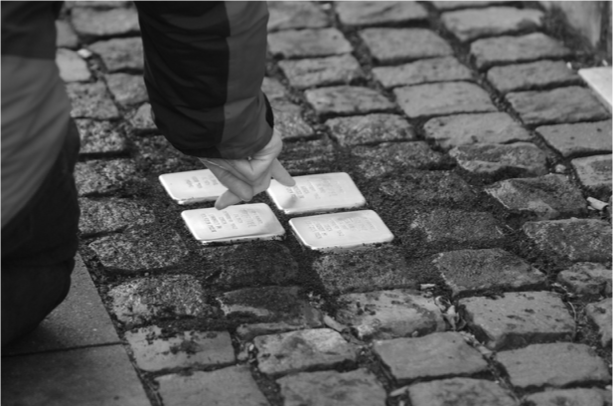
The Stolpersteine project by artist Gunther Demnig is perhaps the most successful memorial project in Holocaust commemoration. The nature of the individual plaques within a network (now numbering well over 100,000 across Europe) makes them an incredibly powerful symbol of and vehicle for Holocaust memory. And, as I described in 2019, laying the stones themselves is an incredibly powerful means of, if not closure, then ensuring that otherwise bottomless grief can perhaps be somewhat contained.
The decision by a new Alternative für Deutschland (AfD) administration in a small town in Saxony to forbid further installation of Stolpersteine should therefore be something that alarms us intensely. That it has done so in coalition with members of the CDU, the backbone of postwar German democratic politics, raises those concerns even further. The German word for the constitution is Grundgesetz (literally “ground law) and in so many ways this move seems an assault on the Grund of postwar assumptions about Holocaust memory, German wartime culpability, and the postwar order itself.
German rehabilitation into the European family of nations was based on a rejection of Nazism, if also on an incomplete acknowledgment of “ordinary” German support for and involvement in Nazi crimes. The attempt by the Allies to draw a line under the Nazi era at Nuremberg was largely successful, though it belied the problems of denazification more widely. The fact that Wilhelm Stuckart, the architect of the Nuremberg Laws and a participant in the 1942 Wannsee Conference, was classed as a “fellow traveller” of the regime and sentenced to time already served, is a much better (or rather, much worse) indicator of the process overall. Many of the defendants in the Auschwitz trial in the 1960s were living with brass plaques displaying their names at the end of the driveway, confident that they did not need to conceal themselves. And only those twenty two defendants were tried from the thousands of “rank and file” who manned the camp – and womaned it as well. Typists, secretaries and others were just as significant to the functioning of the camp as the guards (male and female) and doctors.
It was not a mere publishing flourish that led Gerald Reitlinger to title his book The SS: Alibi of a Nation in 1956. In so many ways, this is the story of the postwar era. The continued defence of the Wehrmacht as merely fighting a brutal war rather than being complicit in a concerted campaign of racialised killing and demographic engineering is a problem in Germany and elsewhere. The irony of David Mitchell’s character in Peep Show asking “Are we the baddies?” while dressed in SS uniform is clearly lost on the surprising (and scary) number of people who “re-enact” battles waged in continental Europe on British soil, ostensibly as education.
If these people are a tragedy waiting to happen, we have long since acted out the problem as farce. In the Fawlty Towers episode, ‘The Germans’ (first broadcast in October 1975) we are encouraged to sympathise with the tourists at the mercy of Basil’s progressively more awful antics. But the one German actor involved, Willy Bowman, was born in 1915. While I don’t know his individual story at all, his generation was exceptionally likely to have been drawn to Nazism and been involved in its crimes at some level. Basil’s insinuation was not entirely without foundation, even if it also betrayed the casual racism that was ignored by fetishising Nazi histrionics through impersonation of Hitler and reference to other high-ranking Nazis. The other driver of the plot, Basil’s racism towards a black doctor, is much less well-remembered than his frantic aside to Polly: “Don’t mention the war! I mentioned it once, but I think I got away with it!” That tabloid appeals to the memory of World War Two during (for example) football tournaments have diminished the resonance of what actually happened is a separate set of ironies.
Helmut Walser Smith has written of the changing “vanishing points” of German history, in the sense of moments or questions which focus the perception of onlookers to the point of distortion. Initially, the moment was the Nazi “seizure of power” in 1933, with the question about how Germany could allow such a thing to happen – as though immense popular support from a broad swathe of German society were not the answer, however culpable the actions of a few aristocratic schemers may have been in the practical outcome of Hitler’s appointment as Chancellor. Since the 1960s, however, the focus has been more and more on how the Holocaust happened. This creates distortions of its own, not least accentuating the tendency to see Nazi antisemitism as sui generis rather than as a central plank in an ideology which labelled many others as “social outsiders” condemned to awful punishment if not outright extermination. The late Sybil Milton, moreover, noted that attention should be given to those “social outsiders” against whom the Nazis did not direct the propaganda offensive which they did to German Jews. Ordinary Germans seem to have needed little persuasion, for example, to countenance the effective ghettoisation of Roma in German cities from 1936 – something the regime never felt confident in doing to German Jews, who were deported to be killed “offstage” in occupied Poland and the Baltic States. As the continued British struggle to reckon with the legacy of empire demonstrates, local memory is at its most potent when the actions remembered were local as well.
A lot of books in the last few years have described the parallel trajectories of memories relating to other groups targeted by the Nazis. Ari Joskowicz on the Roma, Dagmar Herzog on the disabled, and Anna Hajkova on sexualities have illustrated that the terms in which the crimes of the Nazis are framed has been the result of persistent prejudice against some victims. All of them illustrate (following Tony Kushner) the failure of the liberal imagination to encompass certain groups in the category of “deserving” victims. German postwar governments did not recognise the Roma as victims until 1982 arguing until then they had been punished as criminals not persecuted racially – and thus tacitly endorsing the Nazi conception of “hereditary criminality” underlying Roma persecution. Herzog describes how surviving disabled people were left in institutions in which they were victimised, sometimes with the same staff in charge. Anna Hajkova has movingly demonstrated in People Without History Are Dust how the persecution of homosexuals and others with sexualities still deemed “deviant” by postwar society, and marginalised queer histories within established narratives and individuals. The theme for Holocaust Memorial Day next year, No Place for Prejudice, will be an interesting site for these issues to be raised.
Why, though, is all of this provoked by a single action in a small town? Setting aside the unwisdom of regarding abroad in general as “a small country of which we know nothing” there are specific concerns. The late Tony Judt described Holocaust memory as the “entry ticket” to European society. Holocaust Memorial Day is the only pan-European commemoration I’m aware of. The persecution and murder of European Jewry is the Grund on which all kinds of social and memorial progress is founded. Even Nigel Farage seems to have recognised that the accusations that he sang Nazi songs as a teenager is politically embarrassing (if not catastrophic, bewilderingly). Saying “thus far and no further” to the memory of the war and its victims is a very scary development and surely a portent of change in other areas. As events close to home have reminded us the last couple of weeks, local decisions and measures can have important and damaging effects on the climate of opinion and lead to “copycat” measures which acquire their own momentum. Intervention is required from as many places as possible.

