Tags
cumulative radicalisation, fascism, germany, history, HMD2027, Holocaust, Holocaust memory, Migration, No Place for Prejudice, politics
The decision by the Oxfordshire village of Piddington to vote to leave the UK over “concerns” about proposed immigrant housing nearby has drawn attention today. Equally predictably, much of the coverage has taken a fairly lighthearted approach, echoing the 1949 Ealing comedy Passport to Pimlico, in which documents are unearthed which establish that the district is a possession of the House of Burgundy and thus exempt from post-war rationing.
A desire for boutique accommodations with reality is perhaps an inevitable product of modern society. So much is curatable, modifiable and personalised that some people lose sight altogether of the social, political and economic ties of which society actually consists. This mentality produced Brexit and even permeated its opponents in the form of proposals for secondary EU citizenships. But I want to highlight something much darker than desperate attempts to square a circle.
Passport to Pimlico was directed by Henry Cornelius. Born in Cape Town in 1913 to a German-Jewish family, he spent the late 1920s and early 30s in Berlin. Following the rise of Nazism he came to London. He then spent four years in South Africa in the Government Film Unit, before returning to London in 1943. As with many “typically English” cultural products, Passport to Pimlico was realised by someone who had seen the nature of oppression up close. One assumes that he saw the ironies of self-dispossession and “internal emigration” in a more complex way than the villagers of Piddington. Though I suspect that sets the bar quite low.
One of the things that Cornelius was probably aware of when he left Germany was the degree of spontaneous conformity to the Nazi regime. Scholars still debate the extent of German support for Nazism though after what Neil Gregor termed “the voluntarist turn” there is a clear recognition that it is redundant to suggest a model of the Third Reich that does not include considerable activity “from below”. For example, the local administration of Preussich-Friedland was given permission as early as July 1933 to forbid Jews from the local public baths as long as they could “specify in precise detail who is to be regarded as a Jew with the resolution, in order to ensure the proper implementation”. This was two years before the Nuremberg Laws, which created offences (such as “being friendly with Jews”) which were only enforceable with public complicity. As we know from lockdown and hosepipe bans, the authorities need the public to act on these things.
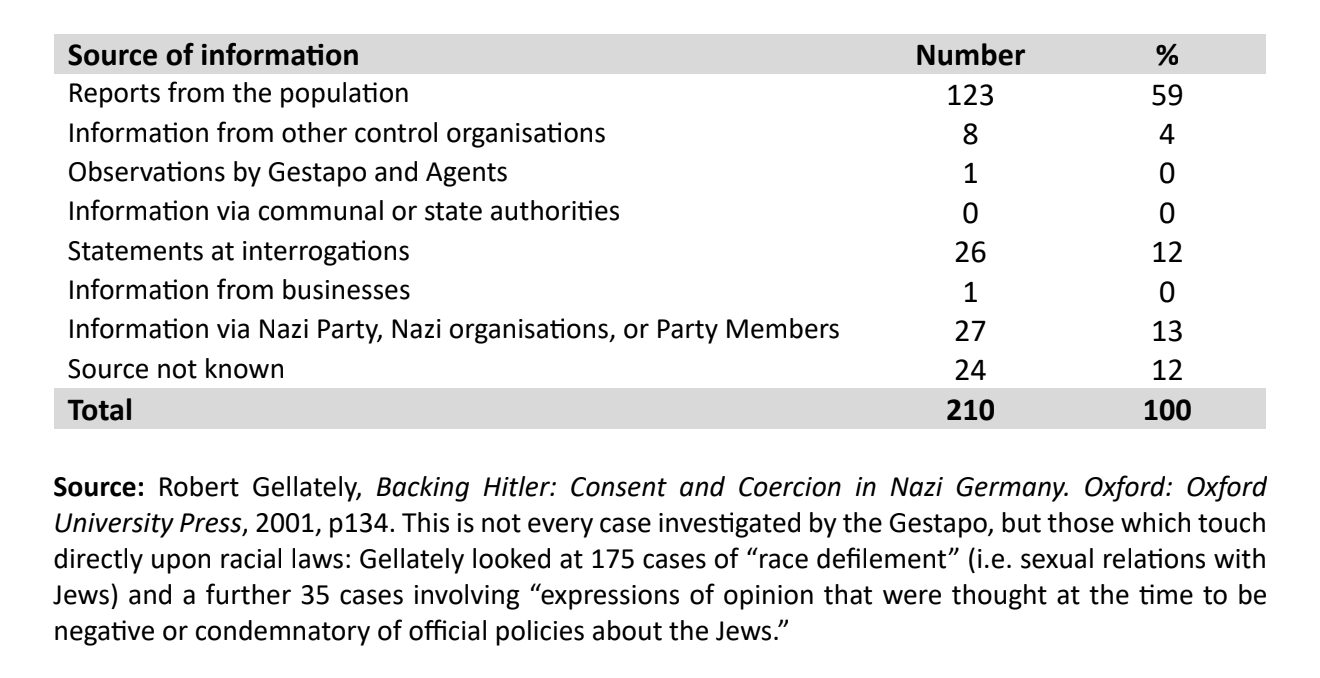
And act the German public did. Robert Gellately looked at Gestapo records from Lower Franconia and made two important discoveries. Firstly, that reports from the public were the vast majority of instigators for investigations. Secondly, that in region of around 850,000 people, the Gestapo assigned just 25 or so investigators.
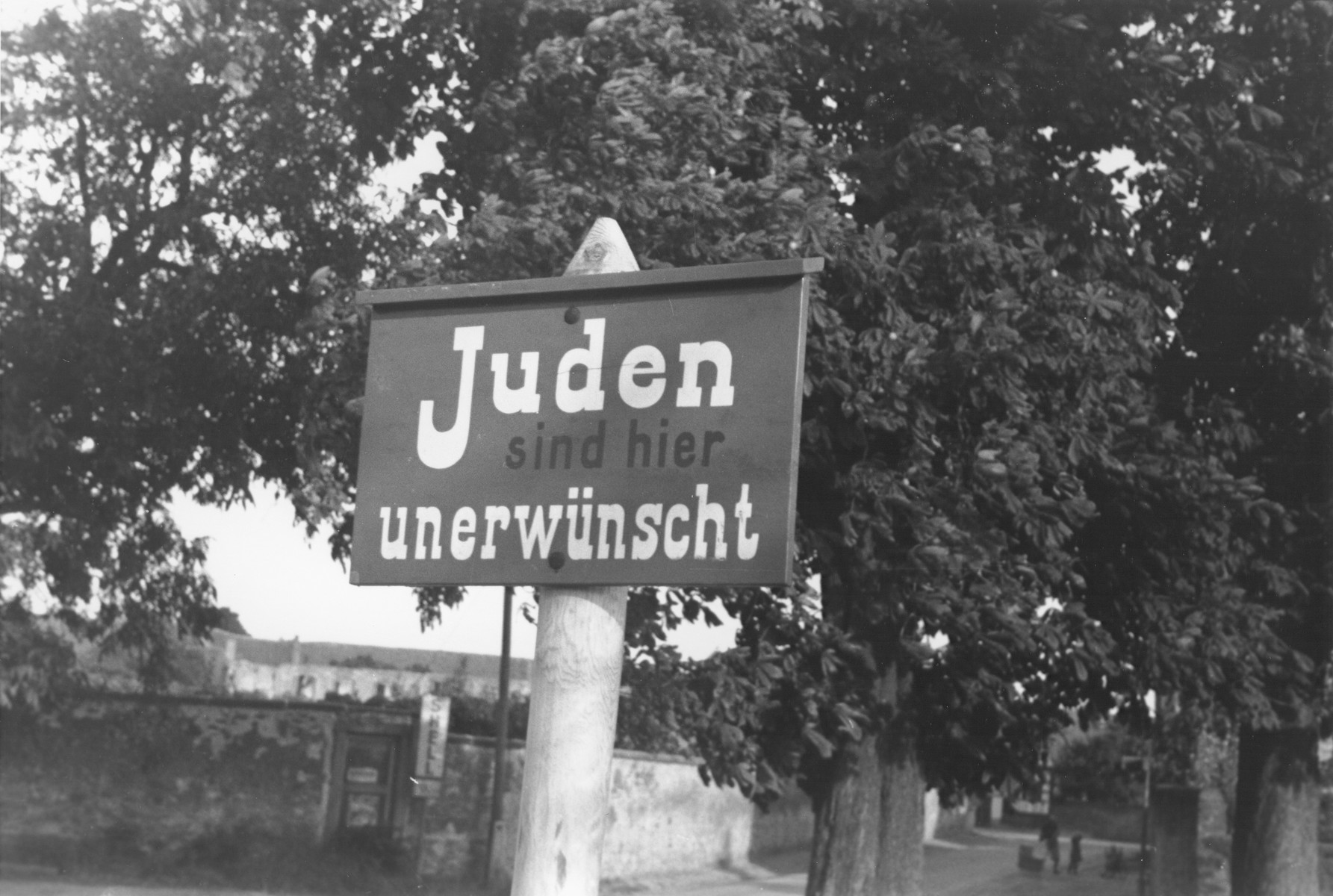
Gellately also noted the rapid spread of signs and placards (such as the one at the top) telling Jews they were not welcome in particular businesses or even towns and districts. This became so prevalent that local police were forced to clarify that there was no legal basis for them.
Eventually of course there was more and more legal basis for the segregation and marginalisation of Jews. But the Nuremberg Laws were a codification of existing practice by the population rather than a departure. In some respects in fact they represented an amelioration of the existing order, since those of “mixed” descent were somewhat less affected than under the earlier “Aryan Paragraph”.
All of this dynamic exchange between periphery and centre, from above and below, was termed cumulative radicalisation by the German historian Hans Mommsen. The regime and the people virtually competed to achieve a result that wasn’t quite defined by anyone but somehow understood by all. A minister in the Reich Ministry of Agriculture, Werner Willikens, termed this process “Working Towards the Führer” in 1934 and it is central (if, inevitably, disputed) to understanding Nazi society and policy in all areas.
How is this relevant to the UK in 2026? Or am I just breaking/confirming Godwin’s Law, and making this about my field? To answer, I defer to Rev. Dr. Jo Kershaw (@mthjro) who pithily said this morning:
Ironically there are “legitimate concerns” you could have about warehousing the unfortunate asylum seekers on a rural military base – it’s not suitable accommodation and will do nothing for their wellbeing or integration or the local community- but acting as if they’re a danger is gutter racism.
We are at a point where British society has internalised the idea that migrants are a problem. Stunts like the vote in Piddington are both symptom and further cause. Unless we reframe the discussion urgently to highlight the humanity of the people involved, we may continue racing down a very dark road indeed.


Brilliant piece, J. Might somebody publish it further? Best, R http://www.imperialfengshui.info http://www.imperialfengshui.info/
For daily doses of my feng shui advice find me on my Facebook page https://www.facebook.com/pages/Richard-Ashworth-Imperial-Feng-Shui/228140213921805 Don’t get up without it.