• Coursework and Dissertation Help
  • About the author…
    • #missinghistories
    • Independent Educator: Research-driven Education and Training
    • Writing and Research
    • Independent Researcher

framingthequestion

~ Reflections on memory, history, photography and culture

framingthequestion

Tag Archives: London

The Medium and the Message

04 Monday May 2026

Posted by jaimeashworth in Culture and Politics

≈ 1 Comment

Tags

Antisemitism, Britain, Community Security Trust, CST, Finchley Reform Synagogue, FRS, Jewish people, Jews, London, Sadiq Khan, Sarah Mullaly, UK Jews

How do we think outside the box if all the information is apparently available?
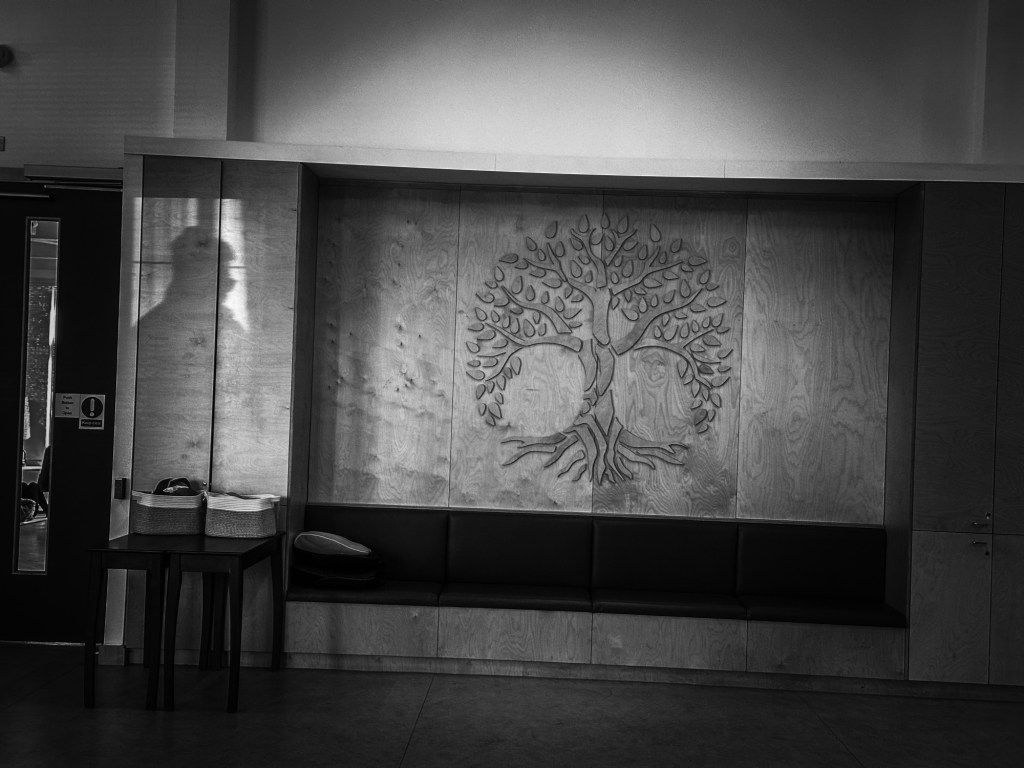
The Tree of Life at Finchley Reform Synagogue the other week. The silhouette was friendly. Photo: Jaime Ashworth.

Being in crisis mode is stressful. Since, three weeks ago tomorrow, I had to carry my daughter on her first day at her new nursery past forensics officers investigating an attempted firebombing on the premises, the world has seemed smaller and more restricted. Security is a way of life for Jewish communities, but since Heaton Park last October, there has been even more emphasis. The recent attacks have raised that still further.

Thankfully the incident with my daughter is as close as these events have come – but that was quite close enough. Once the cold fear of the initial sighting of police and CST had passed, concern for my daughter was the priority. She fell asleep that night saying how much she liked the new nursery: we clearly managed the situation sufficiently well for her not to be overtly harmed.

At times like these, the response to events from outside the affected group is personal. I’ve appreciated messages of support from friends and family, and the statements by public figures have helped to convince me that the situation is being taken somewhat seriously. The repetitive chorus of voices attempting to pre-empt any expression of fear or anxiety with the admonition that (as one particularly uncalled-for comment put it last week) if I was worried about threats and attacks, I should be more concerned with the Palestinian right to existence is a fact of life. Large numbers of people in this country are unable to express sympathy with Jews without either qualifying it with a reference to solidarity with Palestinians (on the left) or to dark allusions to a common enemy in the ill-defined concept of “Islamism” (on the right). As others more eloquent than I have said, it would be nice to be able to worry about a legitimate concern and a genuine threat on my own terms. These buildings and these people on the news are familiar to me. I had to carry my daughter past a crime scene which was also her nursery. If you’re not able to understand that these are important things in their own right, you perhaps aren’t properly equipped to see the bigger picture either.

For whatever it may be worth, I want to reiterate something I have said over and over again. This is not about whichever cause you want to make it about. It’s about the right of British citizens to live their lives without fear. It’s about the decisions by the perpetrators to break the law to threaten and intimidate us in the peaceful practice of our own lives. The only way you can make it something more is by instrumentalising the situation to score cheap political points. Sometimes it is appropriate to take a broader view, but the specific human consequences should never be out of focus.

Right now, UK Jews are very scared and feeling very lonely. Part of that is due to the events themselves and the responses I’ve already described. But part of it is also the sense that many voices which are quick to talk very loudly on other occasions are missing in action. As Sarah Sackman, MP for Golders Green and the Solicitor-General, wrote in last Saturday’s Guardian: “Where are the marches in solidarity and support of our Jewish community? Where is the response of the liberal-left? Where are the anti-racists, the trade unions, civil society, our friends and neighbours?”

This sentiment has clearly struck a chord. I was perusing a social-media platform last night and noticed someone taking up her theme, identifying that as well as silence from “Muslims”, neither Sadiq Khan, the Mayor of London, nor the Archbishop of Canterbury, Dame Sarah Mullaly, had made statements. The author was indignant.

This caused me to pause. Because Sadiq Khan has not only made statements, including an article in the Guardian yesterday, he visited Finchley Reform Synagogue. In fact he visited the same day as Sarah Sackman and Dan Jarvis (the Security Minister) did. Nor was this, as some cynics might claim, opportunism. He has a long history of friendship with the synagogue and its clergy: he did not need his staffers to tell him where it was.

A few hours after the attack in Golders Green last week, the Archbishop of Canterbury made a statement. It was released on a social media platform I no longer use, as well as on the website of the Anglican Communion:

The appalling attack in Golders Green today is another example of the violence, hatred and intimidation that Jewish people in Britain have had to live with for far too long.

The victims are in my prayers, as are all those affected and the Jewish community across the country.

As we discussed at Lambeth Palace last week with @metpoliceuk Commissioner Sir Mark Rowley, the @ChiefRabbi and other faith leaders, there must be zero tolerance for antisemitism or any other form of hatred – and faith communities must work together urgently to counter violent extremism.

We must stand together as a country. An attack on one community is an attack on us all.

We have all got very good at parsing such statements, but I don’t think I need to. Her sympathies and her good intentions are clear, as are the clear and living links with the Jewish people.

Going back to the social media platform on which a user’s displeasure prompted this train of thought, I can also access clear statements of solidarity and support from Muslim community leaders. The Muslim Council of Britain, for example, said:


The Muslim Council of Britain shares our deepest concerns and prayers with the Jewish community following the horrific stabbing attack on two Jewish men in Golders Green this morning taking place in front of a shop and a synagogue.

Dr Wajid Akhter, Secretary General of the Muslim Council of Britain says: “This spike of hate related incidents targeted at people of faith especially in places of worship must be met with stronger security for faith communities and the full force of the law to tackle all forms of hatred in society. Everyone must be allowed to live safely and practice their faith in public in Britain.”

Once again, we can parse the statement. But it exists. The sense of isolation that Jews feel is honestly come by – just take a look at the efforts to diminish and relativise a clear and tangible threat – but it is made worse by relying on algorithms to collate and serve us reality.

What is frightening is that we are so secure in our channels of communication, and so out of practice in stretching our attention beyond them, that we are at the mercy of the media’s decisions, which this week have focused on highlighting the idiotic intervention by Zack Polanski of the Green Party and the response by Sir Mark Rowley of the Met. In this case, as with so many issues concerning the media, it’s hard to know for sure whether supply or demand is to blame. The media produces dross in the expectation that it will generate consumption. This is as true today as it was in 1997, when the Great British Public demanded to know why intrusive pictures of Diana, Princess of Wales were so highly valued, apparently not noticing its own role in buying them.

We must remember that the medium and the message are harder and harder to separate, and that at times of crisis we would in any case be well advised to seek information from where it comes best, not where it is easiest. Moreover, if we are not receiving messages of support and solidarity, what else might we be missing?

Though founded to keep Jews safe from the far-right in the 1950s, the Community Security Trust (UK Charity 1042391) works with people and institutions of many faiths to keep them safe and secure, including many mosques. If you feel like donating, the page is here: https://cst.org.uk/donate-now

Finchley Reform Synagogue (UK Charity 1137557) is a thriving and important Progressive Jewish community in North London: like all communities, it is reliant on donations to keep doing the work it does, which will now include security changes. The link to donate is here: https://www.frs.org.uk/donate-to-frs.html
#missinghistories

26 Wednesday Aug 2015

Posted by jaimeashworth in Culture and Politics, missinghistories, Photography and Visual Culture

≈ Leave a comment

Tags

#missinghistories, atlantic worlds, Brookes, David Olusoga, de Certeau, excremental assault, FE, Further Education, London, Middle Passage, National Maritime Museum, Olaudah Equiano, Roland Barthes, Sites of memory, slavery, Triangular Trade, Walking in the city, Zong

Where’s my coffee (from)?

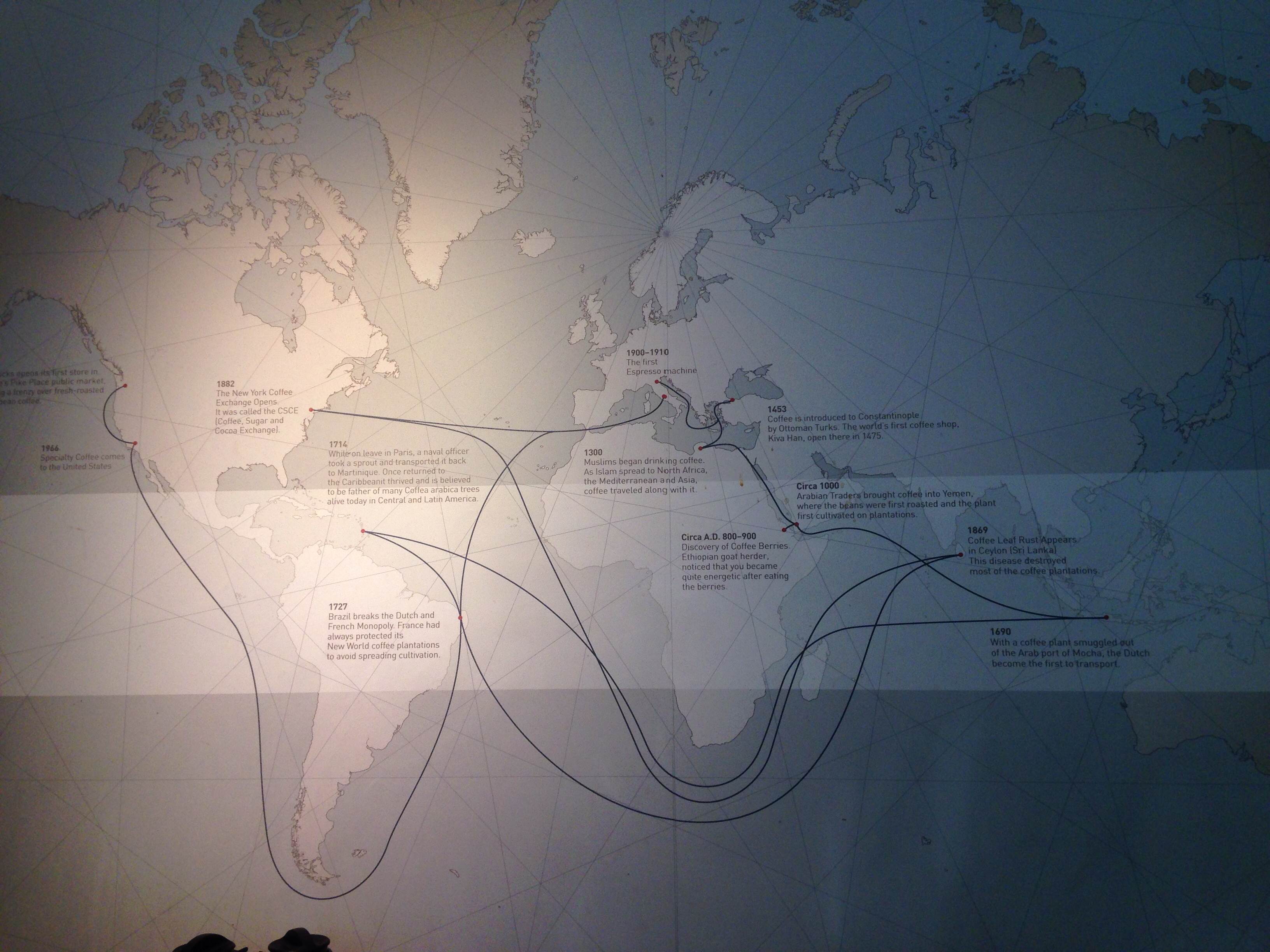
It all begins with a coffee at Starbucks. As I waited for my latte, I noticed a map on the wall: a map of coffee history, from the discovery of coffee berries (c. 800 CE) to the establishment of Starbucks in 1971. The lines tracing Atlantic voyages caught my eye, taking me back to an early lesson in my PGCE placement last year looking at how the demand for tea, coffee and sugar in the eighteenth century had stimulated the British economy. Tea, coffee and sugar grown on plantations in the Caribbean, South America and the southern United States (as they had recently become): plantations where the work was done by slaves. Of this trade, which carried millions over a period of 315 years, not a trace remained.

Starbucks map of coffee

Starbucks map of coffee, July 2015. Photo: Jaime Ashworth.

I didn’t have to teach the following session on the Middle Passage, but the accounts of those voyages between Africa and the slave markets have remained with me. As Olaudah Equiano describes in his ‘Interesting Narrative’, first published in 1789:

At last, when the ship we were in, had got in all her cargo, they made ready with many fearful noises, and we were all put under deck, so that we could not see how they managed the vessel. … The stench of the hold while we were on the coast was so intolerably loathsome…. The closeness of the place, and the heat of the climate, added to the number in the ship, which was so crowded that each had scarcely room to turn himself, almost suffocated us. This produced copious perspirations, so that the air soon became unfit for respiration, from a variety of loathsome smells, and brought on a sickness among the slaves, of which many died — thus falling victims to the improvident avarice, as I may call it, of their purchasers. 

It is a measure of the awfulness that one of the most famous images of the abolition campaign, the Brookes illustration, shows conditions on board after legislation in 1788 to regulate the numbers ships were allowed to carry. The Port Cities: Bristol website explains that while the illustration shows 295 slaves packed into the vessel (with barely room to move), a previous voyage had transported 609. Borrowing a term from Terrence des Pres’s The Survivor on the degradation in the camps of the Third Reich, this was an ‘excremental assault’. Conditions reduced the slaves’ estimation of their own worth as ‘defilement was a constant threat, a condition of life from day to day, and at any moment it was liable to take abruptly vicious and sometimes fatal forms’ (des Pres, 1978: 57). As Equiano narrates: ‘with the loathsomeness of the stench, and crying together. I became so sick and low that I was not able to eat, nor had I the least desire to taste any thing. I now wished for the last friend, Death, to relieve me’ (Equiano, 2003: 56).

As in the Nazi camps, the assault kept others at bay. Other ships could smell the slavers for miles and avoided them and the miasma they carried: literally distancing themselves from the terrible reality, ‘stifling in common loathing the impulse toward solidarity’ (des Pres, 1978: 61).

The legislation of 1788 was introduced partly in response to the case of the Zong: a ship which left Africa in August 1781 with 442 slaves aboard. After 62 slave deaths from malnutrition and disease, the captain ordered that a further 78 be thrown overboard: the terms of the ship’s insurance were such that ‘natural’ deaths would not be compensated (to the slaver) but slaves jettisoned to save the rest of the (human) cargo could be. The conditions had done their work; ‘murder [was] less terrible to the murderers, because the victims appeared less than human’ (des Pres, 1978: 61) and ‘death could be administered with the conviction that so much rotten tissue had been removed from life’s body’ (Ibid.: 62).

Brookes illustration

The Brookes Illustration

Furthermore, although the Zong featured in abolitionist literature just as in contemporary curricula as a milestone on the road to abolition, the facts are less reassuring. The case was brought by the insurers out of a sense of financial rather than moral outrage and never properly resolved.

The connections between slavery and British wealth are well documented, not least in the National Maritime Museum‘s superb galleries on the Atlantic and the East India Company, the Liverpool International Slavery Museum and the Legacies of British Slave-ownership project at UCL. But the gap in everyday discourse represented by the single reference in Starbucks to the Caribbean was striking.

While on leave in Paris, a naval officer took a sprout and transported it back to Martinique. Once returned to the Caribbean [it?] thrived and is believed to be father of many Coffea arabica trees alive today in Central and Latin America.

The web of imperial and colonial power that took the plant from Africa to Paris and thence from Paris to Martinique is obscured by the statement itself. It is an example of what Barthes termed the privation of history, in which historical language ‘is a kind of ideal servant: it prepares all things, brings them, lays them out, the master arrives, it silently disappears: all that is left for one to do is enjoy this beautiful object without wondering where it comes from’ (Barthes, 2000: 178-179).

Am I not a man and a brother?

Wedgewood anti-slavery medallion copied from the seal of the Anti-Slavery Society.

It is not coincidental that this project begins with a link between the past and addictive consumption: eeven imperial defender Niall Fergusson notes the importance of the new stimulants in British imperial expansion: the Empire, he writes ‘was built on a huge sugar, caffeine and nicotine rush’ both commercial and physical (Fergusson, 2003: 15). Christopher Keep and Don Randall have read the ‘relationship between the imperial imaginary and the psychic economy of addiction’ (Keep and Randall, 1999: 208) into the Sherlock Holmes story The Sign of Four as one of the ‘stories which the Empire told to itself’ (Ibid.: 207) in order to ‘authorise, legitimise and mythologise its campaigns of material and economic exploitation’ (Ibid.: 219). The Ibis trilogy by Amitav Ghosh depicts this process from the perspective of the colonised, drawn into a global web of trade, power and exploitation.

History consists of both voices and silences, and the latter are hard to address. As Gayatri Chakravorty Spivak famously and despairingly noted, ‘the subaltern cannot speak’ (Spivak, 1988: 308). Hugh Thomas, in his magisterial history of the slave trade, comments: ‘The slave himself is a silent participant in the account […] an unknown warrior, invoked by moralists on both sides of the Atlantic, recalled now in museums in one-time slave ports from Liverpool to Elmina, but all the same unspeaking, and therefore remote and elusive’ (Thomas, 1997 : 799).

The gendered language as Thomas comments on the gaps in the record is ironic testimony to the problem he identifies, his formulation eliding the possibility of an alternative which recovers the voices and histories of women and children. The question posed by the abolitionists – Am I not a Man and a Brother? – is once more problematised: certainly a man (not a woman or a child) but still not a brother, or at least only a younger, subservient one to be pitied. The figurehead carved for the Royal George yacht in 1817 stands in the National Maritime Museum. The information notes that its figures (copied from the Wedgewood medallion) ‘indicate[s] how much anti-slavery imagery and language had pervaded British society by the early 19th century’ but I can’t help seeing in it the persistence of a hierarchy: grateful supplicants to royal mercy.

Royal George figurehead

Detail of the ‘Royal George’ figurehead, National Maritime Museum, Greenwich. Photo: Jaime Ashworth, 2015.

The silences of the Starbucks map set me thinking about the need for educational resources to fill these silences. As a history teacher, I am very aware that as Alison Kitson and Chris Husbands put it, ‘the selection of what we teach, as well as how we teach it, directly confronts our assumptions about ‘usable’ or ‘significant’ knowledge’ (2011: 133).  If we see the construction of curricula as ‘a selection and organization from the available knowledge at a particular time’ (Young, 1971: 24), justified by assumptions about culture and ‘fields of knowledge’ (Stenhouse, 1975: 19) and who can be seen as a ‘legitimate author’ (Apple, 2000: xxviii) we can also see ‘disciplines’ and ‘subjects’ as social constructs which serve to replicate power relations. One does not have to be a Foucauldian to partner ‘discipline’ with ‘punish’ or to see the linkage between the elision of historical slavery and the obscuring of the nature of the supply chain to the modern consumer: I can’t answer the question that acts as a heading to this section.

These elisions are what Heidi Safia Mirza terms ‘embodied intersectionality’: the physical manifestation of ‘patterns of power and ideology that reproduce inequalities based on race and gender differences’ (Mirza, 2009: 2). Silences of the type embodied in the Starbucks map are perhaps the most insidious practices which go toward creating ‘gendered, raced, classed, colonised, sexualised ‘others’’ (Mirza, 2009: 3) since it is difficult to become aware of them, much less confront or challenge them. #missinghistories is intended to be a way for different voices to express themselves. The conundrum of whether a white middle-class heterosexual male can even raise this without being patronising is probably irresolvable: the reader will have to trust my goodwill.

Practically, an INSET training by Mirza helped me articulate the power of educational resources in addressing these patterns by exploring and exploiting the gaps created in the language of history itself. I had already designed a session intended to problematise the use of the word ‘mulatto’ in a historical analysis in response to comments by students of Afro-Caribbean descent at earlier material, and continued to draw attention to the language in which (in the Barthesian formulation) the past was spoken. Looking at Indian participation in WW1 from the perspective of work by David Olusoga (2014) and Santanu Das (2014) both challenged the dominant narrative that reduces it to a ‘tragic but monochrome European feud’ (Olusoga, 2014: 424) and allowed students to make links between historical writing and empire.

Samples of all these resources (suitable for AS History) are available to download on the #missinghistories page, along with an elaboration (missinghistories) of the project’s concrete outcomes.

Conclusion

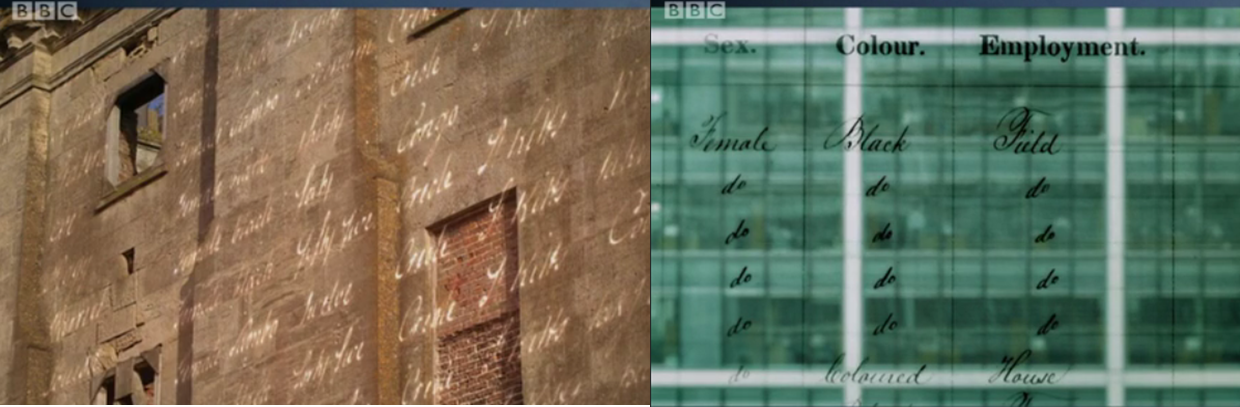
IMG_0888Amitav Ghosh has written that “the only people for whom we can even begin to imagine properly human, individual existences are the literate and the consequential . . . the people who had the power to inscribe themselves physically upon time”. In his novels, he inverts this significance by making the coloniser speak in a historical patois that is hard to comprehend while his ‘colonised’ characters are narrated in lucid and limpid prose. Supplying #missinghistories helps us to perform a similar inversion where ‘alternative’ sites of memory (Nora, 1989) can become part of the narrative of the city and so change it. In the recent documentary Britain’s Forgotten Slave Owners, projections of the registers of those who claimed for compensation were superimposed on contemporary London: #missinghistories allows us to do this over time and for many other stories. A tweet from my placement colleague John Siblon is a model of how twitter might be used to do it: why was the East India Company formed? How did the growth of the port affect the coffee shop? What was the role of the Bank of England? We can ask these questions on the move.

More broadly, therefore, these rewritings of the problematic representation or non-representation of the past change the city in which they are found. Michel de Certeau described the city as composed of ‘unrecognised poems’ (de Certeau, 1988: 93) of meaning in relation to space and time. The voices of Londoners could rewrite this poem, creating new ‘trajectories and alterations of spaces’ (Ibid.) that send thoughts and everyday habits along new figurative as well as literal avenues. If you attended the London Open Garden Squares event earlier this year, you will know the way your eyes are opened in new ways by finding somewhere you’ve never been before. If you went to the Clay Cargo event at King’s Cross, you’ve seen the power and beauty of Londoners literally remoulding the fabric of the city in their own image. By filling in #missinghistories we are actually creating a new history which in turn opens up a new future. Hopefully, by rewriting and remapping the city in which we live, we can change the lives that are lived within it.

composite landscape

Stills from ‘Britain’s Forgotten Slave Owners’. Copyright of originator.

What we want…

From the public: photos of representations or non-representations of the past that fascinate, infuriate or just simply amuse.

From educators: teaching resources designed for use in addressing representations or non-representations of the past, or linking local points of interest to the formal curriculum.

From institutions and organisations: links to the resources designed already for use with exhibitions and sites, with as much detail about the exhibition or site as possible.  

Post to Twitter (@missinghist) with the hashtag #missinghistories or post direct to the page on this site. 

Recent Posts

  • Clean Up on Aisle 3
  • The Medium and the Message
  • Pseudohistory
  • The Holocaust and its Perpetrators: A Response to Douglas Murray and Andrew Roberts
  • Cracked Mirror: Holocaust Unconsciousness

Archives

  • May 2026
  • March 2026
  • September 2025
  • July 2025
  • June 2025
  • February 2025
  • January 2025
  • November 2024
  • February 2024
  • January 2023
  • January 2022
  • October 2021
  • September 2021
  • June 2021
  • August 2020
  • July 2020
  • March 2020
  • January 2020
  • January 2019
  • November 2018
  • January 2018
  • September 2017
  • August 2017
  • February 2017
  • January 2017
  • August 2016
  • March 2016
  • August 2015
  • August 2014
  • June 2013
  • May 2013
  • April 2013
  • February 2013
  • January 2013

Categories

  • Antisemitism
  • Book Reviews
  • Culture and Politics
  • Heritage Politics
  • missinghistories
  • Photography and Visual Culture
  • The Holocaust: Representations and Meanings
  • Uncategorized

Meta

  • Create account
  • Log in
  • Entries feed
  • Comments feed
  • WordPress.com

Blog at WordPress.com.

  • Subscribe Subscribed
    • framingthequestion
    • Already have a WordPress.com account? Log in now.
    • framingthequestion
    • Subscribe Subscribed
    • Sign up
    • Log in
    • Report this content
    • View site in Reader
    • Manage subscriptions
    • Collapse this bar

Loading Comments...