
We stand or fall together
Antisemitism can take many forms, from asking a Jew on first acquaintance what their view on Israel is to online trolling to acts of violence. Based on the statistics, there are few kinds of aggression or unpleasantness that someone in the UK hasn’t been on the receiving end of based on their identity as a Jew.
As has been pointed out often, estimates of frequency depend on a range of factors. If you look at Home Office statistics for Hate Crime, you get one figure. Of the 7.614 crimes based on the victim’s religion to March 2025, 2,873 of them targeted Jews. That’s 29%, or 106 crimes per 10,000 population. Given that Jews are a tiny minority in British society, just 278,360 people (0.5% of the population) this gives an idea of how frequently Jews are encountering incidents severe enough to be reported to the police. This includes high-profile events such as the recent attacks on synagogues and volunteer ambulances, the stabbings in Golders Green, and the horrific attack on Yom Kippur last year in Manchester.
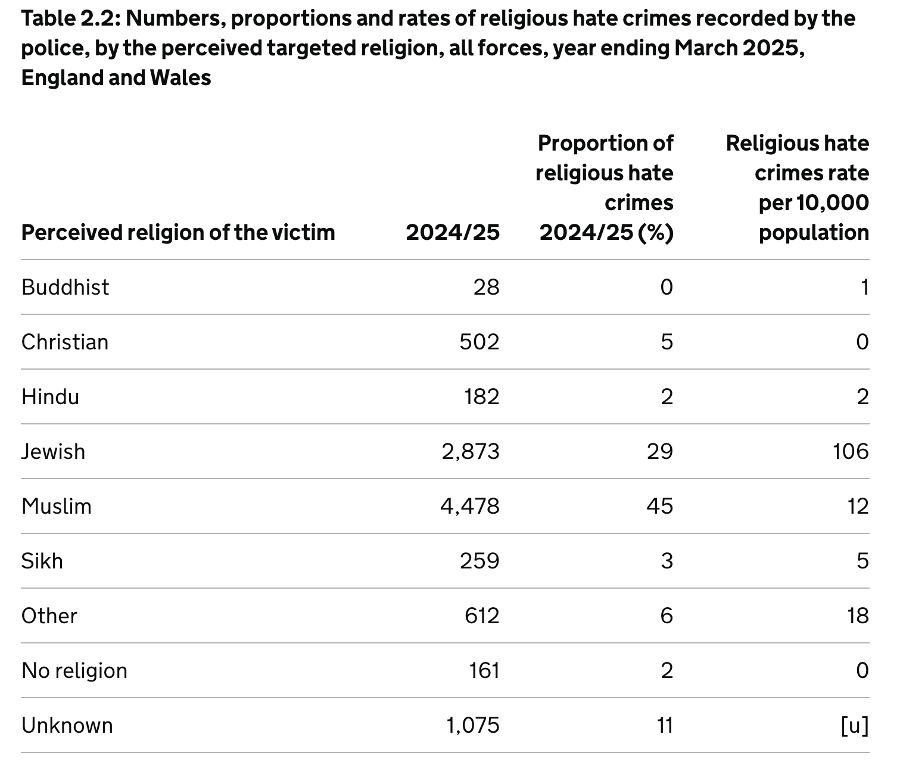
I quote these figures at length because, horrific as they are, they are often referred to misleadingly. Claims such as “most hate crime in the UK is antisemitic” do not take into account that all religiously-motivated hate crime is a fraction of the total number of offences. According to the official figures, there were 115,990 hate crimes recorded in England and Wales 2024-25. Taken together, the figures below show a society with serious social problems and fractures.
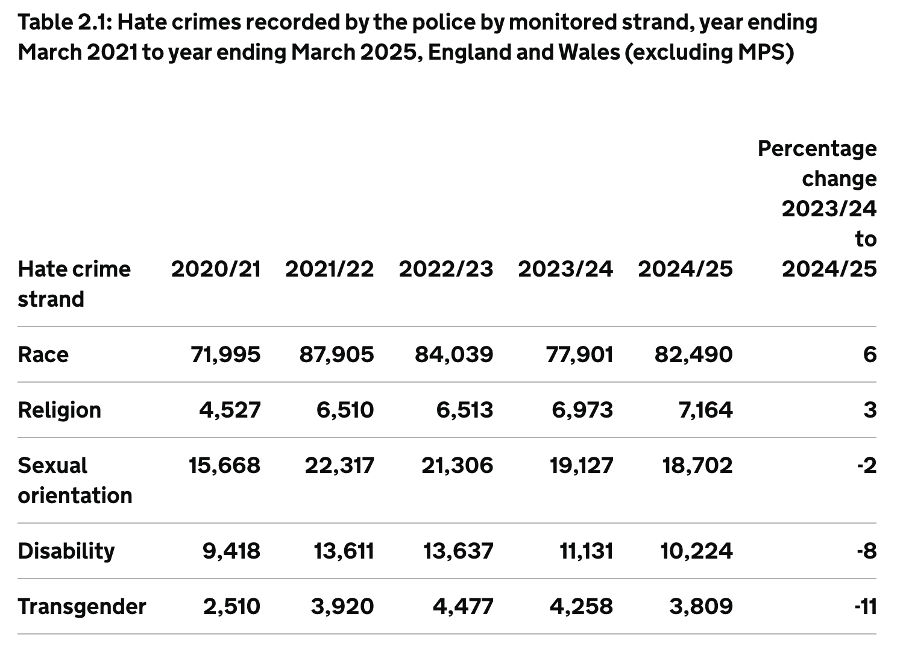
But it remains true that British Jews face antisemitism with a frequency out of all proportion to our numbers. In a society which might like to think of itself as open, the idea that Jews are making themselves much less visible as Jews for fear of reprisals should be very, very disturbing. But they are: children are being told not to wear school uniforms, men wearing the kippa are either removing it in public or hiding it. For those Orthodox Jews who dress in the way dictated by their faith these are not options, and we have seen the consequences.
Parallel to the Home Office statistics are those compiled by the Community Security Trust. Founded by Jewish ex-servicemen in the 1950s and 60s to guard against the far right, CST provides staff and volunteers trained to assess and respond to threats, working alongside the police. It should be noted very clearly that the organisation works with places of worship from other faiths, including mosques, to develop responses to security problems. It is an indispensable leader in British society, not simply in the Jewish community.
CST recorded 3,700 incidents in 2025, the second-highest total ever in a single calendar year. The record-holding year, incidentally, was 2023, with a huge proportion of the 4,298 incidents reported in the immediate aftermath of the attacks on Israel on 7 October. In fact, to be even clearer, the forty-eight hours after 7 October – that is, before Israel had fully dealt with the terrorists, much less retaliated – were the busiest time CST has ever known. The man in Finchley Central on 8 October shouting “Death to the Jews” was not an isolated incident.
The gap between officially recorded crime and the figure by CST is filled with incidents which, while they are clearly offensive and aimed at making Jewish life less pleasant, either did not meet the threshold for official investigation or were simply shrugged off as not being worth starting an official response because, in addition, perpetrators would never be easily identified.
In this last category is a particular series of incidents I encountered last year, in which pork products were repeatedly placed in the kosher section of my local supermarket. The staff and management have responded quickly and sympathetically, but it happened on six or seven occasions last year – and it has now started happening again in the last couple of weeks. Here is an image of the kind of thing I mean:
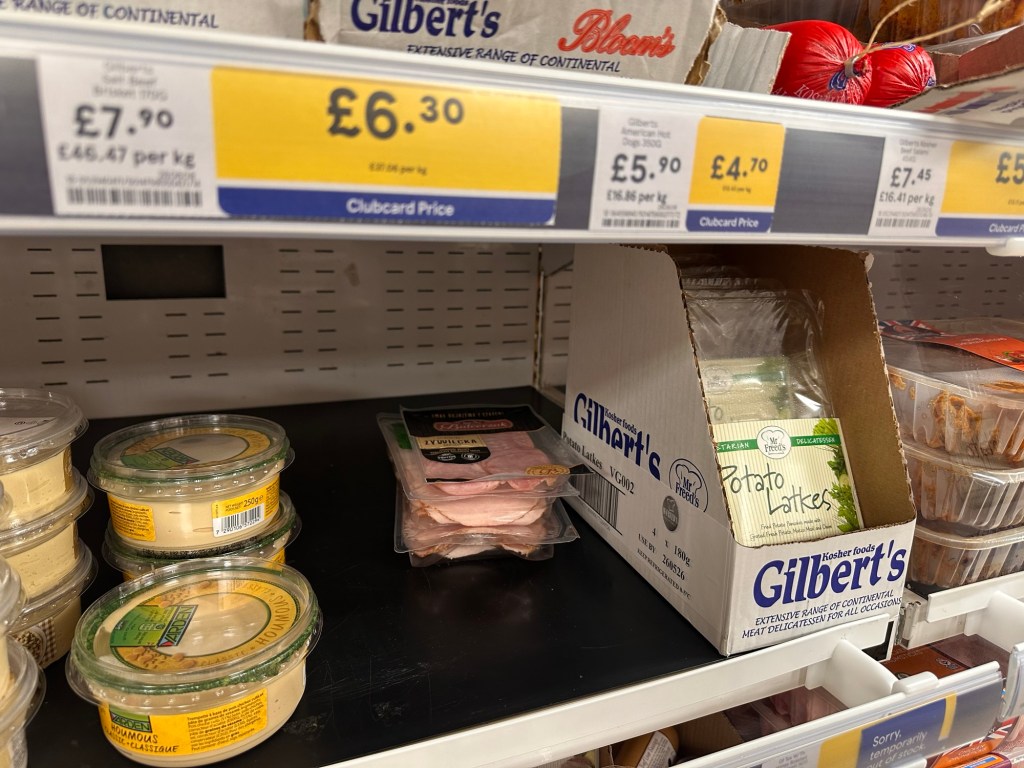
Firstly, let’s be clear what is being done. Basing their actions on the knowledge that observant Jews do not – like Muslims – eat pork, someone has decided to offend their sensibilities. Last week it was a pork joint, this week packets of ham. This is a minor-key variant of the major-key incident in January this year, in which masked thugs in Stockport left a pig’s head spiked on the garden gate of a Muslim family. If you do just a little digging, you’ll see that there have been a disturbing number of such incidents over the last decade or so. The charity Tell Mama records Islamophobic hate crime, and its figures are not better than CST’s, nor are the stories any less disturbing.
But because this is a minor-key variant, it gets complicated. The very helpful manager I spoke to this morning initially wanted to claim that it was simply a customer putting one item back in exchange for another. If your reaction to this was to question whether it was an accident, I would ask you to consider whether a customer who has previously picked up ham would find an obvious alternative in the kosher section. The manager took a second to consider this and quickly realised that she had under-reacted. “Oh my God,” she said, “of course. I’m sorry.” In making me push for it to be recognised for what it was, however, the perpetrator had succeeded. By leaving just enough doubt, the possibility had been raised that I was just another Jew, hysterically seeing antisemitism everywhere. It always requires that level of effort, by the way: I’ve wasted my time waiting for managers to arrive, because if I don’t, it will get shrugged off. And there isn’t any way of stopping it happening again.
The sheer cowardice of the action, moreover, is corrosive. Because it doesn’t take any effort, any planning. Nobody is going to pick it up on a security camera in the moment. And there’s always the possibility that the perpetrator sticks around to enjoy the fun. A middle-aged man asking for staff to act reasonably probably isn’t as entertaining as they were hoping for. But who knows? Who can I trust? Is that person smirking at my irritation, or just smiling? And can I trust the products? It’s not much of a leap from this act to more serious tampering, and detection would be just as hard. I’m probably jumping at shadows, but this is the point of such petty spite, to destabilise me (or whoever encounters it) at neither cost nor risk to the perpetrator.
This is a long way from the most serious or challenging, let alone life-threatening, antisemitic action committed this week. But it’s part of the reason that Jews are marching tomorrow against antisemitism, and part of the reason why Jews have become more and more angry in the last few years.
As I wrote last week, the issue with harassment and crimes in the UK is that they do nothing to help any situation outside it; they simply degrade and disturb people in the UK. Community cohesion, however, is a zero-sum game. If we tolerate the casual persecution of one minority, we lose the cohesion of society. If we lose the cohesion of our society, the wheels come off for everyone. I’ve tried hard in this piece to acknowledge the variety and extent of hate crime in the UK, and the challenges faced by a huge number of people in going about their business without interference. But the nature of hate crime is that it focuses the attention of the individual on themselves and those close to them. We cannot become a society of warring tribes. We must look out for each other, or we all lose.
Note: I’m now registered with Buy Me a Coffee: if you found this post useful or interesting, please consider sending me a small amount to help me do more. Thank you! https://coff.ee/jaimeashworth