
• Coursework and Dissertation Help
  • About the author…
    • #missinghistories
    • Independent Educator: Research-driven Education and Training
    • Writing and Research
    • Independent Researcher

framingthequestion

~ Reflections on memory, history, photography and culture

framingthequestion

Tag Archives: Islamophobia

Clean Up on Aisle 3

09 Saturday May 2026

Posted by jaimeashworth in Antisemitism

≈ Leave a comment

Tags

Antisemitism, Community Security Trust, CST, Islamophobia, Racism, Tell Mama

We stand or fall together
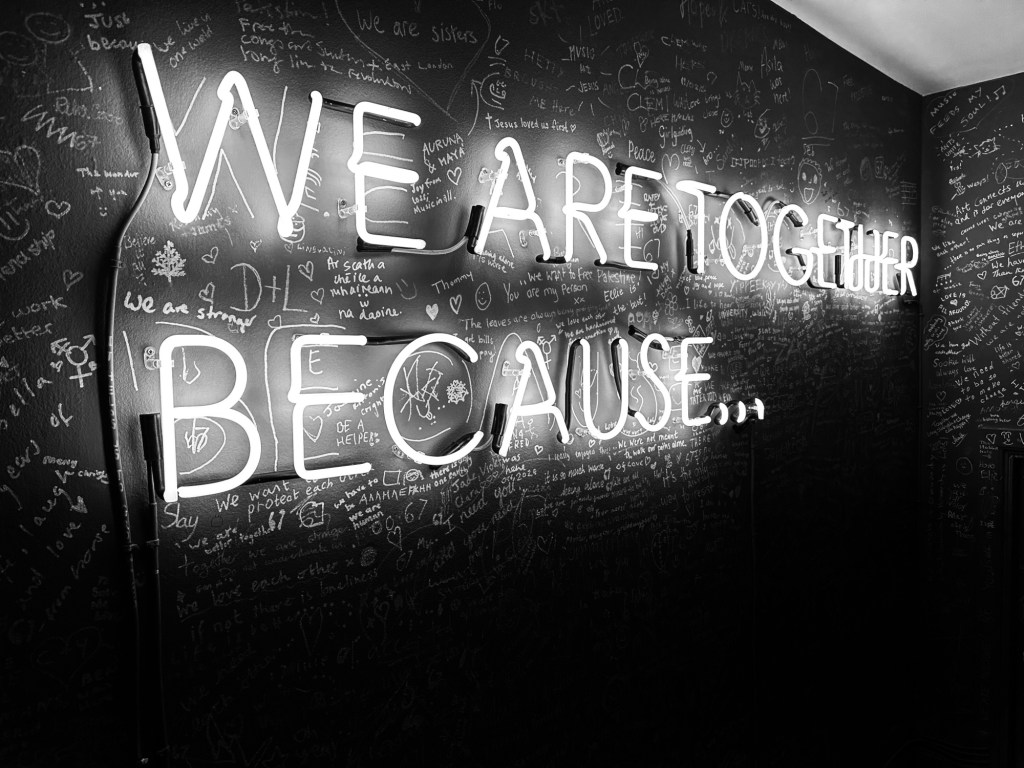
Display at The Foundling Museum, April 2026. Photo: Jaime Ashworth.

Antisemitism can take many forms, from asking a Jew on first acquaintance what their view on Israel is to online trolling to acts of violence. Based on the statistics, there are few kinds of aggression or unpleasantness that someone in the UK hasn’t been on the receiving end of based on their identity as a Jew.

As has been pointed out often, estimates of frequency depend on a range of factors. If you look at Home Office statistics for Hate Crime, you get one figure. Of the 7.614 crimes based on the victim’s religion to March 2025, 2,873 of them targeted Jews. That’s 29%, or 106 crimes per 10,000 population. Given that Jews are a tiny minority in British society, just 278,360 people (0.5% of the population) this gives an idea of how frequently Jews are encountering incidents severe enough to be reported to the police. This includes high-profile events such as the recent attacks on synagogues and volunteer ambulances, the stabbings in Golders Green, and the horrific attack on Yom Kippur last year in Manchester.
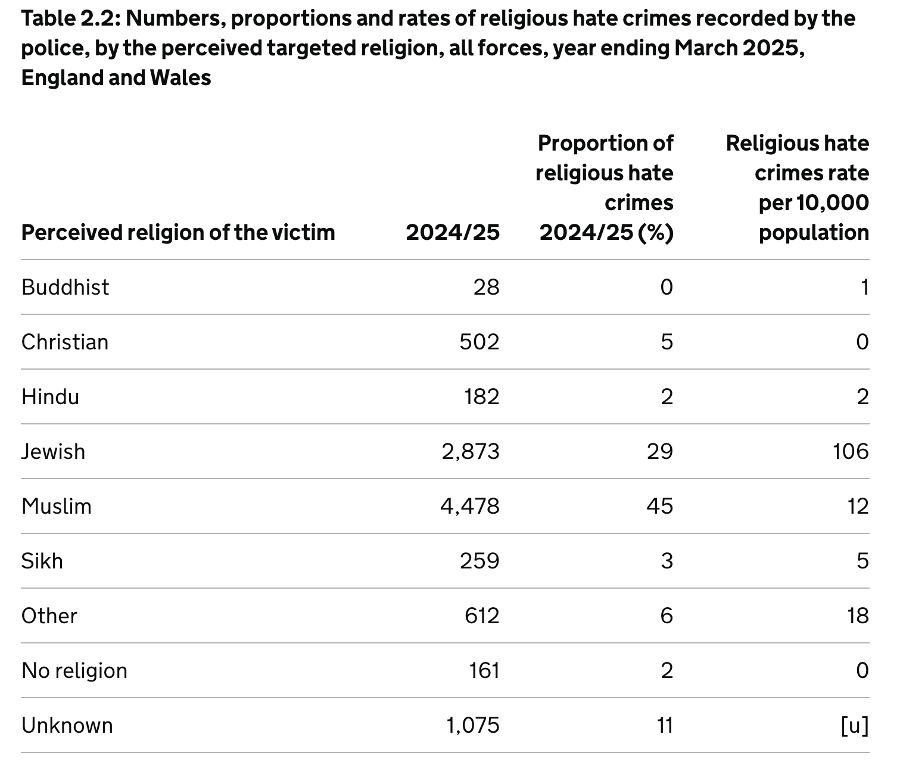
Source: UK Home Office, Hate crime, England and Wales, year ending March 2025 (Published 9 October 2025). Accessed at: https://www.gov.uk/government/statistics/hate-crime-england-and-wales-year-ending-march-2025/hate-crime-england-and-wales-year-ending-march-2025 on 9 May, 2026.

I quote these figures at length because, horrific as they are, they are often referred to misleadingly. Claims such as “most hate crime in the UK is antisemitic” do not take into account that all religiously-motivated hate crime is a fraction of the total number of offences. According to the official figures, there were 115,990 hate crimes recorded in England and Wales 2024-25. Taken together, the figures below show a society with serious social problems and fractures.
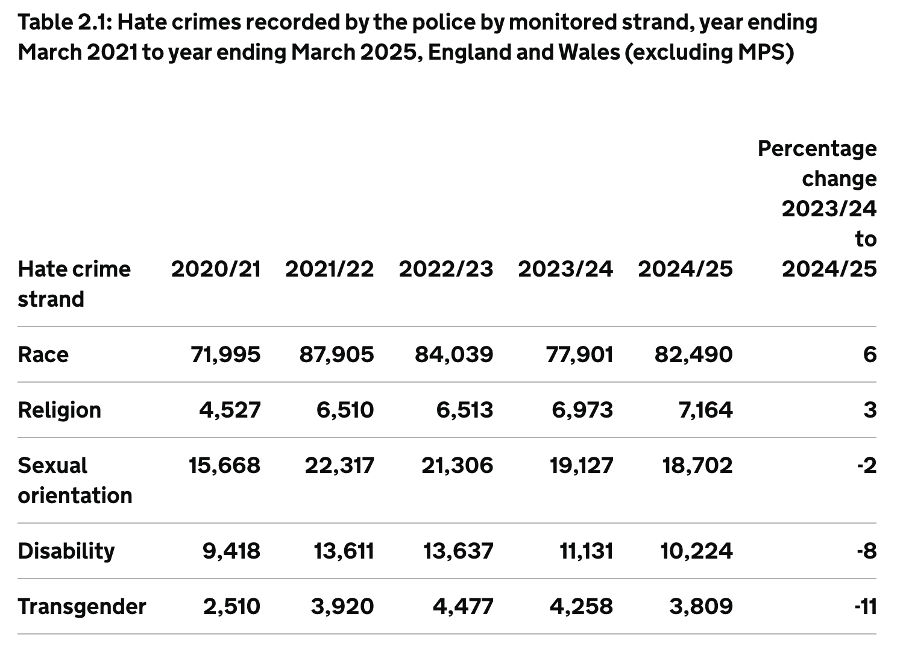
Source: UK Home Office, Hate crime, England and Wales, year ending March 2025 (Published 9 October 2025). Accessed at: https://www.gov.uk/government/statistics/hate-crime-england-and-wales-year-ending-march-2025/hate-crime-england-and-wales-year-ending-march-2025 on 9 May, 2026.

But it remains true that British Jews face antisemitism with a frequency out of all proportion to our numbers. In a society which might like to think of itself as open, the idea that Jews are making themselves much less visible as Jews for fear of reprisals should be very, very disturbing. But they are: children are being told not to wear school uniforms, men wearing the kippa are either removing it in public or hiding it. For those Orthodox Jews who dress in the way dictated by their faith these are not options, and we have seen the consequences.

Parallel to the Home Office statistics are those compiled by the Community Security Trust. Founded by Jewish ex-servicemen in the 1950s and 60s to guard against the far right, CST provides staff and volunteers trained to assess and respond to threats, working alongside the police. It should be noted very clearly that the organisation works with places of worship from other faiths, including mosques, to develop responses to security problems. It is an indispensable leader in British society, not simply in the Jewish community.

CST recorded 3,700 incidents in 2025, the second-highest total ever in a single calendar year. The record-holding year, incidentally, was 2023, with a huge proportion of the 4,298 incidents reported in the immediate aftermath of the attacks on Israel on 7 October. In fact, to be even clearer, the forty-eight hours after 7 October – that is, before Israel had fully dealt with the terrorists, much less retaliated – were the busiest time CST has ever known. The man in Finchley Central on 8 October shouting “Death to the Jews” was not an isolated incident.

The gap between officially recorded crime and the figure by CST is filled with incidents which, while they are clearly offensive and aimed at making Jewish life less pleasant, either did not meet the threshold for official investigation or were simply shrugged off as not being worth starting an official response because, in addition, perpetrators would never be easily identified.

In this last category is a particular series of incidents I encountered last year, in which pork products were repeatedly placed in the kosher section of my local supermarket. The staff and management have responded quickly and sympathetically, but it happened on six or seven occasions last year – and it has now started happening again in the last couple of weeks. Here is an image of the kind of thing I mean:
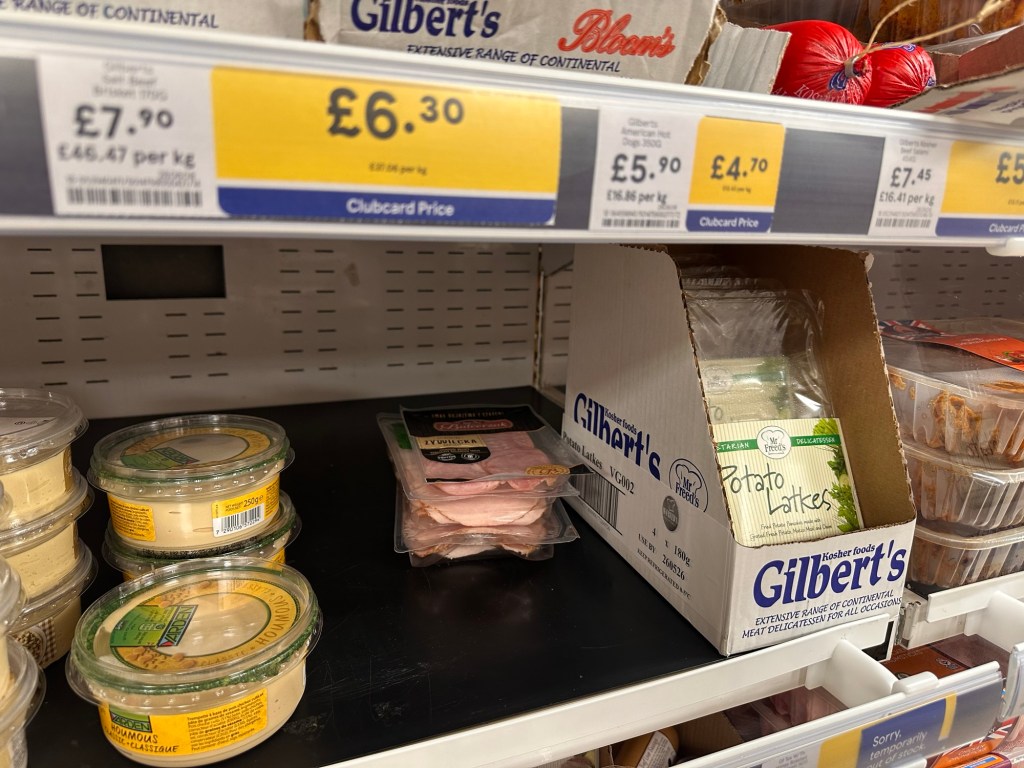
Ham in the kosher section, Tesco. 9 May, 2026. Photo: Jaime Ashworth. I’m choosing to keep the exact location vague for my own security.

Firstly, let’s be clear what is being done. Basing their actions on the knowledge that observant Jews do not – like Muslims – eat pork, someone has decided to offend their sensibilities. Last week it was a pork joint, this week packets of ham. This is a minor-key variant of the major-key incident in January this year, in which masked thugs in Stockport left a pig’s head spiked on the garden gate of a Muslim family. If you do just a little digging, you’ll see that there have been a disturbing number of such incidents over the last decade or so. The charity Tell Mama records Islamophobic hate crime, and its figures are not better than CST’s, nor are the stories any less disturbing.

But because this is a minor-key variant, it gets complicated. The very helpful manager I spoke to this morning initially wanted to claim that it was simply a customer putting one item back in exchange for another. If your reaction to this was to question whether it was an accident, I would ask you to consider whether a customer who has previously picked up ham would find an obvious alternative in the kosher section. The manager took a second to consider this and quickly realised that she had under-reacted. “Oh my God,” she said, “of course. I’m sorry.” In making me push for it to be recognised for what it was, however, the perpetrator had succeeded. By leaving just enough doubt, the possibility had been raised that I was just another Jew, hysterically seeing antisemitism everywhere. It always requires that level of effort, by the way: I’ve wasted my time waiting for managers to arrive, because if I don’t, it will get shrugged off. And there isn’t any way of stopping it happening again.

The sheer cowardice of the action, moreover, is corrosive. Because it doesn’t take any effort, any planning. Nobody is going to pick it up on a security camera in the moment. And there’s always the possibility that the perpetrator sticks around to enjoy the fun. A middle-aged man asking for staff to act reasonably probably isn’t as entertaining as they were hoping for. But who knows? Who can I trust? Is that person smirking at my irritation, or just smiling? And can I trust the products? It’s not much of a leap from this act to more serious tampering, and detection would be just as hard. I’m probably jumping at shadows, but this is the point of such petty spite, to destabilise me (or whoever encounters it) at neither cost nor risk to the perpetrator.

This is a long way from the most serious or challenging, let alone life-threatening, antisemitic action committed this week. But it’s part of the reason that Jews are marching tomorrow against antisemitism, and part of the reason why Jews have become more and more angry in the last few years.

As I wrote last week, the issue with harassment and crimes in the UK is that they do nothing to help any situation outside it; they simply degrade and disturb people in the UK. Community cohesion, however, is a zero-sum game. If we tolerate the casual persecution of one minority, we lose the cohesion of society. If we lose the cohesion of our society, the wheels come off for everyone. I’ve tried hard in this piece to acknowledge the variety and extent of hate crime in the UK, and the challenges faced by a huge number of people in going about their business without interference. But the nature of hate crime is that it focuses the attention of the individual on themselves and those close to them. We cannot become a society of warring tribes. We must look out for each other, or we all lose.

Note: I’m now registered with Buy Me a Coffee: if you found this post useful or interesting, please consider sending me a small amount to help me do more. Thank you! https://coff.ee/jaimeashworth
None of the Above

17 Wednesday Aug 2016

Posted by jaimeashworth in Culture and Politics

≈ Leave a comment

Tags

Antisemitism, Brexit, Chakrabarti Report, Islamophobia, Jeremy Corbyn, Labour, Labour Leadership, Owen Smith, Prevent Strategy

IMG_2040

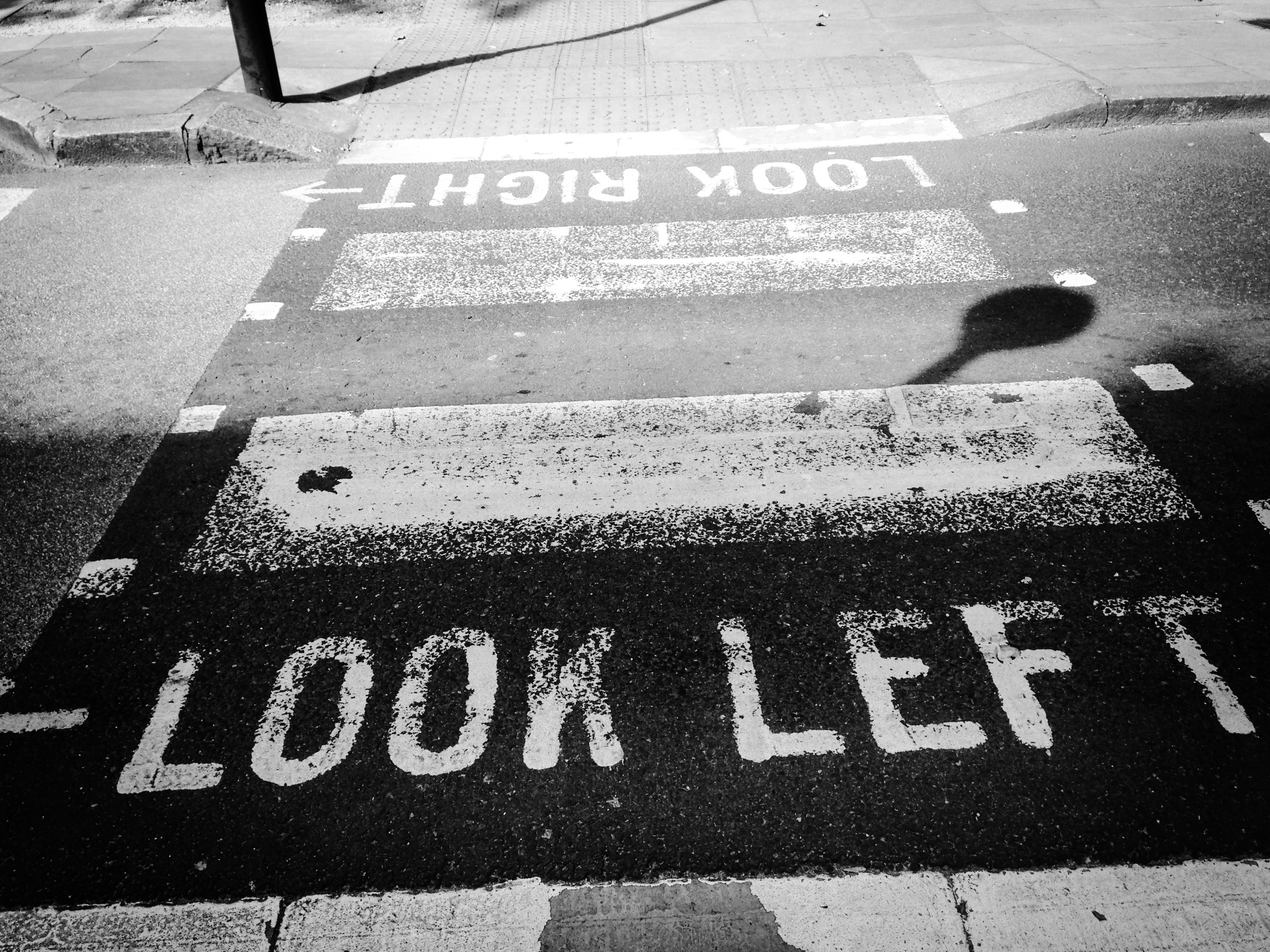
Photo: Jaime Ashworth, 2016.

In David Hare’s play The Absence of War, about a privately charismatic Labour leader unable to connect with voters through a web of political advice and spin, a senior political adviser bemoans the diversity of opinion that is a feature of Labour politics. “It’s easy for the Tories,” he complains, “They’ve got money and power to unite around. What have we got? Bloody justice. And no two definitions of that are ever the same.”

While it might be argued that a progressive politics necessarily stems from vigorous debate informed by passionately held principles, the last few months have demonstrated the other side of that: an emphasis on ideological purity and groupthink at the expense of the party’s alleged political goals of either holding the government of the day to account (the job of the official opposition) or winning power to implement change (pretty close to a textbook definition of a political party). As a follower of two Twitter accounts (@GentlerPolitics and @LabourAbuse) devoted to chronicling the abuses of both sides, I can testify (with many others) to the intensity and abusiveness of the debate. It has, however, generated much more heat than light. While I regret saying this (but not as much as I will once this piece is available to comment on, I suspect) I can’t see how I can vote for either candidate.

Let’s start with Jeremy Corbyn. I didn’t vote for him, because I think that fundamentally he’s wedded to a political model that has passed its sell-by date and is temperamentally a (frequently principled and often right) rebel rather than a unifier. Poachers can turn gamekeeper but they have to be wary of shooting themselves in the foot. He has discovered the hard way why Kinnock, Smith, Blair, Brown and Milliband would all have preferred him to toe the party line at various points. For his supporters to complain about parliamentary disloyalty is as hypocritical as the actions of many in his Shadow Cabinet were craven as they fled the coop when they became afraid the liberal sheen was about to come off him post-Brexit. Though in fairness Corbyn has, in regard to Trident, proved himself capable of criticising his party’s policy while leading it.

And then there’s antisemitism. Ken Livingstone’s comments were misinformed and offensive, and the failure to respond decisively was damaging. The response in the Vice.com documentary to an article by Jonathan Freedland was frankly bizarre: describing it, without any obvious foundation or subsequent explanation, as “disgusting” and “subliminal” suggests some agenda I can only guess at but many others have concluded about. The figures for his appearances in support of the Remain campaign are contested, but his reluctance to appear alongside those he disagreed on other issues with – like David Cameron, Tony Blair or Gordon Brown – is clear and puts his relationship to Hamas and Hezbollah back on the table as indicating his point of view rather than (as claimed) his desire to explore issues with those he disagrees with.

As for the response to the incident… I think Shami Chakrabarti has done more than enough in her career to justify a peerage but her report was anaemic at best, as some of the abuse chronicled in the Twitter accounts mentioned above has shown. Corbyn’s remarks at the launch were incompetent rather than malicious, but suggested a failure to take the issue or the audience seriously. The offensive remarks addressed to a Jewish MP by an activist who was later greeted warmly by Corbyn reinforce the view of him as one of the following: a fierce holder of principles with very limited ability to maintain focus when an issue doesn’t interest him; someone who didn’t understand why the remarks were offensive; or someone who agreed with the sentiment. Any of these are deeply problematic qualities in a potential Prime Minister (which is what Corbyn allegedly is): sometimes, annoying and frustrating as it is, you do have to accept the premise of the question. To govern is to choose, but you can’t always choose the issues you govern on, or the choices available.

Choiceless choice leads neatly to the candidacy of Owen Smith. While he may offer an alternative, and is certainly the most defiant spectacles-wearer to run for major political office since, well, John Major, he shares with the former Prime Minister a kind of anti-charisma. Major’s fashion sense combined with Tony Blair’s hand gestures and just a hint of predatory scoutmaster is not an appetising package.

In terms of his policy views, his soundbite on Newsnight that “There are too many immigrants in parts of Britain” suggests that Smith needs to learn when the premise of the question does need to be challenged. His statement in the leadership debate that “The Prevent strategy, that is grossly undermined and under-resourced in this country, ought to be at the forefront of Labour’s policy, making sure we foster better community relations in Britain” is even more troubling. Prevent, which is the unholy love-child of Theresa May as Home Secretary and Michael Gove at Education, mandates (among other things) that teachers report potential radicalisation to the authorities. Salma Yaqoob has described in the Guardian how her son suffered sleepless nights after being reported for participating in a WhatsApp group and suggested that Prevent “fosters the very climate of division and fear in which extremism grows.” A senior member of staff at a prestigious home-counties FE college described to me at an interview how a talented student had been interviewed for ninety minutes about her plans to visit family in Iran and how, as one of the approximately 20% of British teachers from BAME backgrounds, he was profoundly uncomfortable with the policy and the barriers it placed between staff and students in reporting genuine concerns. A far cry from the “cohesive, integrated multi-faith society [and] parliamentary democracy” it claims to be defending. Smith’s support of Prevent suggests that he is more interested in raising the level of social control than addressing the root causes of social problems. It signals a mixture of opportunism and limited vision that is less the dawn of a new era than the dusk of liberal politics.

As Richard Pryor’s character discovers in the 1980s classic Brewster’s Millions, “None of the Above” is a seductive slogan. Many reading will suggest that I too have to accept the premise of the question and vote one way or another, or that I am making politicians scapegoats for problems that extend well beyond their – or anyone else’s – control. They may also ask how I intend to vote in a General Election: thankfully, under the present circumstances, I’m unlikely to have to worry about that for a while. In any case, living in a safe Labour seat occupied by an MP I respect, the democratic deficit is likely to work in my favour.

But the leadership of the Labour Party is not a contest that requires my participation in the way a General Election does: it is what Anthony King has termed the “democracy of the fervent few”. It is the job of political parties to present coherent, practical and reasonably attractively packaged policies so that I can exercise my right in a democratic society to choose who to vote for: in my case for policies that try to thread the (perhaps impossible) needle of retaining and advancing social justice without descending into statism. It is also a question of presenting the ability to execute policy; to legislate as well as agitate, with the compromises and attention to boring detail that entails. Democracy of the fervent few requires a fervour that neither candidate inspires, and therefore: I’m out.

Recent Posts

  • Clean Up on Aisle 3
  • The Medium and the Message
  • Pseudohistory
  • The Holocaust and its Perpetrators: A Response to Douglas Murray and Andrew Roberts
  • Cracked Mirror: Holocaust Unconsciousness

Archives

  • May 2026
  • March 2026
  • September 2025
  • July 2025
  • June 2025
  • February 2025
  • January 2025
  • November 2024
  • February 2024
  • January 2023
  • January 2022
  • October 2021
  • September 2021
  • June 2021
  • August 2020
  • July 2020
  • March 2020
  • January 2020
  • January 2019
  • November 2018
  • January 2018
  • September 2017
  • August 2017
  • February 2017
  • January 2017
  • August 2016
  • March 2016
  • August 2015
  • August 2014
  • June 2013
  • May 2013
  • April 2013
  • February 2013
  • January 2013

Categories

  • Antisemitism
  • Book Reviews
  • Culture and Politics
  • Heritage Politics
  • missinghistories
  • Photography and Visual Culture
  • The Holocaust: Representations and Meanings
  • Uncategorized

Meta

  • Create account
  • Log in
  • Entries feed
  • Comments feed
  • WordPress.com

Blog at WordPress.com.

  • Subscribe Subscribed
    • framingthequestion
    • Already have a WordPress.com account? Log in now.
    • framingthequestion
    • Subscribe Subscribed
    • Sign up
    • Log in
    • Report this content
    • View site in Reader
    • Manage subscriptions
    • Collapse this bar

Loading Comments...