• Coursework and Dissertation Help
  • About the author…
    • #missinghistories
    • Independent Educator: Research-driven Education and Training
    • Writing and Research
    • Independent Researcher

framingthequestion

~ Reflections on memory, history, photography and culture

framingthequestion

Category Archives: Culture and Politics

Truth and Memory, 1914-2014

17 Sunday Aug 2014

Posted by jaimeashworth in Culture and Politics, Heritage Politics, Photography and Visual Culture

≈ Leave a comment

Tags

Blood Swept Lands and Seas of Red, David Olusoga, First World War, Imperial War Museums, IWM First World War Galleries, Paul Cummins, representation, Roland Barthes, WW1 Centenary

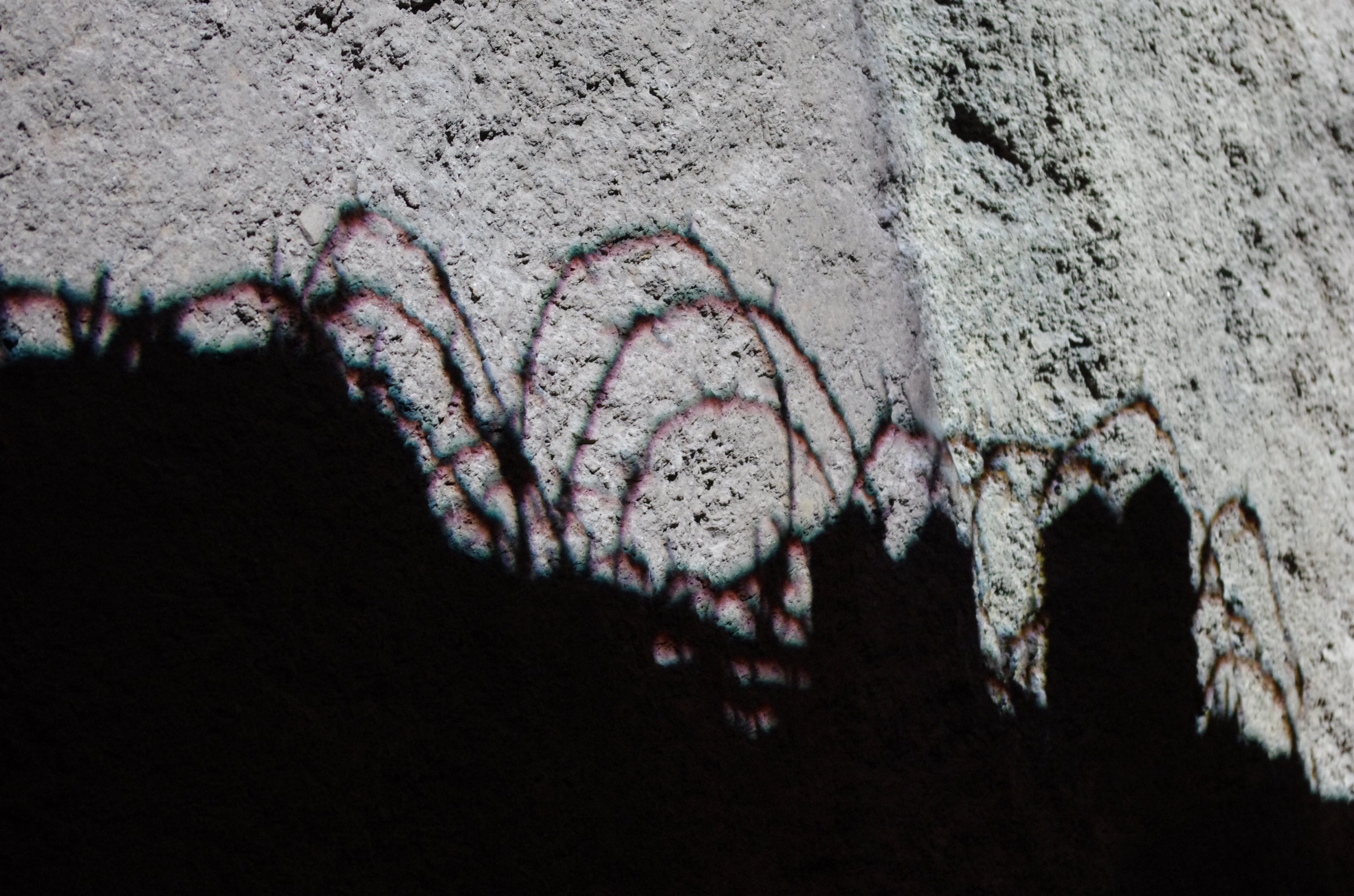
IMGP1695 Detail from Paul Cummins, ‘Blood Swept Lands and Seas of Red’, July – November 2014. Photo: Jaime Ashworth, 2014.

In The Missing of the Somme, his 1994 meditation on the legacy of the First World War, Geoff Dyer suggested that ‘in terms of remembrance the years 2014-2018 will represent the temporal equivalent of a total eclipse. By then no one who fought in the war will be alive to remember it.’ While the concrete prediction was unsurprisingly accurate (though Harry Patch, ‘The Last Fighting Tommy’ died only in 2009) the weight of coverage and number of memorials mean that it can hardly be considered an eclipse. Visiting the newly renovated Imperial War Museum London and its new First World War Galleries and the installation by Paul Cummins at the Tower of London, Blood Swept Lands and Seas of Red, I have been struck not just by the sheer numbers (the IWM galleries have timed tickets to cope with demand) but the intensity with which people have engaged. For an event which has passed out of living memory (for combatants at least) it is remarkably emotive still. Even allowing for the degree to which media attention will amplify/produce/manufacture interest the response has been impressive. According to 1418Now, three million homes turned out their lights and lit candles to mark the centenary on 4 August.

photo The ‘Truth and Memory’ logo. Photo: Jaime Ashworth, 2014.

There is no shortage of pieces explaining/asking ‘What WW1 did for us’, nor is there any dearth of historical research exploring the origins and significance of the conflict. What I want to do here is look at the way this is happening in relation to the terms ‘Truth’ and ‘Memory’ – employed by the IWM as the title for an incredible exhibition of their First World War art collection.

The exhibition is in two parallel galleries separated by the chasm of the central atrium. The first contains works produced during or very shortly after the conflict while the second houses works produced after, incorporating the major works produced for the Hall of Remembrance project abandoned in 1919 by the British War Memorials Committee. The tensions in this division are acknowledged by the logo: ‘truth’ dissolving upward and ‘memory’ resolutely solid beneath. As the introductory panel notes, the ‘truth’ gallery contains works that ‘challenged established ideas of war and in turn redefined notions of the “truth”’. The gallery for ‘memory’ is intended to display evidence of ‘the central role envisioned for British art in commemorating the First World War’ – apparently underpinned by ‘the belief that art alone could convey the legitimacy of Britain’s cause and the nation’s sacrifice.’

Walking through the exhibition, my respect for the art itself was only slightly offset by disquiet at the ideas behind it. If there was a redefinition of ‘truth’ then how did that work? Did William Orpen’s use of biblical motifs redefine or reinforce them? Iconoclasm or even theodicy can be the sincerest forms of worship. Was the ‘grizzly truthfulness’ of Percy Delf Smith’s The Dance of Death a challenge to established ideas? Employing the medieval allegory of the Grim Reaper seems to emphasise continuity rather than challenge. Conversely, can anyone stand in front of John Singer Sargent’s Gassed and see ‘the legitimacy of Britain’s cause and the nation’s sacrifice’ without any hesitation or question? These questions, of course, are in the context of a breathtakingly thorough exhibition that needs to be seen and reflected upon.

The tensions between the concepts are nonetheless there, and unsurprisingly so. Truth will always require formulation and to that extent will be partial, at least in its expression. Memory presupposes that something is being remembered – which means that the scope of the imagination will come up against the facts of what happened. As Barthes put it, there is ‘stupefying evidence of this is how it was, giving us, by a precious miracle, a reality from which we are sheltered’ – the reality being the truth which can only be partially expressed.

IMG_0367 From the IWM London First World War Galleries. Photo: Jaime Ashworth, 2014.

Rather, therefore, than seeing a binary, on/off relationship between truth and memory, I see a spectrum of what I term mythology. Building on the work of Barthes, I see our engagement with the past as resulting from a tension that starts with an awareness that there is always ‘a language in which we speak of something’ which creates and defines the gap between what happened and how (or whether) we can speak of it – or if in fact we can sometimes stop speaking. This is about resonance and allusion, conscious or unconscious, of the period and/or anachronistic. Thus the title of William Roberts’s 1918 The Gas Chamber summons associations that are at once anachronistic and relevant. The chamber Roberts depicts is for training soldiers in the use of gas masks but at the same time the experience of gas attacks as both perpetrator and victim had a legacy in the death camps of the Third Reich, though it would be a mistake to join the concepts as though with a ruler. We need to remember Johan Huizinga’s injunction (quoted by Dyer) to ‘put ourselves at a point in the past at which the known factors seem to permit different outcomes’ and simultaneously know that it did happen a certain way and not another. In short, an awareness that we are not dealing with the object ‘memory’ but the act of remembering. Not mythology but mythologisation.

To achieve this, a museum needs to tread a path between explanation and play-acting that explains and illustrates the experience without confusing it with the reality that is being described. Not “I have been in a trench from the First World War” (which is patently false) but “I have enough insight to know what I can never experience”. The Blitz Experience and Trench Experience that used to occupy the parts of the building that are now the First World War Galleries used to fall into the trap of trying to recreate a reality which could not be recreated. The Dutch journalist Geert Mak wrote of sitting in a ‘fairy-tale air-raid shelter listening to the howl of the sirens and the thudding of the Heinkel bombers’.

More recent exhibitions such as the permanent Holocaust Exhibition and In Memoriam (commemorating the ninetieth anniversary of the end of the First World War) have succeeded, however, in precisely the terms I am talking about, using installation and artful display spaces to suggest the experience of what is being described rather than indulging in theatrics that leave the visitor aware that it was just a fairground ride. In clearing out the ramshackle dioramas and glass cases of the First and Second World War exhibitions the challenge was to produce a space that provided information and experience in ways that are accessible and thought-provoking. The new galleries succeed in this with remarkable sophistication.

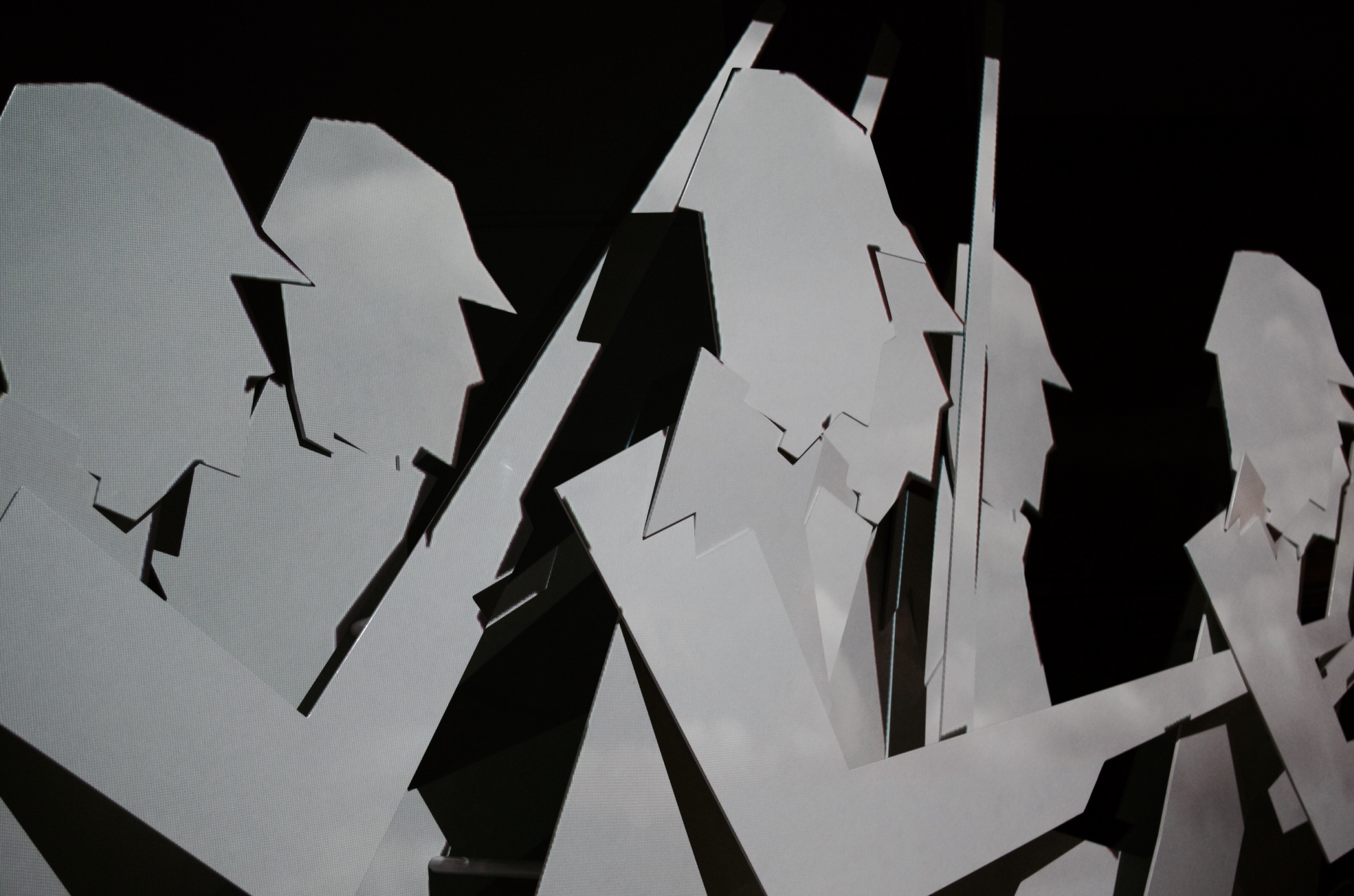
IMG_0290 Paper soldiers go to war. IWM London First World War Galleries. Photo: Jaime Ashworth, 2014.

A phenomenal array of exhibits and artefacts fill an exhibition space which crawls with explanations and questions, not asking you to imagine you are there but challenging you with the question; can you imagine this? Making your jagged way through the exhibition, the structure allegorises ‘The Trench’ while the lapidary scansion of the information panels constantly draws attention to the language in which they speak. One of the final panels reminds us that ‘Different generations/ have taken different standpoints/ as to what the war meant/ and we still grapple with its meaning today’. It is a brave choice to end a historical exhibition in such a significant location with questions about what is contained therein but this is what the IWM has done. In keeping with the awareness in its Corporate Plan that there is no end in sight to its role as ‘a global authority on conflict and its impact, from the First World War to the present day’ it offers questions. The present day is a moving target and answers are therefore provisional.

IMGP1551 A visitor to IWM London engages with ‘Queen and Country’ (Steve McQueen, 2006). Photo: Jaime Ashworth, 2014.

And this is not isolated but clearly a strategy that the future will maintain. In the post-1945 galleries, bringing Queen and Country by Steve McQueen into the body of the museum does this: on the day I visited, two staff members were watching visitors explore the work and murmuring approvingly at the interaction – in contrast to its previous splendid isolation next to Sargent’s Gassed. On the same floor, Mark Neville’s Bolan Market – footage taken from inside an armoured vehicle on patrol in Afghanistan – puts the visitor uncomfortably into the shoes of an occupier, the scowls and fear-struck faces leaving you in no doubt of the relationship between watcher and watched. And all through the ‘temporary’ Galleries, the thoughts of curators, designers and historians emphasise the constructed nature of the museum, forcing a confrontation with the means by which the story has been spoken. There is always emphasis on the work of memory, returning the responsibility to find answers to the visitor.

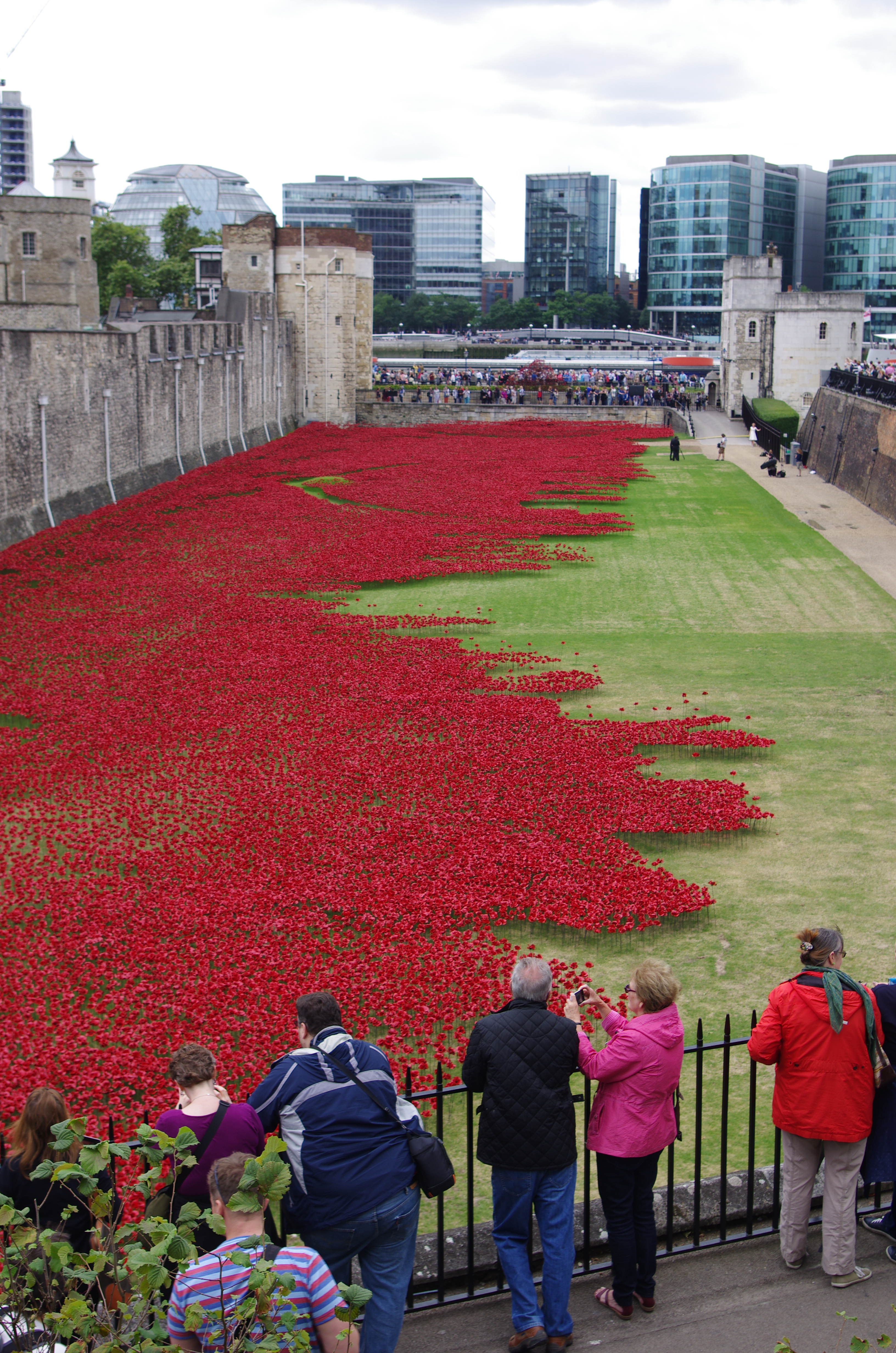
IMGP1682 ‘Blood Swept Lands and Seas of Red’ (Paul Cummins, 2014) at Tower Hill. Photo: Jaime Ashworth, 2014.

It is this kind of work that I missed when visiting Tower Hill to see the installation by Paul Cummins, Blood Swept Lands and Seas of Red, which is slowly filling the moat of the Tower of London with 888, 246 ceramic poppies to remember ‘every death among the British and Commonwealth forces between 1914 and 1921’. No crowd of the size that was there will ever be silent – life, after all, goes on – but many individuals were. Many wiped away tears.

But the novelty will fade. The weather will be less conducive to standing and watching this creeping static tide. And at that point the questions come. For a start, British and Commonwealth? Surely you mean Empire? David Olusoga’s passionate and critical The World’s War: Forgotten Soldiers of Empire has told the stories of some of those whose tomorrows were not ‘given for our freedom’ but rather mortgaged by their Imperial landlords. Talking of the Boys’ Own retelling of Paul Lettow-Vorbeck’s brutal campaign in Africa (entitled Heia-Safari!), Olusoga fixes the camera in the eye and says very clearly: “But I can’t see it like that. Because I was born here.” In the previous episode he was seen to physically recoil from some of the aggressive racism in propaganda about the colonial troops. It’s this kind of aggressive and visceral counter-narrative that installations like Blood Swept Lands and Seas of Red negate in their scale and pure emotional appeal, smoothing away problems with a form that renders all casualties in one colour, blending all, servant and master, officer and soldier, ruler and ruled, into one egalitarian mass.

And over the road from the Tower, a memorial to the Merchant Navy of 1914-18 stands all but ignored by the crowds. Have you forgotten yet? This question begins Siegfried Sassoon’s ‘Aftermath’, which goes directly on to describe how ‘the world’s events have rumbled on since those gagged days,/ like traffic checked while at the crossing of city ways’.

Solid and reassuring answers are in many ways the best indicator of a problem. Like the mannequin in Colin Self’s 1966 The Nuclear Victim (Beach Girl), answers and questions should be textured and challenging rather than smooth and accommodating. The IWM renovation works because it demands engagement from the visitor: as I looked at the work by Self, I heard a boy (maybe twelve) ask ‘Dad, what’s happened to her? What’s happened?’ his alarm increasing with repetition. The other reason the IWM works (and why museums in general can work)  is because finding out demands from the boy and his father (and others just like them) an active enquiry.

The confrontation between those who favour ‘smooth’ interpretation and representation and those who reject such in favour of more ‘worked’ or ‘textured’ answers has been in the offing all year.  Michael Gove’s sniping contempt for ‘left-wing historians’ indulging in ‘misrepresentations which reflect an, at best, ambiguous attitude to this country’ can (for me) be detected in passive-aggressive form in many of the injunctions to ‘remember’ “all those who gave their lives for us to live free” which fill Twitter feeds and Facebook pages and newspapers and all the other ways that ‘public opinion’ asserts itself. I remember them. As brave men who were scared. As good men who did terrible things. For a good cause, for a bad cause, for no cause at all. Because they wanted to and because they were compelled or even forced to. But I try to do so in as many of these ways as possible, knowing that all (and none) are true. But in the trying, I remember.

IMG_0397 A detail from the IWM London First World War Galleries. Photo: Jaime Ashworth, 2014.

What kind of people will we be? On Gaza, 2014

05 Tuesday Aug 2014

Posted by jaimeashworth in Culture and Politics, The Holocaust: Representations and Meanings

≈ Leave a comment

Tags

Fella Scheps, Gaza, Israel, Marianne Williamson, Operation Protective Edge

IMG_0344 Part of the wall from the Pawiak prison in Warsaw. Photo: Jaime Ashworth, 2013.

‘What kind of people will we be?’ This question from the diary of Fella Scheps, a young Polish Jew who died in 1945 shortly after her liberation from the concentration camps, has been running through my head lately as, along with the rest of the world, I’ve watched Operation Protective Edge burn its way through Gaza and into our living rooms, poisoning further any chances of a solution to the Arab-Israeli conflict that is short of apocalyptic. My social network feeds have, like yours, been full of the horrendous images and awful facts that are the stuff of life in Gaza. It is clear, as Jeremy Bowen writes in the New Statesman, that ‘from Gaza to Damascus, the Middle East is on fire – and no one knows how to put it out.’

I have no practical solution to the broader political problem, chiefly because there is no real need to present one again. As an article by Bronwen Maddox in July’s issue of Prospect suggests, there is broad understanding that the practical steps are what they have been and always will be until somebody (ideally everybody) steps up: an agreement by both sides to abjure violence; cessation of Israeli settlement building and an easing of the economic blockade of the Palestinian Authority; recognition on the part of the Palestinian leadership that whether or not they think Israel should exist it nevertheless does exist and will continue to do so in the event of any peaceful solution. And then we can get down to the substantive issues of Jerusalem, refugees and everything else. Assuming we’re interested in a peaceful solution, the steps are as well-worn as the streets in the city that both sides have claimed for as long as memory.


But to what extent is anyone interested in a peaceful solution? The government of Israel clearly isn’t, preferring to bring the temple down on their own heads, chipping away at the pillars of the international support it has more or less enjoyed for sixty-five years: one more shell, one more broken ceasefire, one more dead child at a time. As someone who has spent his adult life studying the Holocaust and its aftermath, I understand (I think) something of the case ‘for Israel’: on this occasion, the bloodshed seems so disproportionate, the consequences so predictable, that I cannot find the words to make it. I have just started Shani Boianjiu’s novel The People of Forever are Not Afraid and shudder inwardly at the title. Please, be afraid. Please, don’t bank on the memory of your sufferings to shield you from the realities of what you’re doing. Please, stop banking on forever. Please, ask what kind of people you have become. Please: stop.


To a much lesser degree, this can be applied to the Palestinian side of the equation. A two-state solution will require a recognition of the other state. The fact of being oppressed and threatened and attacked is no guarantee of exemption from the scale of moral values. If there is one thing to be learnt (indirectly) from the Israeli rhetoric of existential threat, it is surely that suffering does not automatically ennoble.


In many ways, the real burden of Fella Scheps’s question may – unfairly – fall on the citizens of Gaza. If there is to be a peace that lasts without even more bloodshed, it will come from you, the current victims, deciding on a magnanimity in defeat and despair that has eluded your oppressors. One aspect of the Israeli insanity is that, in the words of Avraham Burg’s impassioned The Holocaust is Over, We Must Rise from Its Ashes, ‘All is permitted because we have been through the Shoah and you will not tell us how to behave.’ If the bombing stops, if somehow a moment comes where you have the choice of what to do with your enemy, what kind of people will you be?


And for those of us watching, heartsick and angry, wondering if there is an end in sight worth seeing, Fella Scheps’s question holds lessons also. In this moment, the brutality with which Israeli forces are prosecuting this campaign deserves our condemnation and the resilience of the people of Gaza deserves our support. I have been struck, however, by the way in which the comment on the crisis on my newsfeed has at times been almost calculated to make the opposing view harden its position, has seemed to be intended to antagonise rather than persuade, has degenerated into personal abuse. Reinforcing the views of those who see themselves as friendless with no recourse but further violence (and they exist on both sides) will not make anything better.


Yes, everyone is entitled to a point of view and, yes, these events are extreme and horrifying. We should be outraged, we should be sad, we should be angry. But we also need to be humble. Because we all know, however impassioned we are, that we are fundamentally sitting on the sidelines. And from that position, any exhortation of either side to violence, any abuse of those who disagree, is irresponsible and simply not helping. If we insist that those who do not agree with us are wrong a priori, we leave them only submission or retaliation as responses. And the cycle continues, spinning around the globe: the swiftness of the digital ‘like’ and the cheapness of the half-formed comment becoming flywheels that lose control, spinning us all into nothing.


I’m sure I’m not alone in feeling helpless in the face of both the situation itself and the anger it generates. But if hatred and anger can be transmitted instantly across the globe so can anything else. Marianne Williamson recently promoted the idea of a wave of love across the world – all over the world, for a day, people simply saying ‘I love you’ to friends, family and especially to perfect strangers, especially to those whom we mistrust, especially to those whom we hate. This is of course a tall order: what, one might ask, does one do when there is no love to give? I have no answer but paradox. At the front of my copy of Yosl Rakover Talks to God, a classic statement of Jewish post-Holocaust theodicy, there is an inscription from a cellar in Cologne where a group of Jews remained hidden for the duration of the war:


I believe in the sun, even when it doesn’t shine.


I believe in love, even when I don’t feel it.


I believe in God, even when he is silent. 


I am tempted to say that ‘even’ should probably read ‘especially’. At moments like these, the only route to long-term survival is crossing the boundary of otherness with nothing but tenderness: precisely because it is hard, precisely because it eludes us. Perhaps we should bring the day Williamson suggests forward: otherwise, what kind of people will we be?


Totalitarianism: By the People, For the People

12 Wednesday Jun 2013

Posted by jaimeashworth in Culture and Politics, Photography and Visual Culture

≈ Leave a comment

Tags

Afrofuturism, British Library, Ellen Gallagher, Emplotment, GCHQ, NSA, Prism, Propaganda: Power and Persuasion, Tate Modern

Image

A US War Bond Campaign from 1918 remains chillingly relevant to this week’s news. Photo: Jaime Ashworth.

The essence of propaganda is to capture the imagination so thoroughly that the mind has no choice but to follow, holding you in thrall with the medium so the message is absorbed and accepted without question. Propaganda: Power and Persuasion at the British Library succeeds because its presentation is as compelling as its analysis.

This has been a week when the issues of consent, control and information that underlie any discussion of propaganda have been very important. Internationally, the revelations around Operation Prism and the mining of data have raised these questions particularly sharply, while in the UK the continuing row over the history curriculum and the plans to commemorate the 1914 centenary through ‘objective facts’ are also relevant. Most pointedly, this week the Russian Duma passed legislation making it illegal to spread what it termed ‘homosexual propaganda’, which it seems to equate with simply being homosexual. The question of how we navigate between education which teaches us how to think and propaganda which tells us what to think is not a relic, any more than it was in 2007-2008 when the Imperial War Museum put on the related exhibition of war posters, Weapons of Mass Communication. David Welch, in his beautifully produced book accompanying this exhibition, outlines the continuing tensions and fault lines very concisely, perhaps setting out the case for a detoxification of the word propaganda better than the exhibition does.

Welch’s concern for the negative connotation of the term propaganda raises very acutely the problems surrounding the limits of language to express anything without imposing some kind of register or significance on what it describes – what has been termed the problem of emplotment. Earlier this week I added my name to an open letter to the Prime Minister and Education Secretary which claims that the proposed history curriculum runs counter to the 1996 and 2002 Education Acts. It refers to a petition to ‘Keep the History Curriculum Politically Neutral’, opposing the promotion of ‘a nationalist political agenda [which] will stop history being a vehicle for teaching critical thought.’ This is a worthy and well-intentioned campaign, which does not (in all fairness) make clear what the author of both letter and petition propose to teach instead and why (and indeed how) that is neutral. I am, if not a Marxist, then certainly a leftie – and if I weren’t, Michael Gove excoriating Marxists and lefties would certainly increase my sympathy with them. At the same time, however, it is vital to maintain the distinction between ‘neutral’ and ‘what I happen to agree with’. To do otherwise is to engage in propaganda.

Image

Detail from ‘Page 1, Penelope’ (Joe Tilson, 1969) in the British Library foyer. Photo: Jaime Ashworth.

Underneath these issues is another conflict beautifully drawn out by the exhibition between integrative and divisive propaganda. Portraying the enemy is one thing, but it always goes alongside a definition of the collective, and official propaganda can acquire its own power as its themes are developed ad hoc by societies in ways that do not stay within the confines of doctrine. In his novel, The Woman Who Waited, Andrei Makine describes the way in which for many Russians ‘this slim consolation was all they had left: the belief that, thanks to their husbands, brothers or sons, Leningrad had not fallen.’ In the face of this kind of meaning being derived, the narrator concedes that the description ‘propaganda’ seems ‘a little on the terse side.’

In Britain, the work by Paul Addison and Jeremy Crang on the Mass Observation weekly summaries of the public mood highlights that across Europe this kind of information was collected to a purpose during World War 2. Seventy years later, many of the slogans and campaigns developed in response are part of the common cultural framework: Dig for Victory, Careless Talk Costs Lives, Coughs and Sneezes Spread Diseases,Make Do and Mend. All of these have been revived by the Imperial War Museum for their modern resonances with ecologically sustainable living. Even the duds – Keep Calm and Carry On was never widely distributed due to lack of response – have become a part of our discourse, as anyone who watched the Hungarian dance troupe Attraction win Britain’s Got Talent after a montage of soupy patriotism can attest.

We all have views on whether a message is good or bad that rely on criteria which are to varying degrees impervious to argument. Though Max Hastings this week seemed unclear about this, it is very hard to state ‘just the facts’ – and consequently retaining a firm grasp on when propaganda is bad is not as easy as it might seem. One of the sections in the exhibition is called ‘Nation’ and includes the following comment on the inclusive use of propaganda in the processes following decolonisation.

To succeed, new leaders had to build credibility and authority among their populations. Where nations included diverse cultures and perspectives, new rulers worked hard to create a sense of unified purpose.

Benedict Anderson suggests in Imagined Communities that this process is more of a cycle where aspirations and self-conceptions agglomerate to untidily form what we now term ‘nationalism’. Is a national self-awareness merely a form of propaganda? I was reminded of Yes, Prime Minister, where Bernard would formulate ‘irregular verbs’ to demonstrate hypocrisy: he might have said that I inspire; you preach; he spreads propaganda. Alistair Campbell is a talking head in the exhibition and praises the power of the 2012 Olympic opening ceremony with the simple (and telling) phrase ‘That’s country branding.’ Well, yes it is – but so was Triumph of the Will.

The difficulty in answering these questions is skilfully reflected in the exhibition design. Sections bleed into one another and so emphasise the commonalities between campaigns to (variously) smoke less or not at all, buy war bonds, take more exercise, realise the objectives of the Five-Year Plan, use a handkerchief, enlist in the army or have only one child. This last poster, for the One-Child Policy, was for me the most horrific in its concealment of awful, sustained (and continuing) suffering behind simpering glossiness. Though I am aware that others might find the insouciant sense of entitlement of the interwar Empire Marketing Board equally if not more deceitful. One man’s nostalgia, after all, is another woman’s history of bloody oppression. In moving the viewer to consider the contradictions and centrality of ‘our’ histories this exhibition is constantly engaging, challenging and informative.

In being so, however, the means by which this happens are slightly neglected. The diversity and quantity of what is on display is incredible in terms of both historical scope and geographical coverage. I felt at times, though, that a more focused look at why and how different forms and media, whether visual, plastic or performative, have their effects would have been useful. The throwaway reference to the ‘documentary style’ of Der Ewige Jude really needed to consider the range of visual and social criteria suggested by the phrase. As John Tagg put it in the title of his book, there is a burden to representation which this exhibition perhaps wears a little too lightly at times. I was struck by the analysis of one of Norman Rockwell’s ‘Four Freedoms’ posters: it took the individual image apart but did not address the way in which the campaign as a whole opposed the ‘Freedom from Fear’ and ‘Freedom from Want’ which were ‘Ours to fight for’ and the ‘Freedom of Worship’ and ‘Freedom of Speech’ – which were there to be saved (in all cases by buying War Bonds). Medium and message could perhaps have been isolated slightly more. In the same vein, I felt that amongst an abundance of manipulative polemic, any distinction between ‘propaganda’ and ‘anti-propaganda’ boiled down to very subjective and historically contingent judgements. And there were some missed opportunities in this context: for example the ironies of poacher turning gamekeeper. We have all, at some point, been more spinned against than spinning.

On a related note, I was struck by the way which the form of the exhibition encouraged a kind of ‘semiotic totalitarianism’ in some of its structures. Waiting to listen on individual headphones to some of the audio-visual material locks the visitor into their individual experience in a way which recalls Arendt’s idea of an ‘atomised’ society, with the possibility of debate and discussion closed off. The faceless mannequins, often with apposite quotations on their chests, are extremely ambiguous, recalling both the silenced individual and the faceless guard. Finally, the security guards who smoothly insinuate themselves as people try to take (forbidden) photographs bring to life the ultimate goal of propaganda: to control and define the terms of individual experience, if necessary by force but ideally by volition.

Image

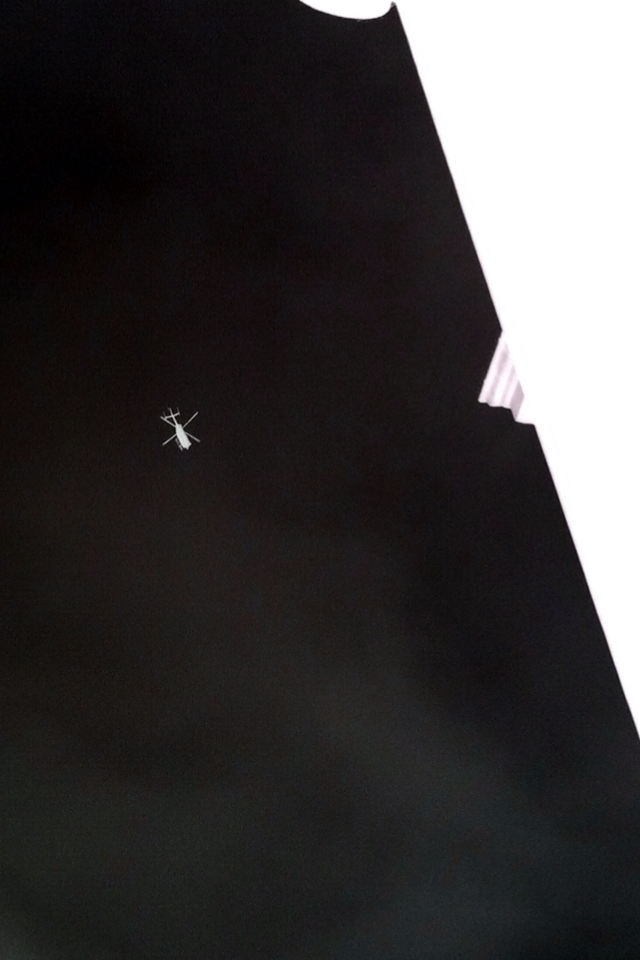
A helicopter hovers over Central London, 11 June, 2013: the Evening Standard reported that ‘Police made arrests as they launched a crackdown to prevent rioting and serious disorder’ ahead of next week’s G8 summit. Photo: Jaime Ashworth.

Propaganda therefore requires surveillance: to tell people what they should think requires that you first know what they are thinking, so that can be either subverted or reinforced. Whether it’s called opinion polling, market research or preventive custody, and whether you get a free coffee or a trip to the camps as a result, the prerequisite of propaganda is the maintenance of supervision over the thoughts and activities of others. It requires, in short, the creation of a power structure of information and ideas. As a plaque in the office of a Nixon White House Staffer put it, ‘If you have them by the balls, their hearts and minds will follow.’

Once established, these structures are extremely resistant. Ellen Gallagher’s aggressive deconstructions of the racial and gender identities expressed through advertising are a case in point. As much as they attack the status quo, they are also exhibited within it (at Tate Modern) and thus to some extent tamed.

These are obviously very live issues this week, with the revelation that the NSA and GCHQ routinely obtain, store and analyse our data, often with the connivance of some very familiar – if not perhaps actually trusted – brands. In response, William Hague issued the standard bromide: that the innocent have nothing to fear. And it should be borne in mind that there is a lot to keep track of. The exhibition’s final installation, Chorus, 2013, consists of fifteen columns of Twitter posts, pulsing relentlessly across the field of view while being sorted in different ways. No eye could possibly monitor such action – and this is just a tiny fraction of the stream of data produced every second of every minute of every day. One has to wonder whether, just as to defend everything is to defend nothing, to collect such quantities of data is to render it permanently incomprehensible, certainly for the predictive purposes that some might suggest. So why collect it? So that when your crime is discovered (or more worryingly, defined) the evidence can be found? The innocent do have nothing to fear: but who decides who is innocent? How do I know they’re wrong? The real damage done by propaganda is its erosion of the essential trust that exists in a healthy society between government and the people.

Propaganda: Power and Persuasion is at the British Library (www.bl.uk/propaganda) until 17 September, 2013. Adults £9 (£10 with GiftAid donation), Under 18s free, Concessions available.

Ellen Gallagher: AxME is at Tate Modern (www.tate.org.uk) until 1 September. Adults £11, Concessions £9.50.

Forms of Memory

06 Thursday Jun 2013

Posted by jaimeashworth in Culture and Politics, Heritage Politics

≈ 2 Comments

Tags

Afghanistan, First World War, Frank Ledwidge, Memorials, representation

Image The Cenotaph, Whitehall, Sir Edwin Luteyns 1919-20. Photo: Jaime Ashworth, 2013.

The next two years are going to see a huge number of military anniversaries. Next year will be the centenary of the outbreak of the First World War and the 70th anniversary of D-Day. The ‘Twenty Years Crisis’ as E.H. Carr termed it is becoming history. There are already no living British veterans of the First World War and the number of Second World War veterans is decreasing. To paraphrase the Ode of Remembrance, the sun is going down and we can only remember them. The means by which we negotiate these events – what Susan Rubin Suleiman has termed ‘crises of memory’ – is likely to feature prominently in these posts.

This memory-work, though, will be done against a backdrop of the war in Afghanistan, projected for ‘drawdown’ by the end of 2014. After a meeting with Anders Fogh Rasmussen last month, President Obama has proposed a NATO summit to discuss the withdrawal – as he put it, to ‘underscore this final chapter in our Afghan operations’ – for 2014.

Counting the cost of the Afghan campaign is, however, well underway. A front-page story in The Guardian last week announced the publication of a book by Frank Ledwidge: Investment in Blood: The True Cost of Britain’s Afghan War. The article outlines the book’s claims, including an estimated cost of ‘at least £37bn’, 444 British troops killed, 2600 wounded and more than 5000 he terms ‘psychologically injured’. In addition to which Ledwidge claims that more than 500 Afghan non-combatants have been killed. The article notes that half of these have been admitted by the British government. As to whether the war is winnable, Ledwidge is quoted as being dismissively derisive:

“Once the last British helicopter leaves a deserted and wrecked Camp Bastion, Helmand – to which Britain claimed it would bring ‘good governance’ – will be a fractious narco-state occasionally fought over by opium barons and their cronies.”

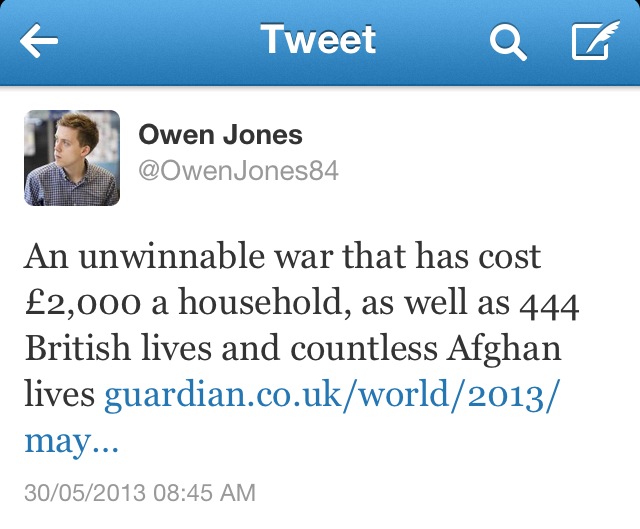
The article came to my attention via a Tweet from Owen Jones, who distilled the article in the following way:
Image

As someone who has engaged with various forms of memorial practice, I was struck by the way in which Jones had emphasised the number killed. With full respect for the fact that anyone’s death is a tragedy, there is an interesting shift in our response to Afghan casualties that deserves to be considered in the context of its historical evolution.

Looking at the BBC website for the casualties I was reminded of the 2007 project Queen and Country by the artist Steve McQueen, intended to remember those killed in Iraq through facsimile sheets of postage stamps bearing images of the dead. I viewed the work when it was at the Imperial War Museum and was struck by its patient dignity: the sheets are only visible one at a time, forcing the viewer to engage with each casualty as a discrete loss of life.

In one sense this is a continuation and modernisation of a memorial form that has endured throughout the twentieth century’s violent history: the list of names. The United Kingdom National Inventory of War Memorials (UKNIWM) has records of 64,000 of an estimated 100,000 war memorials in the UK, and many of them bear lists of those killed from a particular institution or locality. Entering the name of Godalming, the small Surrey town where I live, into the search engine produced results for the town, in the parish church and for a municipal roll of honour, as well as for the memorial cloister and plaque at Charterhouse School. Although the search only produces some of the individual names (those recorded at Charterhouse), the list of the fallen is central to the form of memory involved. This is a pattern replicated across the country – the Cenotaph at Southampton, for example, was inscribed with 1,997 names in 1922, though research by Tony Kushner of Southampton University apparently suggests that this excluded the names of members of the Jewish community.

The Southampton Cenotaph was designed by Sir Edwin Luteyns, the designer of the Cenotaph in Whitehall (and coincidentally a resident of Godalming). Originally commissioned in 1919 as a temporary monument in wood (the original was kept by the Imperial War Museum until its destruction in a WW2 air-raid), the stark simplicity of the design bears neither names of the fallen nor religious motto. Instead two stone wreaths and the words ‘The Glorious Dead’ invite the viewer or participant to think about its meaning. This blank quality opens the memorial to different meanings and has allowed it to transcend its origins in the aftermath of a specific conflict to act as a focus for the national act of remembrance of all conflicts.

At the core of these efforts to remember, however, is a dialectic between the event being remembered and the form in which this is done. In other words, what an event commemorates will determine the form of memorial that is most appropriate – and conversely, the form of memorial can tell us a great deal about what is being remembered.

ImageA useful example here is Maya Lin’s Vietnam Memorial in Washington D.C. which takes the list of names as its basis. The description on the artist’s website (click the quote for the link) brings out the three key elements: names, closure and geographical location at the heart of the national capital. The idea is that, as the National Parks Service puts it, it is a ‘Wall that heals’, by providing a place where those who served or lost friends and relatives can be reasonably certain of finding the name of the person they are remembering, a process facilitated by printed and online registries. So the form of the memorial tells us that this was a bloody war (there are currently 58,261 names) of long duration (the casualties are ordered over a period of fourteen years). The subdued quality of the memorial – with no heroic figures or waving flags, unlike the Marine Corps memorial in the same city – suggests that this was a defeat. But perhaps counting the cost in this very personal way turns even a victory into a defeat: perhaps the most striking of Luteyns’s memorials, the Memorial to the Missing of the Somme at Thiepval, has the names of more than 72,000 soldiers with no known graves inscribed into its fabric: a consequence of weapons which not only killed but obliterated.

So what does this mean for our forms of remembering our own war, here and now? It would be easy and inappropriate to simply suggest a glib contrast between the names on the Vietnam Memorial or at Thiepval and the 444 deaths recorded on the BBC (though Ledwidge’s comment above clearly invokes Vietnam as a comparison). To their families and friends, these deaths were and are shattering events: read the account by the Rev. Stuart Hallam of the death of 22 year-old Lieutenant John Thornton on 30th March 2008 in the collection of testimonies relating to Thornton’s death. After giving the last rites, Hallam writes:

I remembered that the lads were still waiting outside for news – but I was in bits, so before I went to see them I found a quiet room and wept… Then I went outside and told them that JT was dead.

As a political liberal who has concerned himself with the history of genocide, I have to concede the use of armed conflict in addressing certain kinds of situation at the same time as I deplore the loss of any life. In Rupert Smith’s intriguing book The Utility of Force, he sets out criteria for the successful use of military action:

To apply force with utility implies an understanding of the context in which one is acting, a clear definition of the result to be achieved, an identification of the point or target to which the force is being applied – and, as important as all the others, an understanding of the nature of the force being applied.

Smith’s set of tests can be applied with a little alteration to the critiquing of memorials. This may seem a frivolous exercise for the armchair peacenik but to me it seems that questioning the terms in which the last war is remembered is an essential part of preparing for – and perhaps avoiding – the next one. No one can make any certain pronouncements in the face of the individual tragedies created by such moments. And yet, I am moved to wonder whether this kind of very personal memorial would have been possible in other conflicts; whether our ability to pay personal homage to individual coffins arriving home does not reflect a kind of luxury that we should perhaps value more highly in asking questions about whether and how armed force is deployed. Because the marking of the individual death is a result of the economic, cultural, political and military power that allows us to make war in a fashion that is ‘asymmetric’, which is why our roll of honour can be contained within a single webpage or memorial. Which makes it no less honourable.

We have come a long way at great human cost since Wilfred Owen wrote Dulce et Decorum Est. We value individual suffering and deplore injustice in ways that many of those who fought a century ago would struggle to comprehend: there is, though, clearly some way to go. I honour the memory of those who die by trying to make my world better.

Frank Ledwidge’s Investment in Blood: The True Cost of Britain’s Afghan War, was published last week by Yale University Press, RRP £18.99. The words of Rev. Stuart Hallam are taken from Helmand: Diaries from Front-Line Soldiers, Osprey, Oxford 2013.

The family of John Thornton set up a charity in his name, The John Thornton Young Achievers Foundation, www.jtyaf.org

The Heart of the Matter

23 Thursday May 2013

Posted by jaimeashworth in Culture and Politics

≈ Leave a comment

Tags

Forgiveness, hope, Lee Rigby, Woolwich Attack

Image

“Returning violence for violence multiplies violence, adding deeper darkness to a night already devoid of stars. Darkness cannot drive out darkness; only light can do that. Hate cannot drive out hate; only love can do that.” – Martin Luther King Jr., 1958.

But where to find it? Where to even look for it this evening? The macabre chaos surrounding the death of Drummer Lee Rigby of 2nd Battalion The Royal Fusiliers late yesterday afternoon seems to have brought the darkness closer, provoking a response which mixes fatuity with venom and achieves nothing except the goals of those who want us divided and fearful; those who want us to blame others before we examine what we can do to make things better.

Judith Butler has addressed this in her book Precarious Life, arguing that the belief in a cycle of violence is one of the most fundamental obstacles to arresting it. Her observation that after violence ‘a narrative form emerges to compensate for the enormous narcissistic wound opened up by the public display of our physical vulnerability’ is borne out tragically by the headlines of newspapers this morning. The degree to which the designs make it unclear whether they are quoting the suspect or issuing his threat back to him is chilling in its endorsement of the inevitability of retaliation.

Image

http://www.metro.co.uk

Butler asks ‘what, politically, might be made of grief besides a cry for war’ though she concedes that she is unclear how ‘inevitable interdependency becomes acknowledged as the basis for global political community.’ My own answer is that forgiveness is a foundation of any possible solution. It meets many of the criteria Butler’s analysis implies, arresting the impulse to strike back, asking us to consider our response in the light of (as she puts it) ‘collective responsibility for a thorough understanding of the history that brought us to this juncture.’

Forgiveness is a concept that has been dealt with exhaustively but not at all effectively. In the course of developing this concept for the closing chapters of my doctoral thesis (an early version can be found on the Writing and Research page of this site) I looked at a range of responses by philosophers on the problem of forgiveness. The results were not edifying. For philosophers, it seems forgiveness is like the flight of a bumblebee to a particular kind of mathematician: something which, since it cannot be denied, must be explained away. Either an action is not sufficiently heinous to warrant forgiveness or the forgiveness is necessarily inadequate in response to a heinous act. In Getting Even, Jeffrey G. Murphy uses this impasse to develop what is almost a theology of the ‘vindictive passions’. In The Sunflower by Simon Wiesenthal, a range of thinkers seem to go out of their way to put obstacles in the way of forgiveness, arguing that even if they might be inclined to forgive, they can understand a decision not to.

So what are those obstacles? Forgiveness seems to require a few things. Firstly, a genuine act of wrongdoing: there has to be intent in the wrong or forgiving it is illogical. Secondly, there has to be an admission of guilt or responsibility by the person asking for forgiveness, who must be the person who committed the act being forgiven. Thirdly, the perpetrator must make amends through a process of atonement. Finally, only the victim can give forgiveness. If, by the way, this is starting to sound like a cross between an RE class and a life insurance policy, then you have the measure of the debate. These criteria do, however, explain why murder is often regarded as unforgivable: because intention must be present, because full restoration of the wrong is impossible, and because the victim cannot (by definition) forgive their murderer.

There is, however, a reverse to this. The victim of a murder cannot forgive their murderer, but I could (and I hope I never have to learn whether I could do this) forgive the murderer for the victim’s absence from my life. Similarly, if the wrong were one which could be redressed simply then would it be worthwhile even raising forgiveness? If the only circumstances under which a principle was operable were those in which it was an exaggerated response then it wouldn’t be much use at all. Moral principles are almost always at their most useful when we resist their implementation: they are there to guide us to the response we know to be the best when our instincts pull us elsewhere.

Which raises one final question, and this is crucial in engaging with the debate over yesterday’s attack. Those who argue that no one but the victim can forgive need to answer a question: how can anyone but the victim blame?

UPDATE: The Guardian Reader’s editor on the Guardian coverage explores some of the issues raised here and is worth reading (like most columns from that source) as an explanation of how the media cope with these issues in real-time. (Added 27 May 2013)

Heritage Politics

17 Friday May 2013

Posted by jaimeashworth in Culture and Politics, Heritage Politics

≈ Leave a comment

Tags

Barnes Wallis, Dambusters, Guy Gibson, icon, Lancaster, representation, Scampton, Spitfire, UKIP, World War 2

Image

Photo: Jaime Ashworth, 2013.

Seventy years ago last night, nineteen Lancaster bombers left RAF Scampton in Lincolnshire. 617 Squadron had been formed only a few weeks earlier, its mission a secret even from the pilots and crews. They had only been told of their objective – to break the dams of the Ruhr valley and thus disrupt German industry – earlier that day. The following morning, on 17 May, 1943, the surviving eleven crews returned – some all but crashing on the base perimeter – and a legend was born.

This is a story that will be told a lot today: the last few weeks have seen a wave of publications, supplements and television documentaries. BBC Radio 2 will spend the entire day commemorating the raid, its presenters broadcasting from Scampton and Biggin Hill before a concert in the evening. The trailers for this have been a regular feature on Radio 2, portraying the raid as a feat of courage and technical accomplishment: as Dan Snow puts it in an article for the BBC News website, a ‘combination of science, flying skill, grit and the obvious impact of the raids’. In short, the story as it has been told and retold since 1943, especially in the 1954 film starring Richard Todd (as Guy Gibson, the commander of the raid) and Michael Redgrave (as Barnes Wallis, the inventor of the bouncing bomb).

Like any operation by Bomber Command during World War 2, the Dambusters Raid has been the subject of intense debate, with no clear consensus on whether the raid achieved its short or long-term objectives. The authors of the official history of the Strategic Air Offensive, Sir Charles Webster and Noble Frankland (a veteran of Bomber Command and subsequently Director of the Imperial War Museum) dismissed the raid’s impact as overrated. And the civilian cost of the raid was huge: approximately 1650 people were killed in the towns and villages beneath the Möhne Dam. From their aircraft, the crews watched the impact of their breaching of the dam. Guy Gibson recounted:

Image

Guy Gibson (second from left) was 24 when he commanded the raid. He died in 1944 over Germany. IWM Photos.

It was the most amazing sight. The whole valley was beginning to fill with fog from the steam of the gushing water, and down in the foggy valley we saw cars speeding along the roads in front of this great wave of water, which was chasing them and going faster than they could ever hope to go. I saw their headlights burning and I saw water overtake them, wave by wave, and then the colour of the headlights underneath the water changing from light blue to green, from green to dark purple, until there was no longer anything except the water, bouncing down in great waves. The floods raced on, carrying with them as they went viaducts, railways, bridges and everything that stood in their path.

One survivor of the floods described what happened when the wave reached a labour camp where Ukrainian women were imprisoned.

Most were locked into their barracks and couldn’t get out. They were trapped inside the barracks as they were swept down until they came to the concrete bridge, where they were smashed to pieces. The terrible screams of the women trapped inside still rings in my ears.

Whatever the arguments about disruption of economic production – and Albert Speer made clear after the war that had the raid been exploited further it might have had serious consequences – the human cost was both immense and unavoidable. If the objective is to knock down a dam holding back millions of tons of water, the only way to do so without widespread and indiscriminate loss of life is to give a warning. Since the element of surprise was integral to the success of the operation, along with the necessity that water levels be at their highest, the civilian casualties have to be seen as at the very least an anticipated consequence of the mission. The moral questions about the raid mirror the broader questions around the Bomber Offensive, something which will certainly be revisited in the context of other forthcoming anniversaries, most notably (I suspect) that of the Dresden bombing in 1945. In that context, it is worth remembering as well that the Dams raid was codenamed Chastise.

In the meantime, though, a thought about the broader issues. In addition to the Dambusters and David Beckham, the news this week has focused on the progressive implosion of the Conservative Party over Europe, a process catalysed by the startling success of UKIP in the recent local elections. As entertaining as this is in terms of political theatre, I was struck by a tweet from Robert Eaglestone of Royal Holloway (@BobEaglestone if you’re on Twitter) who pointed out that ‘a problem with UKIP is that they believe the last thing to ‘happen’ in UK is WW2, so they create an odd ‘heritage’ politics.’ My response was this: surely the odd thing is that heritage politics are not perceived as strange?

The air war of World War Two has a particular and peculiar hold over us. The Battle of Britain Memorial Flight is a standard part of our pageantry: witness the role of the iconic aircraft as part of the 2012 Jubilee and the 2011 Royal Wedding. Perhaps for the Jubilee it was comprehensible – the Queen is after all the last surviving head of state to serve in uniform during the conflict. But for the wedding of two people born almost forty years after the war it is curious. We are in a Barthesian mythology, where the constraints of the metalanguage in which we speak make the contingent and strange appear natural. To illustrate the strangeness, look at the photo at the top of this post, taken last week in a pub in Guildford. And ask yourself what would be the reaction if there were a German beer called Messerschmitt?

Quotations from the crews and witnesses taken from Max Arthur, Dambusters: A Landmark Oral History, Virgin Books, London 2009. ‘Friday Night is Music Night presents The Dambusters 70 Years On’ is on Radio 2 at 8pm.

The sound of the invisible hand clapping

12 Sunday May 2013

Posted by jaimeashworth in Culture and Politics

≈ 1 Comment

Tags

Bill Paterson, Brecht, Bruce Norris, Dominic Cooke, Economic Inequality, Elizabeth Berrington, Ellie Kendrick, Johnny Flynn, Royal Court, Social Justice, The Low Road

Image

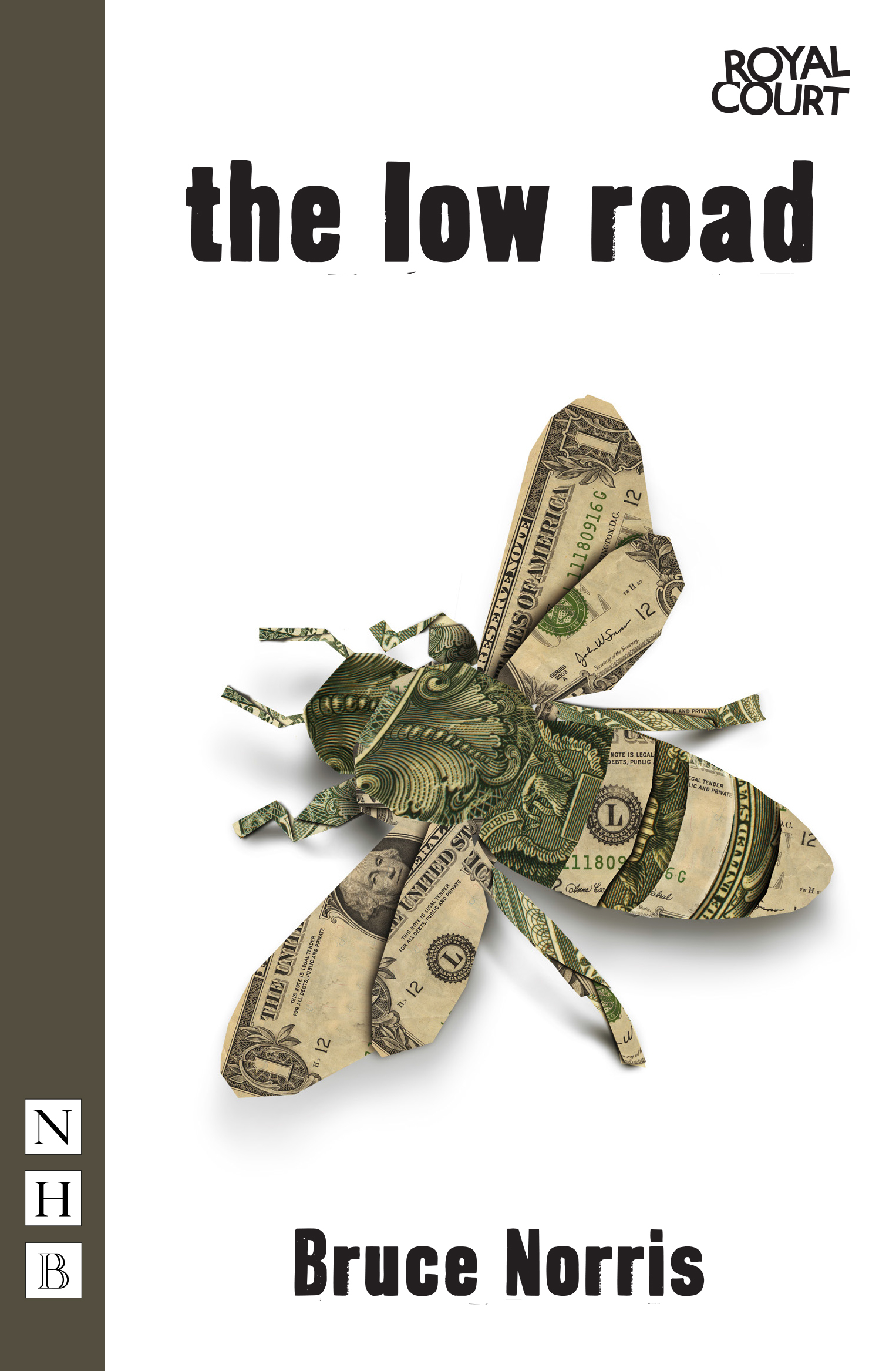
The clearest indicator of the quality of The Low Road at the Royal Court is that a scene in which twelve characters sit at a table debating the scriptural basis of capitalism is as entertaining as the expertly realised scenes of broader comedy. Employing inventive and hugely skilful physical means to tell the story of a foundling’s journey to (inadvertently) establish a banking dynasty, the cast move between costumes, characters and epochs with a rapidity that in lesser hands might be bewildering but in this brilliantly performed and realised production is simply accepted as occasionally breathtaking fait accompli. As well as being a superb piece of theatre technically, however, it is also a profound example of the use of theatre to explore political and moral problems in a way that engages head and heart while allowing the audience to be aware of their interactions.

In a piece which relies on the smooth working together of an ensemble on and off stage, it is slightly invidious to single out individuals. In the central role of Jim Trumpett, however, Johnny Flynn pulls off the feat of making a reprehensible chancer loveable while not concealing his baseness from us (even if it remains firmly hidden from the character’s awareness). Bill Paterson gives the narrative role of Adam Smith an amiable pomposity that allows his character to direct the audience to the interval while keeping the tension of the melodramatic cliffhanger intact. Similarly, Kobna Holdbrook-Smith gives the role of John Blanke a dignity and integrity which both he and the character seem to relish jeopardising. For her part, Ellie Kendrick clearly has enormous fun in her three roles, finding a physical intensity which is simultaneously completely aware and totally unconscious of its absurdity.

For me, though, the trio of pitch-perfect characterisations by Elizabeth Berrington deserve special acknowledgement. Whether portraying the generous dishonesty of a brothelkeeper (celebrating the subterfuge that ends the action with a cheery exclamation that justice has been done), the icy precision of an Economic Forum conference chair (‘And just to be clear, this is not the plenary session’) or the fragile delusion of an eighteenth-century philanthropist who wonders whether the first settlers didn’t go to America ‘partly for the unspoiled landscape’, Berrington is absolutely confident in her performance while never succumbing to the temptation to steal a scene. In a first-rate cast, she is a pleasure to watch.

None of this, of course, would work if the script and the direction were not superb. But they are. Dominic Cooke’s direction of a piece that could be incomprehensible is assured and meticulous. Bruce Norris’s script, meanwhile, always knows the line between poignance and sentimentality and clearly understands the Brechtian principle that in order to truly have engaged an audience they have to laugh at the characters’ tears and cry at their laughter. Norris is even brave enough to have one character speculate on the possibility that ‘a work of dramatic intention can prick our hearts by shewing us the humanity of those depicted’ – while playing such an idea for laughs. From both writer and director, the genius of the production is to commit to the moment and its contradictions inside and outside the action.

None of this should be read, however, as though there is nothing whatsoever to criticise in this production. Act One is an eighteenth-century romp whose foundlings and characters could have been lifted in their richness from Henry Fielding. Act Two, however, seemed to lose its way slightly as it tried to develop the themes of race and gender that the first raised while clearly leaving them subordinate to the central economic issue – namely ‘Tis one thing to admit the inescapable cruelty of nature, friend, but quite a different one to encourage it.’ In wrestling with the issues and finding a resolution to a complex plot, the laser-guided focus of the play dissipates slightly, the storytelling and analysis slightly less securely connected.

But though it doesn’t find clear answers, and even if at times the formulation of those questions takes second place to a dramatic tour de force, The Low Road is always asking (or trying to ask) the right questions. Emerging from the Royal Court on the high that follows witnessing a piece of drama that truly engages as well as entertains, the flagship stores of designer labels that encompass Sloane Square confront the alert audience member with concrete evidence that the dilemmas of western affluence are far from resolved. Do we, in the words of one character, ‘having crashed the car once […] want to hand the keys back to the same drunken driver?’

And if we do, do we first need to ask ourselves if we are the ones who will really pay the price? Sitting outside a café off the Kings Road, my sisters and I were served (politely and cheerfully) by a young black woman who shivered beneath the company-branded fleece she wore to serve overpriced (Fairtrade?) coffee in a bitter wind. ‘If you really want to make the world a better place,’ says one unpleasant character at the beginning of Act Two, ‘first thing you gotta do is help yourself.’ Easy for him to say – but where and how do we balance the cooperative with the competitive, as the final deus ex machina puts it.The Low Road does not have the answers but should provoke a great discussion of the questions. Probably over expensive coffee on the Kings Road. And the invisible hand so fulsomely extolled by Adam Smith won’t make that.

The Low Road by Bruce Norris, directed by Dominic Cooke at the Royal Court Theatre, Sloane Square, 23 March-11 May 2013. Text published by Nick Hern Books, price £9.99.

Then he saw her face…now she’s a Belieber?

15 Monday Apr 2013

Posted by jaimeashworth in Culture and Politics, The Holocaust: Representations and Meanings

≈ Leave a comment

Tags

Anne Frank, Holocaust Education, Justin Bieber, literature, reputation

Image

Justin Bieber went to the Anne Frank House last week and caused something of a controversy when his comment in the visitors’ book was released via a Tweet from the museum itself. For accuracy’s sake, here’s the text.

Image

As reported in a number of news outlets, the comment caused many of Bieber’s followers (and detractors) to attack the singer for being overly full of himself. In particular, it caused Emma Barnett in the Telegraph to write an indignant article under the intriguing headline ‘Justin Bieber doesn’t get to second-guess Anne Frank. Nobody does.’ 

Barnett takes Bieber to task for his ‘crass attempt to associate himself with one of the faces of the Holocaust’, recalling her memory of first visiting the Anne Frank House at age 10: ‘I still get chills thinking about my impressions of what I was about to discover, walking through the door into the cramped collection of rooms, tightly holding my mother’s hand.’

The business end of Barnett’s article, though, is in the final four paragraphs, where she outlines what I suspect are a representative set of attitudes under the outrage. To avoid any possibility of misrepresenting Barnett through clumsy paraphrasing, they are reproduced verbatim below.

Of course we don’t know if she would have been a ‘belieber’. The little girl inside of me hopes the wonderfully vibrant Anne Frank wouldn’t have stooped so low to be a cult follower of anything. She was a leader in my mind, not a follower. But I won’t be as crass as Bieber to try and even imagine her tastes or anything beyond those words she shared in her diary, her darling ‘Kitty’. 

What she wanted to let ‘Kitty’ know, (and then what Otto Frank deemed acceptable to share with the wider world when he published his daughter’s remarkable diary) is all we can and will ever know about Anne Frank. 

As you leave the Anne Frank Museum and write in the guestbook, most people I know almost don’t have any words. They often just share their sorrow, perhaps their own Holocaust story if they have one and express their praise and gratitude to the people who have kept Anne’s story alive. 

They certainly don’t write anything which is self-referential, nor attempt to guess what Anne would have been like had she been born to different generation. Justin Bieber needs to take note.

A few points. Firstly, as any visitor to the Anne Frank House would know, Anne was a keen follower of celebrity, as the pictures of film stars on her wall bear witness. As she noted in her diary on 11 July 1942 (just two days after the family moved to the attic: ‘Thanks to Father – who brought my entire postcard and film star collection here beforehand – and to a brush and a pot of glue, I was able to plaster the walls with pictures.’

The same passage, incidentally, is quoted in the downloadable guide to the museum, so one should be wary of the dismissive tone that Barnett adopts to explain Bieber’s comment as due to ‘one of the guides, who pointed out that Anne Frank was a fan of the pop culture of the time and that she might have been a fan of his.’ This seems to be a slight extrapolation of a standard part of the tour rather than the (implied) flattery of a famous visitor: so much, by the way, for ‘praise and gratitude to the people who have kept Anne’s story alive.’

The truth, though, is that we don’t know very much about what Anne thought about many things. As Barnett acknowledges, Anne’s diary was edited after the war by her father, who suppressed references to Anne’s sexuality and to the tensions in her relationship with her mother. Whatever the motivations for these choices, there can be little doubt that the version of the diary sold in the UK for much of the last sixty years has been The Diary of a Young Girl rather than (as it perhaps should be) The Diary of a Young Woman.

But the complexity doesn’t end there. On 29 March 1944, a broadcast by Gerrit Bolkestein, the Minister for Education in the Dutch Government-in-Exile, broadcast that ‘after the war a collection would be made of diaries and letters dealing with the war’ led Anne to rewrite and edit what she had written thus far, either for the official collection mentioned by Bolkestein or for a publication of her own. On 11 May, 1944, she wrote:

You’ve known for a long time that my greatest wish is to be a journalist, and later on, a famous writer. We’ll have to wait and see if these grand illusions (or delusions!) will ever come true, but till now I’ve had no lack of topics. In any case, after the war I’d like to publish a book called The Secret Annexe. It remains to be seen whether I’ll succeed, but my diary can serve as the basis.

From then on, not only was Anne writing with at least half an eye to posterity (there is, for example, a broader selection of themes than previously), she also edited and rewrote earlier sections. What we have of the diary for December 1942 to December 1943 is all from this period of rewriting. The authoritative Critical Edition of the Diary published by the Netherlands Institute for War Documentation in the 1980s puts all the alternative versions of all the entries alongside each other: a much less digestible and straightforward document than the paperback still (rightly) available from most bookshops. But this complexity means that everyone is creating an Anne of their own from the fragments left behind: Barnett is fooling herself if she thinks she isn’t ‘second-guessing’ Anne to some extent. Indeed, the final entry of Anne’s diary explains at length the extent to which she ‘second-guessed’ herself.

As I’ve told you, what I say is not what I feel, which is why I have a reputation for being a boy-chaser, a flirt, a smart aleck and a reader of romances. The happy-go-lucky Anne laughs, gives a flippant reply, shrugs her shoulders and pretends she couldn’t care less. The quiet Anne reacts in just the opposite way. If I’m being completely honest, I’ll have to admit that it does matter to me, that I’m trying very hard to change myself, but that I’m always up against a more powerful enemy.

Perhaps the most memorable quote from Anne’s diary is her comment on 5 April, 1944 (in reference to her literary ambitions, in the immediate wake of the Bolkestein broadcast) that ‘I want to be useful or bring enjoyment to all people, even those I’ve never met. I want to go on living even after my death!’ She certainly has: almost seventy years later, she is still famous and her diary is still the first introduction for many to the history of the Holocaust, though (as Barnett points out inadvertently) the Holocaust to a large extent happens ‘offstage’.

But this kind of fame comes at a price. Anne Michaels wrote in The Winter Vault that ‘we cling to the paintings from Theresienstadt, to a Dutch girl’s diary, because we need them to speak for every war child’s loss.’ But in making them speak for anything but their own fate and being, we make them into puppets for our own ends. Many of these ends are laudable – the work done by the Anne Frank House and the Anne Frank Trust, for example, in educating about the Holocaust, racism and (in)tolerance. Conversely, it might be argued that to derive an educational programme from the diary of a 13-15 year-old without her consent is to indulge in an editing of the past that is necessarily self-referential. We are all guilty of the same offence as Nathan Zuckerman in Philip Roth’s The Ghost Writer as he tries to persuade himself that a mysterious graduate student is actually Anne, survived and gone into hiding. ‘Alas,’ he writes, ‘I could not lift her out of her sacred book and make her a character in this life.’ Neither can we: we are all left with the blank knowledge that ‘Anne’s Diary Ends Here’.

I wonder whether Barnett would object to a photograph of Anne appearing on a Holocaust textbook? I suspect not, and yet for me the question this raises is to what extent the remarkable, inconsistent and talented young woman that Anne was is obscured by her placement within a view of the past that she could not consent to. Anne died in 1945, just days before the liberation of Belsen. We do not know the extent of her knowledge that she was one of the last victims of a campaign to murder the Jews of Europe. It had certainly not yet solidified into the historical edifice of ‘The Holocaust’. We also – and this is the tragedy when someone so talented dies so young – have no way of knowing how it might have changed her outlook. We all second-guess Anne, all the time. We have to, because we too must go on living after her death.

Quotations from Anne’s Diary are taken from Anne Frank: The Diary of a Young Girl, The Definitive Edition edited by Otto H. Frank and Mirjam Pressler, translated by Susan Massoty, published by Penguin in 2001.

If you need a monument…

12 Friday Apr 2013

Posted by jaimeashworth in Culture and Politics

≈ Leave a comment

Tags

icon, legacy, Margaret Thatcher, reputation, symbol

Image

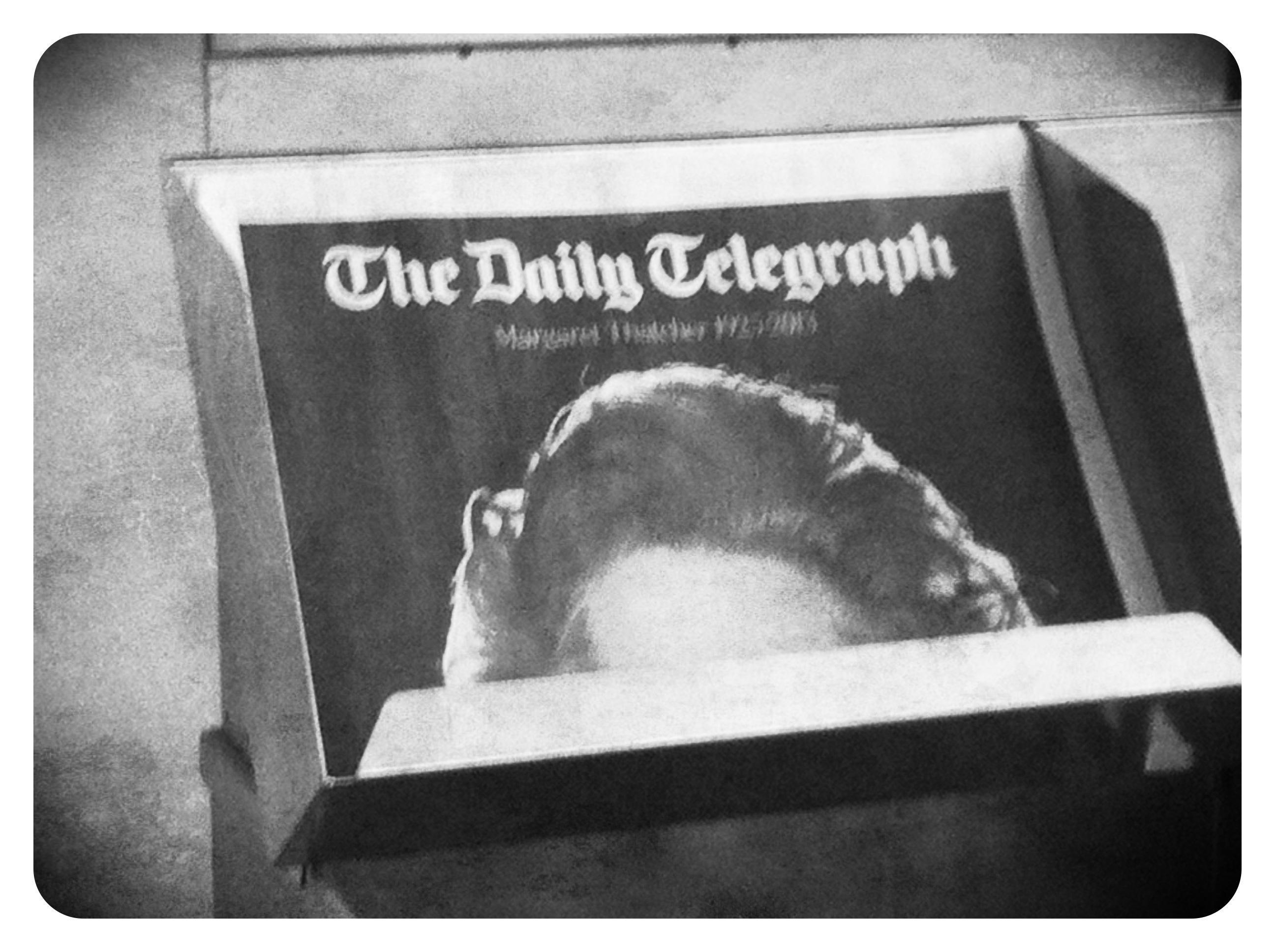
The death of Margaret Thatcher this week, aged 87, has predictably led to a re-opening of almost tribal divisions, in which a mawkish triumphalism has been equalled in unpleasantness only by the opposing frivolous vitriol. The irony of her famous pronouncement on entering Number 10 in 1979, promising that ‘Where there is discord, may we bring harmony’ has been more in evidence in the last few days than in the almost twenty-three years since she left office. Even in death, it seems, she divides the country in two: either ‘one of us’ or not.

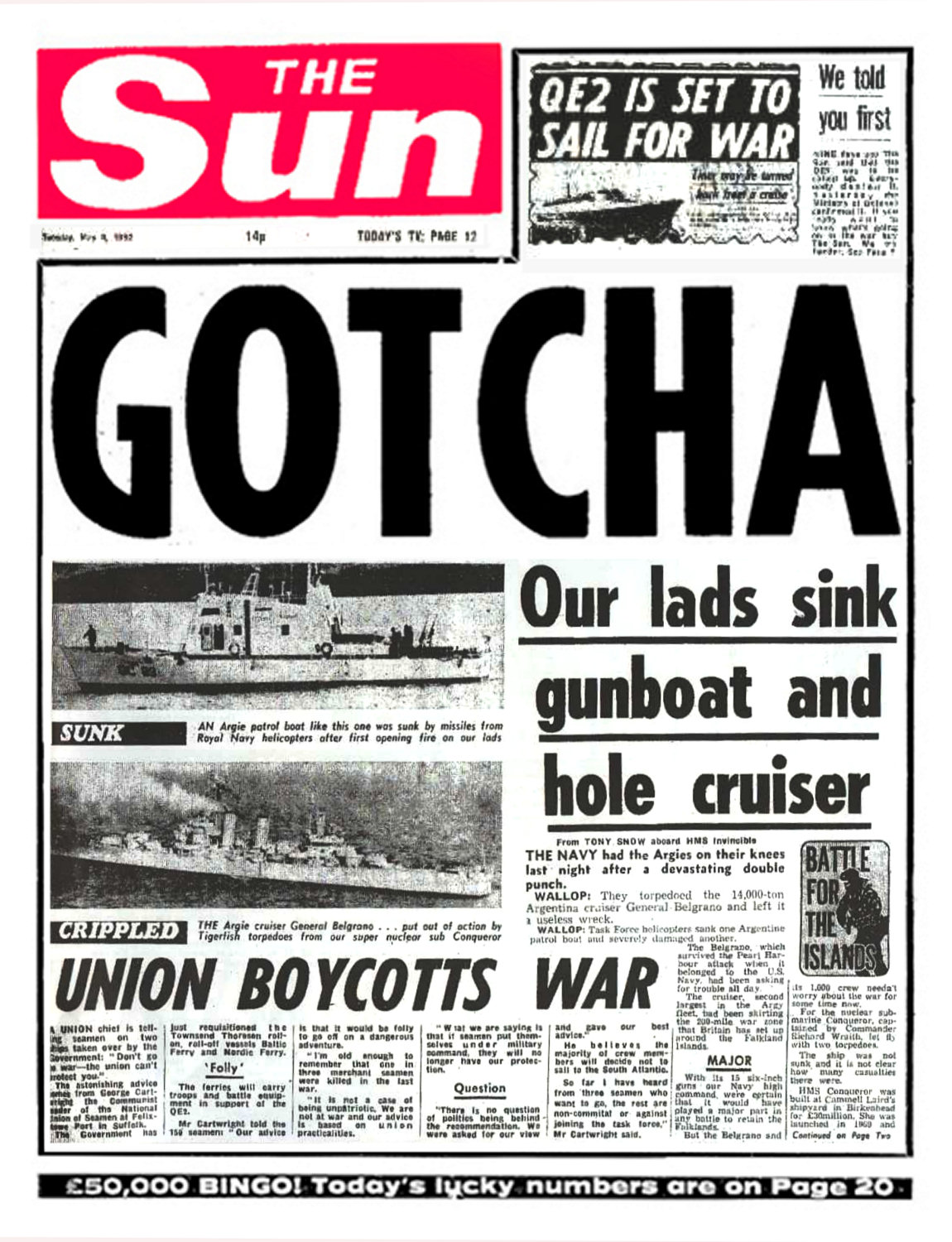
Personally, I am aware that the personalities and policies of the Thatcher years have shaped my life. The society we live in is defined by the confusion (so characteristic of the Thatcherite view) between individual interest and individual gain. Whether in the form of section 28 or the Poll Tax, energy privatisation or her failure to oppose Apartheid, the society she created (while denying there was any such thing) tended to be like her policies: nasty, brutish and short-sighted. And those who deplore the (admittedly unedifying) spectacle of jokes related to The Wizard of Oz ought to cast their minds back to 1982. How many of those asking the BBC to ban ‘Ding Dong the Witch is Dead’ this week complained at the Sun when it decided that ‘Gotcha’ was an appropriate summary of the deaths of Argentinean sailors?

Image

What has also struck me this week, however, has been the power of the symbol. The ingredients – a hairdo, a handbag, a particular shade of blue – are instantly recognisable: a true icon in that they continue to signify the meaning even (perhaps especially) in the absence of the content. There is particular irony in the resemblance of David Cameron (when kitted out as Thatcher) to Michael Heseltine.

Image

Christopher Wren’s epitaph (in St. Paul’s where Thatcher’s funeral will take place next week) ends with the words ‘Si monumentum requiris, circumspice’ – if you need a monument, look around. In the few days before her funeral, let’s look at her monument – in the NHS, in privatised and ineffective ‘public’ transport, in companies that perpetuate the ‘trickledown recession’ by not paying enough tax, in the lack of social housing, in the growing gap between rich and poor, even in the coarseness of the rhetoric surrounding her passing – and ask if we really like what we see. But let’s make it a true monument, by consigning the selfish and aggressive bluster to the past. The lady wasn’t for turning, but the world and the times must.

What’s Next?

07 Thursday Feb 2013

Posted by jaimeashworth in Culture and Politics

≈ 1 Comment

Tags

DoJ memo, Glenn Greenwald, hope, Obama, reputation, Terror Tuesday

‘With high hope for the future, no prediction in regard to it is ventured.’ – Abraham Lincoln, Second Inaugural Address

Obama bw

If you haven’t read it yet, the article on the Guardian website by American lawyer and blogger Glenn Greenwald on the assassination of US citizens outside the US by the Obama Administration is sobering reading. Picking through the assumptions of the Department of Justice memorandum setting out the legal basis for such actions, Greenwald argues that the measures constitute ‘an authoritarian conflation of government accusations and valid proof of guilt.’ Greenwald sets out clearly and compellingly the legal and philosophical bases for this view, arguing that there is a depressing continuity between the Bush/Cheney years and the present administration. To twist a one-liner from The West Wing, the US at present seems to be setting itself up as Joe McCarthy with first-strike capability.

Greenwald is a lawyer and as such better equipped to draw these conclusions. What concerns me (in both senses) is the challenge to my mental picture of Obama, whose election has (twice) made me think – or rather, hope – that the world had turned some kind of corner. The image that heads this post was a summary of how many of us felt on November 5, 2008 when, in the early hours of the morning (for those of us watching from the UK) the new President-elect stepped out from backstage and into history as he gave his victory speech. Amidst the applause, he said

It’s the answer that led those who’ve been told for so long by so many to be cynical and fearful and doubtful about what we can achieve to put their hands on the arc of history and bend it once more toward the hope of a better day. It’s been a long time coming, but tonight, because of what we did on this date in this election at this defining moment change has come to America.

Two months later, at his inauguration, we listened as he repeated this theme, promising that he would lead Americans to ‘choose [their] better history; to carry forward that precious gift, that noble idea passed on from generation to generation: the God-given promise that all are equal, all are free, and all deserve a chance to pursue their full measure of happiness.’ Whether any mortal could have lived the promise of such rhetoric is open to question: but we hoped.

The projection of Obama as, though perhaps compromised, fundamentally on the side of the angels is the point at issue here. The man who movingly spoke of the need for gun control in the wake of the Connecticut school shootings is also, it appears, a man who holds weekly meetings on ‘Terror Tuesdays’ to select a US citizen living abroad for assassination. Greenwald puts it starkly: ‘The power of accuser, prosecutor, judge, jury and executioner are all consolidated in this one man, and those powers are executed in the dark.’

I don’t want to believe that this is the ‘real’ Obama, and that I have been dazzled by propaganda, lulled into romantic complacency. In addition, I know that historical reputation is always contingent on what happens next, which no-one can tell you for sure until it’s already happened. And even then it is always, as Zhou Enlai reportedly said of the French Revolution, ‘too early to tell’ what an event means or a person has accomplished. Sometimes, as with JFK, the birds come home to roost after the person themselves has gone, meaning we have to reconcile the promise of the past with our disappointment at its consequences. It is almost always the hope that things will be different next time that allows us to do so.

In this case, however, it needn’t be too late: the next time is now, the change in the future is still at hand, a better history can still be chosen, even if what has been done cannot be undone. We have to hope that the disclosure of these documents makes those responsible look again at their actions and stop. Once again, Mr. President, you need to give us hope for a change.

← Older posts
Newer posts →

Recent Posts

  • The Holocaust and its Perpetrators: A Response to Douglas Murray and Andrew Roberts
  • Cracked Mirror: Holocaust Unconsciousness
  • The Price of Memory
  • Simulated Horror: AI and the Holocaust
  • Through the glass, darkly: a warning against Holocaust Distortion

Archives

  • September 2025
  • July 2025
  • June 2025
  • February 2025
  • January 2025
  • November 2024
  • February 2024
  • January 2023
  • January 2022
  • October 2021
  • September 2021
  • June 2021
  • August 2020
  • July 2020
  • March 2020
  • January 2020
  • January 2019
  • November 2018
  • January 2018
  • September 2017
  • August 2017
  • February 2017
  • January 2017
  • August 2016
  • March 2016
  • August 2015
  • August 2014
  • June 2013
  • May 2013
  • April 2013
  • February 2013
  • January 2013

Categories

  • Book Reviews
  • Culture and Politics
  • Heritage Politics
  • missinghistories
  • Photography and Visual Culture
  • The Holocaust: Representations and Meanings
  • Uncategorized

Meta

  • Create account
  • Log in
  • Entries feed
  • Comments feed
  • WordPress.com

Blog at WordPress.com.

  • Subscribe Subscribed
    • framingthequestion
    • Already have a WordPress.com account? Log in now.
    • framingthequestion
    • Subscribe Subscribed
    • Sign up
    • Log in
    • Report this content
    • View site in Reader
    • Manage subscriptions
    • Collapse this bar
 

Loading Comments...