My post the other week about the use of AI to generate images purportedly of the Holocaust has had quite a lot of attention. Some of this has been derived from my posting a link alongside critiques of the images as they’ve appeared (and re-appeared) in my social media. I’ve had three basic responses to these comments:
Firstly, responses by people who are what used to be called “hard” Holocaust deniers. These claim that the images are no more fake than any other image of the Holocaust. This recalls David Irving’s rallying cry to fellow deniers to “Sink the Auschwitz!” Irving said that they had to “make it tasteless” to get attention: a strategy developed by the late (and unlamented) Ernst Zündel, who used publications such as “Secret Nazi Polar Expeditions” (1978) and “Hitler at the South Pole” (1979) to get himself invited into television studios to “defend” his views. He also doubtless tapped into the subculture of what we might term today credulous edgelords, many of whom probably went on to buy turquoise shell suits in emulation of David Icke.
(Icke, by the way, has dropped his New Age pretence of trying to create world peace in favour of screaming “Rothschild Zionist!” at pictures of people he disagrees with. No more shell suits either.)
Secondly, there have been comments espousing “soft” denial, especially minimisation. One response ran: “the reason they were running low on food was because the allies uS Great Britain Etc [sic.] were bombing the railways. Otherwise it was typhus killing those Jews.”
Both of these types of comment are to be expected. The effort to distort and deny the scale of the Holocaust started while the Holocaust was still happening, and hasn’t let up since. As Tony Kushner has described, this went alongside a “liberal” suspicion that Jews had brought their fate upon themselves – that there was (and this was an actual phrase used) “no smoke without fire”. Nothing has tortured a certain kind of antisemitic fantasist more than actual Jewish victimhood, often recorded by its perpetrators. That such people seek to muddy the historical waters is not surprising.
But other kinds of indignation have been less expected, and are much more worrying in strategic terms. I expect to draw the ire of deniers, but the people who’ve rejected my challenges to these fakes as an attack on Holocaust memory have been a shock. Particularly when they claim that the fakes reflect realities they’ve read about or even seen on site visits.
Mostly, those kinds of objections can be met with facts. Since the responder accepts the Holocaust as an item of knowledge, they are usually able to accept arguments based on factual information and evidence (even if this is time-consuming, especially as a volunteer.)
But the last kind of objection is the most difficult. These claim that any kind of Holocaust remembrance, however divorced from facts, is worthy of reverence. Since I treat fake images of real events (even if rarely referenced or even employing names) as fakes, I am guilty of (at best) carping or (at worst) challenging the reality of the Holocaust. Challenging Holocaust distortion is now (for some people) on a par with (or worse than) Holocaust distortion itself. We are not so much through the looking glass as picking the shards of critical discourse out of our eyes.
The use of these images is already blurring the boundaries between real and imagined. If it is allowed to go unchallenged it will rapidly become impossible to restrict their use. As we know from the success of The Boy in the Striped Pyjamas, the inadequacy of Holocaust representations is not disqualifying – in fact, it can even be a reason for their success. And there are -as Baudrillard warned – no originals to correct, no negatives to destroy. All we have is experience and expertise, challenges, and the exercise of choice.
The scholar Andy Pearce has done a lot of work on what he terms “Holocaust consciousness” – where the object is simply to create a rather numinous sense of the Holocaust’s reality rather than engage in rigorous education or discussion. We are reaping the fruit of this direction of work, and we need to ask ourselves if we can change course. It is not enough to be aware of the Holocaust; we must ensure that it is known.
Note: I’m now registered with Buy Me a Coffee: if you found this post useful or interesting, please consider sending me a small amount to help me do more. Thank you! https://coff.ee/jaimeashworth
Image: one of the many coffees that have contributed to my productivity.
Reconciling passion and productivity is a challenge. My wife will tell you that I don’t take my task of teaching and learning about the Holocaust lightly. Everything I do is based on the most up-to-date, most solid, and most reliable scholarship I can find – as the state of my study can attest. This comes at a price. Academic publishing seems determined to ensure that the ivory tower is surrounded with searchlights and machine guns, and paywalls of such proportions that George R.R. Martin would think them implausible. Supportive friends can and do help out with discreet emails of particular articles, and I’m expert these days at sourcing second-hand. But there’s a cost.
But, as my recent post on AI and the Holocaust explored, the damage that can be done by shortcuts is immense: we are in danger of the truth of the Holocaust being diluted and debased by AI fabrication that can be produced at little or no cost to the producer. And once produced, it can spread quickly into distant corners of the internet. Meanwhile, those of us who take care and pride in what we do struggle to cover the cost of books, research…and daily life. My two year-old daughter needs nappies, and food, and all the other things that children need.
The internet age has made it easier to create and distribute what the world lumps together as “content”. But the very democracy of it makes it harder to turn a profit. In music, even small bands can produce merchandise like T-shirts and vinyl that can help to manage. But nobody needs a T-shirt with my face on it, let alone the subjects of my research. And publishing is still hard to break into: especially when some of my best ideas are available for free, because I want to communicate when the issue is important, not necessarily when an editor agrees.
I do paid work. The charity Generation 2 Generation uses me as a freelance historical consultant, and this month I’m going to work with the inspired and remarkable young people of HabonimDror UK. But my fees for these organisations are not sufficient to keep me going, since they reflect organisational needs and the willingness of funding organisations to support their work. That doesn’t affect in the slightest how seriously I take everything I do.
I don’t ever want to charge for engaging with my work on this site. In the event that I were to become an established academic, I would still keep this site free to use. But in the meantime, the last post I wrote has had 223 views. If everyone left the price of the coffee I drank while typing this, I wouldn’t be any nearer retirement – but I also might be a little less worried about what to do to keep my work and life together.
So from now on, all new posts will carry the notice that you can Buy Me a Coffee: https://coff.ee/jaimeashworth Please think about clicking and donating, and know you’re supporting the work of ensuring the Holocaust is taught and learned about (and commented upon) as accurately and completely as I can manage. Thank you.
Images In Spite of All, or Images in Spite of the Facts?
Above: Mendel Grossman (1913-1945) takes a self-portrait. He chronicled the Lodz Ghetto until his deportation to Auschwitz; he is reported to have died on a death march. Many of the negatives of his images were held in Israel and lost in the 1967 war. (Image from Wikipedia)
The ubiquity of the Holocaust in popular culture has always had costs. The saccharine American version of Anne Frank in the 1959 film; and the blockbuster Schindler’s List both received criticism for their simplification of a complex reality. In an age in which we are forced to surrender more and more of our creative and intellectual autonomy to AI, they are a starting-point for reflection.
Anne was a complicated, contradictory personality whose development into a woman was (among other things) chronicled in what her father determined would be The Diary of a Young Girl. Her reflections on adolescence, religion, sexuality and identity were excised, and her control of our understanding of what happened in the Secret Annexe has made it difficult to actually think through the challenges for all concerned in her predicament: being in close confinement under threat of death with a teenager must have been a challenge. (The BBC adaptation of the diary, starring Ellie Kendrick as Anne, does a particularly good job of bringing out this aspect.) The 1959 film turned Anne (ironically played by an actress in her twenties just six years Anne’s junior) into a simpering and rather pathetic figure, with (as many have observed) her Jewishness pushed into the background.
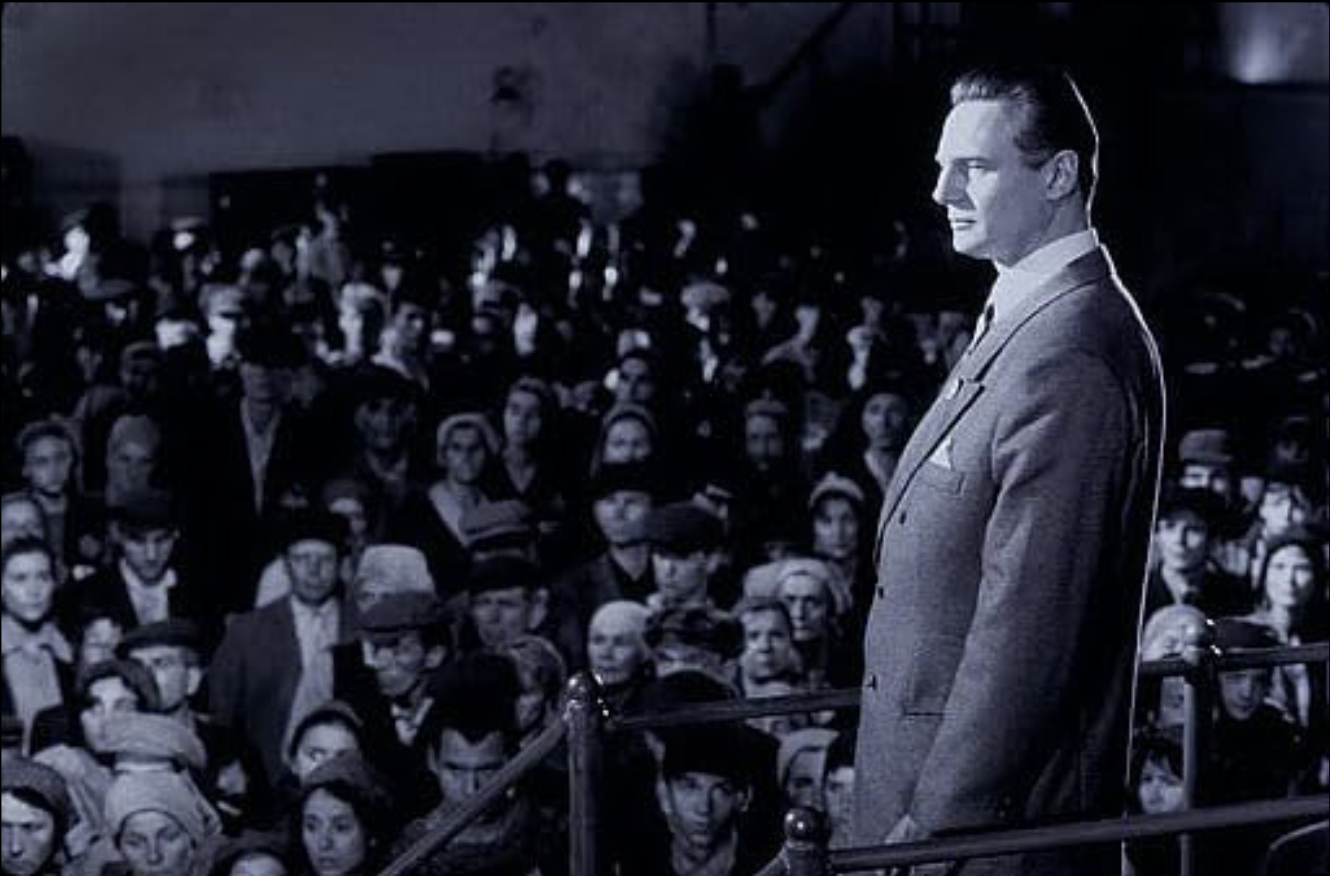
In 1993, Steven Spielberg turned an untrustworthy and feckless chancer (who did a lot of good) into a tragic hero in opposition to a bottomlessly corrupt and evil opposite: the commandant of KL Plaszow, Amon Goeth, played by Ralph Fiennes. It prompted widespread calls for Holocaust education and coincided with the opening of the United States Holocaust Memorial Museum. But many people have pointed out the film’s flaws. Fundamentally, it is still a Spielberg movie, with a clear moral arc (focused on a man who initially saw Jews as a resource to be exploited) and a redemptive ending. It popularised the Talmudic adage that “He who saves a life, it is as if he saved the world entire”, but the film is actually quite uncurious about what those lives meant. “The list is good; the list is life”, but how was it made? And who was not included? The arresting image of Schindler addressing the factory makes clear the relative status of rescuer and rescued.
Liam Neeson as Oskar Schindler announces the forthcoming liberation in Spielberg’s 1993 film (IMDB)
The 1990s also saw instrumental use of the Holocaust as a rhetorical weapon for unlikely causes. Perhaps most egregiously, the claim by the NRA that the Jews should have had guns to defend themselves. This not only reduced the tragedy of European Jewry to the Gunfight at the OK Corral, it also implied that gun owners were a persecuted minority on a par with the victims of genocide. The consequences of such disingenous faux-victimhood is visible in every news item from the contemporary United States.
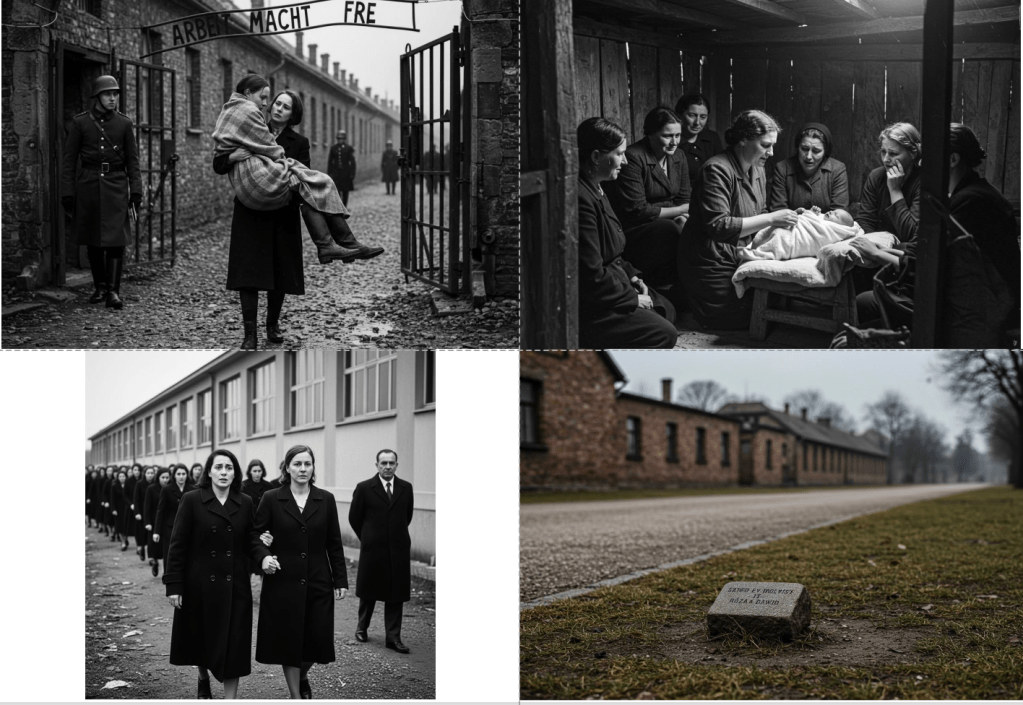
But at least these claims were rooted in an agreement about what was real. In the last few days, my social media has been subjected to a slew of AI-generated “images of the Holocaust” by the “90s History” feed: not my choice, but a result of the algorithms’ ability to present the virtual world without discussion.
These images are disturbing. Based on stories which even I (with thirty years of reading on the subject) can’t easily identify as fact or fiction. The accompanying images take elements of the Holocaust and build a parallel universe of images which could not have been.
Another 90s blockbuster, The Matrix, is useful to consider here. Amid the hysterical, cartoonish violence, a serious point is raised. In a simulation, how can we know what, if anything, is real? The movie says the trick is to know “that there is no spoon”: thus, Neo (Keanu Reeves) can make the world behave as he sees fit.
The philosophical depth of The Matrix is a matter for debate. But at one point a glimpse is given of Jean Baudrillard’s Simulacra and Simulation (1981; English 1983). Baudrillard argued that simulacra – copies for which there are no originals – were a burgeoning feature of the postmodern condition. Art Spiegelman’s MAUS, which reproduces his father’s Auschwitz testimony in graphic novel form, with Jews ”played” by mice, poses something of this challenge. But so too does Schindler’s List, in that it is arguably more faithful to Thomas Keneally’s novelisation of the story than to the facts themselves. But in each case, we can find solid ground under our feet. Plaszow existed, so did Goeth. Władek Spiegelman existed, as did Art’s brother Rysio, murdered by the person hiding him. It is essential to remember that these were real.
But the woman holding a child as she walks through a simulated “Arbeit Macht Frei” gate? The woman delivering a baby in what appears to be a wooden barracks allegedly in the Lodz Ghetto? The women proceeding through “Auschwitz” in identical woollen overcoats rather than the rags such prisoners were given? The nonexistent memorial tablet in a part of the Auschwitz camp that does not exist?
It might be argued that these are uses of technology to fill in gaps. But the historical record is evidence and gaps, in the same way that music is sound and silence. Both are needed: one for aesthetic purposes and the other for epistemological and ontological reasons. A Holocaust in which everything was saved, all is known, is much less of a Holocaust. It is the implied gap in the vast Book of Names held at Auschwitz – for which two million names will never be known – that provides the impact.
FAKES
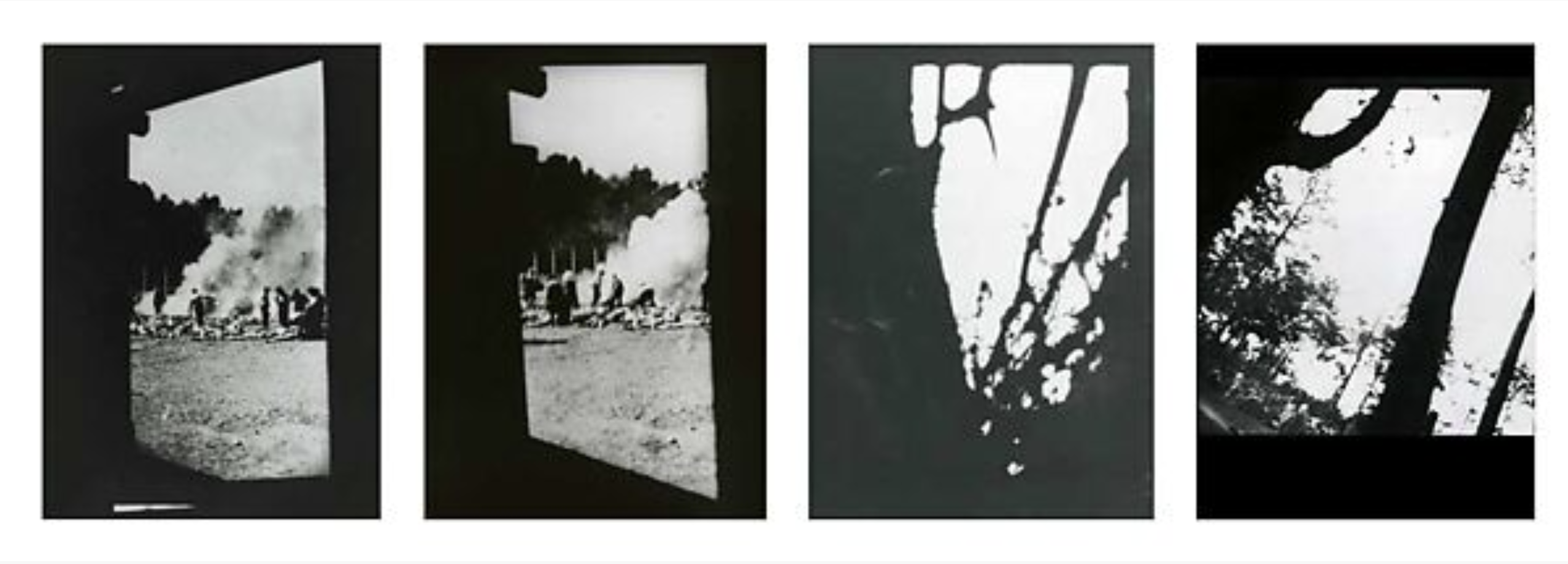
The smooth glossy surfaces of AI are infinitely easier than the real thing. The gritty, hastily taken “images in spite of all” (Didi Hubermann) taken by the Sonderkommando in summer 1944, as prototype gas chambers and burning pits had to be used to cope with the endless stream of deportations, are blurry, badly framed, at odd angles. But this is testimony to the reality of the situation: taken with a camera stolen from luggage brought by the victims, fearful of discovery. The author John D’Agata and fact-checker Jim Fingal begin their fascinating The Lifespan of a Fact with two epigrams from Lao Tze: “True words are not beautiful” and “Beautiful words are not true.” The flaw in the lens, the smudge in the record, the gap in the tape: this is the texture of evidence.
Above: the photographs taken by the Sonderkommando at Auschwitz II-Birkenau, Summer 1944 (Metropolitan Museum of Art digital copy)
It is possible that critics of this view might call me a Luddite. I wrote in 2017 of the risks I believed were posed by the efforts to create interactive holograms of survivors. I feared what they might be able to say in the future, uncanny purveyors of algorithmic “wisdom“. In the age of deepfakes I’m only surprised (and dismayed) that the world has changed so fast. But this confusion will only favour those who continue to deny, distort and denigrate the memory of the Holocaust: against such duplicitous and mendacious fakery, the best historian will flounder. We do not need to make their jobs easier in the quest for clicks: to do so is to cheapen the event we sigh wistfully over before scrolling onward.
And what to do? The director of Shoah, Claude Lanzmann, once said that if he encountered film of the gas chambers he would be compelled to destroy it. While I am unsure whether I could watch such a film, my instinct as a historian is that preservation is generally preferable. As a record of the insanities of the 2020s, these images may be valuable in the future. But these images are also, in my opinion, the historical equivalent of littering. So for now, I suggest two established technologies are most useful: the delete key, and the off switch.
Note: I’m now registered with Buy Me a Coffee: if you found this post useful or interesting, please consider sending me a small amount to help me do more. Thank you! https://coff.ee/jaimeashworth

A plane flies over Tate Modern, Bankside, London. Photo: Jaime Ashworth, June 2020.
The twentieth anniversary of 9/11 is a significant milestone, in the paradoxical way that the ordinary turning of the calendar somehow is both mundane and mysterious. Many of us will be asking “Where were you when…?” this week and next week, in an effort to locate ourselves and each other in relation to the event itself and the “normal” world that we left behind without knowing it on the night of 10 September, 2001. It is an attempt to find the rhythm of life without the assumption that such things could happen.
Telling the stories of ruptures is problematic. As Alan Mintz has written, “a destructive event becomes a catastrophe when it convulses or vitiates shared assumption”, so we can no longer trust either the tale or the teller. The tale is not yet formed, and the teller does not yet know what to say. We lose what Barthes called our mythology – the language in which we speak – just as another is being tragically born. I remember hearing the sentence “A plane has hit the World Trade Centre” that afternoon (I was living in Krakow at the time) and thought: how terrible, what an awful accident. In the days before smartphones, it was not until I returned home to find the footage on television that I understood. Like many others, I had thought it was an accident: the tram home in the coolness of a Polish autumn had been quiet: the world seemed on its rails.
As the reality sank in, however, the trauma started to complicate things further. We often say “I was traumatised” or even “I am traumatised” but neither construction does it justice – it is truer to say “I am being traumatised” but there is never time to form that thought. The moment of impact is, by definition, not described, even when it is replayed endlessly, over and over again, making the viewer beg for the pause button or, better yet, rewind. “It’s like something from a movie” was something I heard a lot in the following days and weeks.
The interrupted quality of the most valuable kinds of witnessing means that even in investigating, there is trauma, as we know the witness may have said more, thought more: but we cannot know. Instead the screen crashes to black, the tape clicks off, the diary ends. First-person witnessing always promises an ending which, if not happy, at least holds some promise of continuity. We know, picking up a published memoir, that the witness survives. This is what makes films like The Pianist watchable – we know, though the artefact’s very existence, that the story did not end on the last page – it is equally why the most shocking part of the diary of Anne Frank is the insertion of the editors: “ANNE’S DIARY ENDS HERE”. The tragedy is that she could not finish her story, a symbol for many others whose stories had barely started.
Alongside this, the witnesses have to begin incorporating the previously impossible into their awareness, redrawing the frontiers of possibility and probability. Primo Levi, in a quote I often refer to, described how the liberators of Auschwitz struggled to recognise what had happened as something that could happen, that belonged in “the world of things that exist”. In trauma, we are confronted with things that just moments earlier were unthinkable, precisely when our minds lose the ability to do more than record because the routines and operating assumptions of our world are upside-down. We see people throwing themselves from a burning building and numbly watch, trying to make sense of what will not make sense. Things of which, to be honest, there is no sense to make. It is happening, live and on-camera, and we have no choice but to sit on the sofa, strapped into history as it carries us who knows where. And yet our understanding may far outstrip those on the scene.
A couple of weeks ago, we watched the fall of Kabul, completing an arc which began its upward drive on that day twenty years ago. And the experience of that day allowed us to see terrible things more clearly: Afghans falling from their desperate handholds on a departing cargo plane, their twisting and flailing bodies a contrast to the almost balletic grace of the jumpers from the towers.
The photo of “The Falling Man” captures the duality of all traumatic testimony: that it describes both what happened, and what it is like to have experienced it. For the only experience that we can access, come even close to, is that of the onlookers whose only decision is what to allow into the lens of history, helpless as the thought hundreds of metres above turns into action that can only be witnessed, never truly understood.
As the event unfolds, the shift in metalanguages accelerates. Comparisons and analogies are sought, however hackneyed, however inadequate, to convey something of the unthinkable in terms that have already been thought, relating it back to their own lives and preoccupations. A few weeks later, my MA adviser commented on a draft of my dissertation, saying “You know, this is the end for a certain conception of Auschwitz.”
But for most, the early period is a time of confusion. As Muska Dastageer, a university lecturer in Kabul, tweeted on 19 August: “You feel like a speck of dust in some uncontrollable convulsion of history. It is not true, of course. There was a causal chain, decisions, failures. But that is how you feel. And from this shaking ground, it is hard to speak.” One strategy is to take pieces from the wreckage, hoping the specks of dust resolve themselves into a whole that can be understood. But that wholeness comes from without the storm, as we see what the others saw.
Slowly, however, dust does settle, creating the first symbols out of what comes to hand, as people try to position themselves and sift their memories as rescue workers sift ashes. Art Spiegelman, author of the graphic novel MAUS, found himself both the child of survivors (of the Holocaust) and the parent of a survivor (his daughter’s school, within Ground Zero, became a triage centre). Commissioned to design a cover for the New Yorker magazine, he later described himself as “reeling on that faultline where World History and Personal History collide” – realising that the “indescribable” smell of burning flesh his father had described in Auschwitz was now a sense memory for him too. Otherwise, the image of “the looming north tower’s glowing bones just before it vaporised” was the essential image as he tried to “sort out the fragments of what I’d experienced from the media images that threatened to engulf what I actually saw.” His eventual design was black, the silhouettes of the towers picked out in a deeper ebony, “in the shadow of no towers.” The legacy of trauma is ongoing, and sometimes all the more indelible for being invisible.
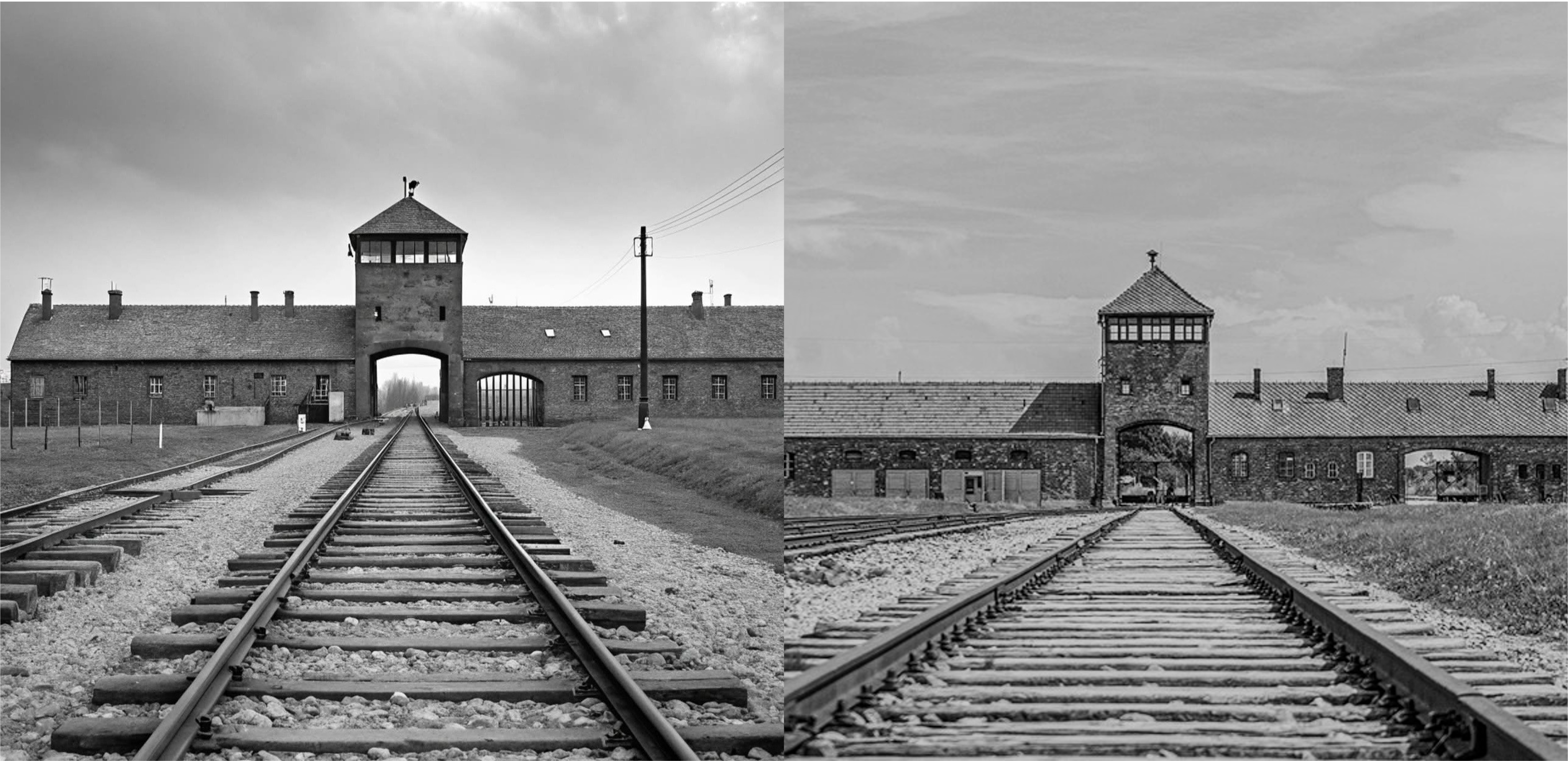
Symbols are created with dizzying speed, to try and provide an ending, or at least a way station to recovery, triage for the mind. I remember the way the twisted metal silhouette whose disintegration so transfixed Spiegelman was suddenly everywhere: on television, in newspapers, on the covers of magazines. A shorthand of ruin, a stage-set for a president to proclaim the invincibility of the American spirit as it smouldered, it was woven into the fabric of everyday life, as hard to remove as the stench of smoke from clothes. The way the essence of the image was distilled from photograph to graphic reminded me of the way the terror and complexity of Auschwitz is reduced to the symbol of the Birkenau gate and rail tracks: simplifying and smoothing the roughness of the real into the manageable symbol.
But symbols allow healing, of a kind. The Polish poet Andrzej Bursa of how “Inside Auschwitz’s barren rib-cage/ Through which the setting sun flowed/ Like blood/We journalists wandered around looking/ into the black holes of crematoria”. The ruins can be viewed, studied, understood – even if this can be “Blasphemously objective”, it presupposes that there was life afterward, even if only of a kind. The “ribs” of the towers are now museum pieces.
The challenge of the next catastrophes will be that they will not come roaring out of a cloudless sky, raining death with vicious suddenness. It will not be, as Jonathan Safran Foer wrote, Extremely Loud and Incredibly Close, but something which we will have to make an effort to hear. News will come slowly, confusingly, in scattered reports of disease, in sudden silences from remote settlements, in the repetition of “once-in-a-generation” events. It is announcing itself now, in a microscopic virus that brings nations to their knees, in sea levels that only reach their deadly new point of advance for a few moments of a turning tide, in air that is imperceptibly less easy to breathe, even in the increasing intensity with which fools insist it is not happening, that all is well, that the sky is not falling.
But if we do not do something, the question the children will ask will not be “Where were you when…? but “Why did you not…?” And we will have no answer, because the task of making sense of now was often hard enough, and the future is unknown. But in moments of silence, as we measure the distance from the certain tragedies of the past, we can perhaps stop and ask what has changed, what is changing, what could change before the next anniversary arrives, unbidden, unexpected and yet completely anticipated. Listen carefully for the storm beginning: all we can do is wait for loud noises, hollowly consoled that if we can hear them, we have escaped the first stage, at least for now.
For Julian Bessa, an accidental survivor, and Dr Syed Tabatabai, who works to save the world from both Covid and itself, and narrates its complications in stunning prose poems. Eyewitness accounts of 9/11 are taken from The Only Plane in The Sky: An Oral History of 9/11 by Garrett M. Graff. The lines from ‘Auschwitz – Excursion’ by Andrzej Bursa come from Killing Auntie & other work, translated by Wiesiek Powaga.
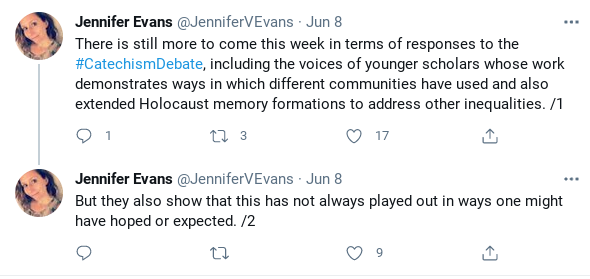
The debate over Dirk Moses’s German Catechism has led to a vigorous and interesting debate online in the last few weeks. The New Fascism Syllabus website has hosted a range of perspectives and responses, and scholars such as Neil Gregor have posted responses on their own blog sites. Doubtless someone, somewhere, is securing a book contract for the edited volume. And of course Twitter has lent itself to pithy and witty interventions, whether or not anyone was listening.
In which spirit, this is, as billed, the intervention in the German Catechism debate for which nobody has been waiting – but that in itself perhaps undermines the argument that the “gatekeepers” which Moses talks about are as effective as he suggests. The problem with which all of the world grapples, after all, is that the right to free speech creates neither a duty to publish nor an obligation to listen. Though as Jennifer Evans and Tiffany Florvil have pointed out, the debate has been conducted largely between and among white men of a certain age and socioeconomic status, ignoring the work of women and people of colour (and often both) in establishing, maintaining and hosting the debates themselves, while also employing arguments that have been currency outside that bubble for some time. The work of Anna Hajkova and Zoe Waxman, for example, in addressing challenging areas of research to do with sexual identities and sexual violence in the Holocaust, illustrates the difficulty of overcoming (in Waxman’s words) “opposition to feminist scholarship and thus to the very study of gender and the Holocaust itself rather than on any meaningful dialogue with the content of the research.” One might perhaps suggest that the debate at least began as a scrap among the gatekeepers themselves rather than those trying to get in.
(Disclaimer: I am hardly a break from the norm in several of the personal respects listed above, though as an independent scholar I do not have the status of many interlocutors. I will however, rigorously and professionally conduct meaningful Holocaust Education for your synagogue, community centre, youth movement, wedding or bar mitzvah.)
My own position is fairly straightforward. Moses is right to call out and protest unreflexive and inauthentic commemoration and research which does not take seriously the continuities and intersectionalities in the Holocaust. The fact that the Holocaust constituted the implementation of colonial warfare and ethnic cleansing against Europeans is an important and vital part of understanding the events. David Olusoga and Casper Erichsen (in The Kaiser’s Holocaust) used the figure of Heinrich Goering (father of the more famous Hermann) to illustrate this, noting that “While the father, whose prospective victims were black Africans, fits our view of a colonialist, the son does not. Yet the Nazis’ war in the East was one of imperial expansion, settler colonialism and racial genocide.”
Hitler himself in Mein Kampf set his purpose as “[drawing] a line under the foreign policy of pre-war Germany” and “putting a stop to the colonial and trade policy of the pre-war period and passing over to the territorial policy of the future” – by which he meant “the East”. What has been missing is the voices and likeness of the victims from which Hitler turned away. David Olusoga further illustrated – through the figure of Paul von Lettow-Vorbeck – in The World’s War (2014) how the First World War in Africa “far from being a meaningless side show in Europe’s war […] became the last phase of the Scramble for Africa.”
Nonetheless, Michael Berkowitz, in his introductions to the recently republished pamphlets by Alfred Wiener, The Fatherland and the Jews, passes over reference to “the Educational Service of the Lettow-Vorbeck Brigade”, noting that they “expressly advocated pogroms and public hangings of Jews” to buttress his claim that Wiener was “completely reasonable in leaving Hitler out of the picture”. Lettow-Vorbeck was (as Olusoga puts it) a “colonial specialist” having participated in the suppression of the ‘Boxer’ rebellion in China and the genocide of the Nama in South West Africa. The existence of a brigade named after him tells us much about the role of colonial mentalities in 1920s ex-soldier communities, yet here it is barely a footnote. The parallel debate about whether the recent “apology” for genocide in Namibia is sufficient or even genuine has perhaps been rather drowned out by the disputes about attitudes to memorialising the Holocaust.
At the same time, the fact that this debate is even taking place represents progress. A characteristically trenchant and engaging intervention from Neil Gregor is also right to remind readers that progress has been made, a point reinforced by Bill Niven. Historical understanding, by its nature, has to proceed at its own pace. There was, after all, a time in which Raul Hilberg was marginalised for pursuing research into the “machinery of destruction” which was set up to annihilate European Jewry. That European scholars have preferred to research topics in which they could retain some clear moral standing is understandable, though the work of scholars to recover and link this to the repression of colonial peoples and patriarchal attitudes to the history of gender and sexual identity should of course be encouraged. There is in some quarters possibly a desire to keep the debate on territory which the interlocutors are comfortable – though both Gregor and Niven have clear track records in both conducting and encouraging research “against the grain”.
The core problem here is the acceptance that time moves in one direction and that historical understanding is highly contingent. The literary scholar Lawrence Langer has recently published a collection of articles under the title The Afterdeath of the Holocaust. As well as commenting on core texts in Holocaust Studies, the articles also explore Langer’s own engagement with the subject of the Holocaust since the 1950s. He returns frequently – one might say almost obsessively – to his desire to avoid “redemptive” memory of the Holocaust. He insists that the Holocaust must be “a landscape of the imagination we never inhabited where solace perished along with the victims whose remnants lie scattered beneath its surface” and reiterates his opposition to “misguided” attempts “to find ways of coping with such desolation by striving to wrest some minimal meaning from the atrocity of mass murder.”
I am set to review Langer in more detail elsewhere, and I will use that space to detail the contradictions he entangles himself in there. But what comes through his writing is twofold: firstly, a profound sense of the lasting shock he experienced in his first encounters with the Holocaust; and secondly his clear frustration that the Holocaust has become normalised, in some important regards through his own work. The influence of his work on Holocaust testimony has been profound, as described by Noah Shenker in Reframing Holocaust Testimony (2015). Shenker notes that the Fortunoff Archive (informed in large part by Langer) has an “aversion to redemptive closure in testimonies” which means it can “miss those moments when a witness actually expresses some semblance of redemption.” It feels a lot like Langer is opposed to any kind of recovery or coping. Which is a heavy burden to live with, if true, for both survivors and subsequent generations.
Art Spiegelman, MAUS.
In Art Spiegelman’s MAUS, “Artie” asks his survivor therapist to explain how Auschwitz was. “BOO!” he replies “It felt a little like that. But ALWAYS.” For the individual encountering the Holocaust for the first time, it is still a lot like that, but it is also part of a “Holocaust metanarrative”. As Donald Bloxham and Tony Kushner put it, “the bundle of ideas and preconceptions handed down under the label ‘Holocaust’ that shapes the contours and parameters of our understanding of the subject.” There is no going back – and as Robert Jan van Pelt realised when starting his expert report in defence of Deborah Lipstadt against David Irving, that is a good thing. Deniers have to work against the Holocaust as historical and social fact: nobody really comes to it with an open mind in the sense of doubting it happened. As can be seen from the COVID conspiracy theory sticker which illustrates this post, the premise of the Holocaust has been very widely accepted. But this must not be allowed to solidify completely into slogans and parrot-like repetitions of formulaic ideas. As Moses reminds us, there is a duty on us to ensure that the contours and parameters of the subject mentioned by Bloxham and Kushner are debated, expanded and made more complex by the arrival of new and challenging research, and in a complex and diverse social milieu.
Ultimately, however, the tendency will always be to simplicity. Jay Winter and Antoine Prost have described how in the aftermath of World War 1, there was a conviction that the experience of combat could not be communicated, and could only be understood by those who were there. Yet a century later, the memory of the conflict is conducted largely through symbols which are easily recognised and understood: the poppy, some key photographs, pieces of poetry and other writing. If we tried to remember every crime committed by Europe in the modern age, we would have no space for any other activity, so we create ways of accessing the appropriate feeling when it is appropriate. Following Barthes, events become languages in which we speak of other things as well as themselves. Yet, as the work of David Olusoga, Santanu Das and many others illustrates, these moments of accessing the symbols of memory can also be occasions on which fresh thinking and energy can invest them with new meaning. In 2014-15 I was teaching an A-level class about India in the First World War and was able to use Olusoga and Das to talk about the conflict in a way which empowered students as agents of memory and change. The challenge of doing so for the Holocaust is the next stage: arguments such as these will recur, cynics may wonder (as Ian Kershaw noted of the 1980s Historikerstreit) whether they generate more heat than light. But as long as we strive to include as many voices as we can, and incorporate as many conflicting and challenging histories as possible, they will not abate – thank goodness.
Albert Camus wrote The Plague in 1947, as an allegory of French society under German occupation. Reading from 2020, however, it also describes with some accuracy the social impact of an actual epidemic. The sense of time suspended, of activity deferred, of relationships interrupted: “As it was a case of marking time, many hundreds of thousands of people were still kicking their heels for endless weeks […] nothing more important happened than this great marking of time.”
And into this space come comparisons, analogies and theories, to fill the empty time and make sense of the chaos and disruption, invented by the mendacious to manipulate the confused. Camus lists the different types and it is impossible not to recognise the stories in the newspapers that blow down our streets, their relevance superseded by new developments.
Some predictions were based on bizarre calculations involving the number of the year, the number of deaths and the number of months already spent under the plague. Others established comparisons with the great plagues of history, bringing out the similarities (which these prophecies called ‘constants’) and, by means of no less peculiar calculations, claimed to extract information relative to the present outbreak. But the ones that the public liked best were undoubtedly those which, in apocalyptic language, announced a series of events, any one of which might be the one that the town was currently enduring, their complexity allowing for any interpretation. Nostradamus and Saint Odile were thus consulted daily and never in vain. What remained common to all the prophecies was that, in the last resort, they were reassuring. The plague, however, was not.
I wrote a while ago about the parallel infodemic coursing through society, as we all struggle to make sense of the senseless, to order the chaotic. Graphs, charts, dashboards, bulletins, maps, timelines: every manner of device intended to help synthesise and distill the rush of events into orderly narrative and discrete data sets. And as Camus said, these are reassuring: not because of their content but because of their form. A viral contagion can be truly controlled only on the page or the screen: every graphic contributes to our sense that because the situation can be described, it can be (or is being) managed. Every rumour, false hope or faked accusation contributes to a sense that the sky is falling.
For this reason, it is unsurprising that conspiracy theories have been part of the year. In March and April, telephone engineers were assaulted and mobile masts set on fire by people who believed the virus was connected to the 5G network upgrade. Paradoxically, they also think that the electronic media is a good place to promote this: I suspect these people are (because things are their opposite) the most fevered users of electronic devices. They seem to patrol the virtual world as they might have once walked the streets, howling about Armageddon and inveighing against the shadows.
I have seen the low-tech versions too, though. Walking through a locked-down Kentish Town, I saw a flyer pushed through the letterbox of a charity shop, its quality print daring the reader to dismiss it for the ravings it contained. I have seen other slogans and warnings, scrawled on signs and bus shelters, painted on doors. They are the inevitable detritus spawned by confusion and despair. And just as surely as the maps of where the virus has taken the greatest toll, they are indicators of deprivation: warnings and fears given venom by resentment. They are the signs (as in Camus) of “those who are looking for reasons and who are afraid.”
In such a context, it was inevitable that antisemitic conspiracy theories should have a resurgence. The Community Security Trust has published a report on the antisemitic tropes and canards revivified by the pandemic. From positing a Jewish conspiracy behind the virus, to using the virus to celebrating Jewish deaths, to using the virus to kill Jews, all the classic elements of the oldest hatred are present. Whether from the right (QAnon) or the left (AntiVaxx) the elements are tiresomely predictable, and make it hard to tell one from the other. As Robert Eaglestone has observed about varieties of Holocaust denial: “these distinctions are rarely fixed, as they demand too much consistency from the world of bigotry and false argument that these people inhabit.”
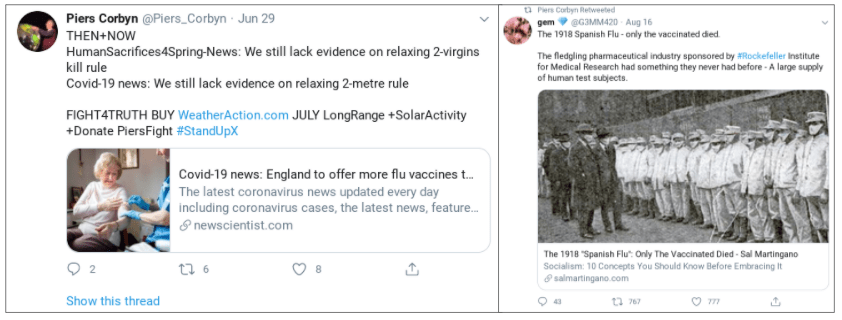
A survey of the Twitter feed of Piers Corbyn, a notable member of the conspiratorial elite, shows the usual distinctions of politics breaking down. Combining the family pastimes of preaching to the choir and never changing his mind, he at once quotes Toby Young and his band of right-wing “Lockdown Sceptics”, argues that Black Lives Matter is a conspiracy funded by big business, claims that man-made climate change is a myth, and that vaccines are designed to control us; and that George Soros, “Rockefeller” or Bill Gates is behind it all.
The left-wing “commentator” Kerry-Anne Mendoza yesterday peddled a more belt-and-braces version of the way the Holocaust can be folded into these discourses of hatred. Not as a conspiracy theory, but just as a lazy juxtaposition. As though the death camps were a punchline rather than an atrocity.
Similarly, the mural Freedom for Humanity by the artist Mear One has been doing the rounds in meme form. This is an image even Piers Corbyn’s brother Jeremy belatedly acknowledged as “deeply disturbing and anti-Semitic” – some years after invoking “Rockerfeller’s” [sic] attack on Diego de Rivera in its defence. Like Mein Kampf, (a major source text for Jewish conspiracy theories) these ideas always find Jews responsible for the evils of the day, placing grimly-eroticised spectres and fantasies of “Jewish influence” where the facts should go.
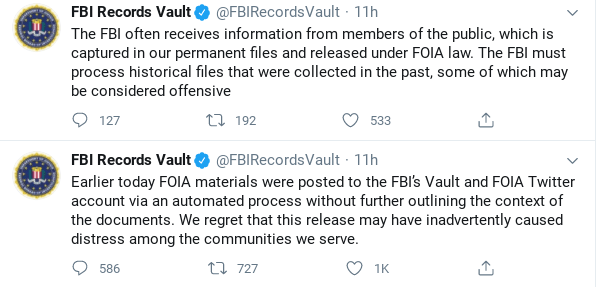
Into this volatile mixture of paranoia, half-truth and pure fantasy, the FBI yesterday decided to publish its records on The Protocols of the Elders of Zion, the antisemitic conspiracy ur-text, without commentary or qualification. When I last checked, the material had been retweeted 16,700 times. By comparison, its belated clarifications (below) had barely been noticed. A lie is, as ever, twice round the world before the truth gets its boots on.
The resurgence of conspiracy theories and panic in a period of intense anxiety and confusion is not a surprise. If you want a funny and informative introduction to why this is the case, follow Marlon Solomon (@supergutman) whose monologue “A Lizard’s Tale” is a chilling and hilarious primer in the back-and forth between claim and counter-claim. Dave Rich (@daverich1) noted in an article published earlier this year that “if it is true that Jews play a central role in conspiracy theories, it is also true that the concept of a conspiracy plays a central role in the history of antisemitism”. Conspiracies and antisemitism are linked by methodology, purpose and personnel.
But nor, it should be underlined, do these theories and fantasies restrict themselves to antisemitism. As documented by the charity TellMama, COVID-19 has prompted attacks and libels on Muslim communities. Stonewall documents the impact of the pandemic on LGBT individuals and communities. As so often, the events of this year show that hatred knows few distinctions and appeals to no logic other than the belief that since the individual is powerless in the face of events, those events must be controlled by the powerful. And since there is nothing more powerful than that which provokes fear, the two must be identical. “It is very tiring to be a plague victim,” wrote Camus, “but it is still more tiring not to want to be one.” And given time to brood, the most illogical solutions acquire the clarity of mathematical proofs. But for the conspiracist, as for their cousin, the perfect Orwellian product of totalitarianism, if the right person says it, 2+2=5.
So what can we do against this tide of reckless hate and thoughtless invective? As Camus recognised, the purpose of these ravings is to provide reassurance against the unpredictable and invisible workings of fate. And like his hero (and unreliable narrator) Rieux, we have to recognise that the answers are not glamorous: “this whole thing is not about heroism. It’s about decency. It may seem a ridiculous idea, but the only way to fight the plague is with decency.” We carry on, we do our best, we remember that common humanity and common confusion are often the same thing, and we do our jobs, however small, to make the world better.
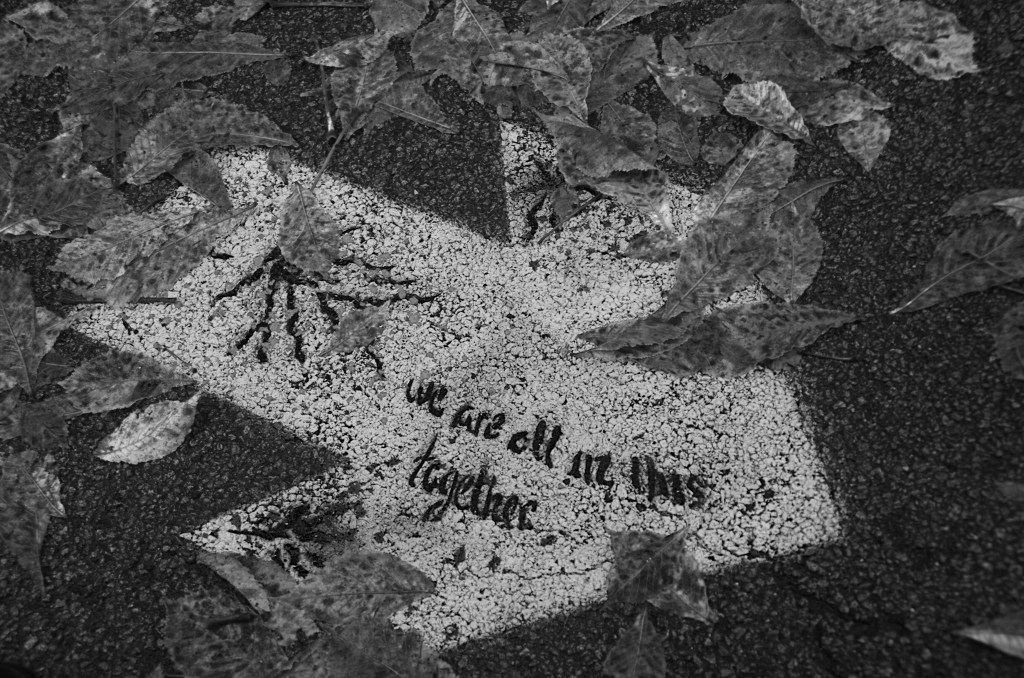
Autumn leaves on a social distancing sign in Alexandra Palace, London. Photo: Jaime Ashworth, August 2020. More of my photography can now be seen at http://www.framingthemoment.gallery
The chaotic and careless handling of this summer’s exam results has illustrated (along with so much else), the rank inequality of our society and the almost comatose carelessness of our government. If you want expert and incisive analysis on this particular tragedy of errors, then you should follow either (but ideally both) @debrakidd or @teacherhead on Twitter and read their recent posts (they also have WordPress sites – see links below). The piece by Tom Sherrington in particular is a rare sighting on the internet: measured and thoughtful reconsideration of a view in light of developments. Debra Kidd offers a passionate analysis of why the disaster really wasn’t much different from business as usual, and why therefore it needs to change.
I don’t have the standing to criticise either of them, nor would I wish to. Their insights and advice have been inspiring and helpful in my journey as an educator. On this occasion, though, their writing and thinking has prompted a few thoughts in response.
Firstly, the piece by Tom Sherrington. As he makes frequent reference to in the piece, he assumed that common sense would prevail, or at least be applied at some point. This is an alluring thought but, since “They can’t be that stupid, can they?” has been close to infallible as a predictor of this government’s actions, perhaps slightly misplaced.
Sherrington’s uncharacteristic lapse is understandable: my brother’s drum practice this week may have knocked him off his game. (I’m not joking: see my Twitter for the exchange.) Also, as a highly intelligent and informed expert, his expectation that basic common sense would be applied was, well, reasonable. It turns out, of course, that not only was common sense and expertise apparently not sought, it wasn’t applied when literally delivered to those who needed to act on it. See the devastating critique of the OFQUAL algorithm by Dr Huy Duong, submitted in evidence to Parliament earlier this year, here.
Two meta-thoughts. First, when the historians of the future come to write the history of 2020, there may be a debate about the degree to which ministers listened to expert advice from SAGE. I would suggest that the decision to ignore Dr Duong’s analysis may be instructive in understanding the governing culture. This government, despite being presented with progressively more complex problems, is still “tired of experts” and only allows them a voice if they are docile. The disappearance from view of openly dissenting scientists from the daily press briefings if they ventured opinions in line with medical training, published law and common sense, is a chilling insight into the degree to which the government cannot brook dissent. For professors of medicine and public health committed to the public good, outward conformity may be an acceptable (if high) price to pay for ensuring they retain some purchase on events, but it is not a choice they should be asked to make.
Secondly, I wonder if a meta-understanding of our current plight is also bound up with the notion of common sense. It is certainly bound up with the sense that panic is always an inappropriate reaction and that everything is manageable. But, if quickly mastered, panic is a very useful indication that events are either imminently or actually out of control. Someone who doesn’t panic a little in the face of a global pandemic or blighting a generation’s life-chances perhaps has yet to fully get their arms around the problem. As Basil Fawlty responds when told by Polly not to panic: “What else is there to do?!”
I’m not suggesting, by the way, that Fawlty Towers is a model for responsible government. Governments led by chancers, sociopaths and inadequates (though the vogue in global leadership) rarely make good decisions. The chronically dissociated always think in terms of brutality, and those struggling to win approval care more about appearance than outcome.
In Debra Kidd’s case, my objection is slightly more technical. She suggests that a return to modular exams and AS levels would have averted this crisis. This is true, but the price of a cohort with (some) concrete results this year would be a cohort next year with nothing: after all, their AS levels would have to have been cancelled and calculated by algorithm – along with next year’s results, which are unlikely to escape the effects of COVID. The government response has been to multiply problems rather than solve them, but another “peacetime” solution would have had different problems. The basic problem with exams as currently constituted is that they are in general simply a final chance for students to prove spreadsheets wrong. When that final chance was removed, disaster was always a strong possibility.
More broadly, the consequences of AS levels were not all positive. I would suggest that the stress of three consecutive years of important assessments contributed materially to the sharp rise in mental health problems among British young people in the first fifteen years of this century. I am also not sure that increased testing is an answer to a failure of grading. But her central point about the negligence and cruelty of the current system is inarguable.
We need – as in so many areas – a more interesting and comprehensive rethink than endlessly switching between linear and modular qualifications. I’d like to see, in my own subject of History, a more actively collaborative externally marked coursework process. But everyone has a wishlist.
Whatever the repercussions of #alevels2020, I hope that both Tom Sherrington and Debra Kidd are among the experts who lead that process of change. Hopefully with a very different government, committed to finding sensible, informed answers to the problems that COVID exposes with such grim regularity.
The era of COVID-19 has seen two processes of contagion. The first is, of course, the disease itself, with its terrible toll on individuals, communities and nations. The second, however, is what the WHO and others have termed an infodemic: defined very precisely a couple of weeks ago by a working group.
An infodemic is an overabundance of information—some accurate and some not—that occurs during an epidemic. In a similar manner to an epidemic, it spreads between humans via digital and physical information systems. It makes it hard for people to find trustworthy sources and reliable guidance when they need it. (Tangcharoensathien et al., 2020)
I’m working on a more detailed piece about the infodemic, to go alongside a collection of my photos from this year. In the meantime, however, I’ve been looking at the memes shared in my social media echo chambers. Sometimes they make me laugh but as a class of discourse they make me profoundly uneasy.
Memes are directly compared to viruses by the epidemiologist Adam Kucharski in his book, The Rules of Contagion (2020). He notes the problems posed by “simplistic anecdotes and ineffective solutions” for disease control and begins the book with an account of how he (accidentally) caused “a small outbreak of misinformation.”
The irony is that memes are simplistic anecdotes masquerading as panaceas. Like viruses, memes have no function but their own reproduction with no regard for the health of the host. Matters are further complicated by the fact that social media offer a perfect environment for them to thrive. Back in the day, “Frankie Says” was a meme, but it’s harder to edit a t-shirt than it is to share something online. One meme in particular recently caught my eye.
This meme is part of longer and bigger debates about education, race and identity. I do not claim any priority for this meme’s importance other than the fact I’ve spent my adult life teaching and learning about the Holocaust and for that reason find it deeply problematic, educationally and philosophically. My experience allows me to locate the sources of my ire because I have expertise: itself a suggestion that the reduction of history to lessons without content is not very practical. But I digress.
Firstly, the idea that the second and third parts of the statement can be accomplished without the first is problematic. Without the murder of six million Jews being remembered, the second statement makes no sense: what is the “it” that was required? And in the third statement, the “history repeating itself” is the murder of six million Jews that apparently the author thinks is optional to remember.
Second, and much more problematic, is the weasel formulation of the first statement. If the word “only” or “just” were added, the sentiment might make more sense (though as I’ve just explained I don’t think it really does). But as written it comes very close not to suggesting that education cannot be reduced to simply memorising (which of course is true and something that all good teachers work hard to ensure) but that education equals not remembering the murder of six million Jews.
This ambiguity is difficult because with a negative reading of an oddly formed sentence, the meme seems to be suggesting that instead of anchoring our understanding of the world to historical facts and debates, it should instead come from belief in an unstated mechanism that led “ordinary Germans” to be “convinced that it was required”. Setting aside the complex historical debate about degrees of knowledge, cooperation, acceptance and resistance this dismisses (the author of the meme can’t be bothered so why should I?), the implication is that children should be “educated” in some unstated monocausal view. Another word for this is indoctrination.
One of the key aspects of indoctrination is ignoring facts in the interests of clarity: such as, for example, downplaying the importance of the victim group of “what happened”. The sleight-of-hand with which this example severs meaning from content (thus rendering it meaningless) is the primary source of my anger.
Ironically, the indoctrinated have historically been very bad at spotting the writing on the wall because, well, they were indoctrinated to believe it wasn’t important. Such a process seems to have taken place very imperfectly in Nazi Germany, chiefly because the Third Reich only lasted twelve years. The debate about why and how this happened, which the author of this meme either doesn’t understand or doesn’t care about, is ongoing. But the desire to present children with “lessons” without evidence is certainly among the phenomena involved: along with ensuring that the benefits of oppression and murder were widely shared, and that perpetrators were placed in stressful, confusing situations with alcohol to dull the senses when reality could no longer be explained but simply avoided. But reiterating the nature of that reality is crucial, educationally, because without it, the question “Why is this important?” is hard to really answer.
Because, finally, let’s not forget that forgetting victims is only in the interests of the perpetrators. Himmler termed the murder of European Jewry “a glorious page in our history that can never be written”. Hitler asked “Who now remembers the Armenians?” This meme asks us to forget the Jews and replace them with an amorphous “victim” group that makes the “lessons” meaningless. The Nazis oppressed and murdered a whole range of groups and individuals, but to try and remove their primary victim group is an assault on memory and an abuse of education. Subject (the Nazis) verb (murdered) and object (six million Jews) are all required for any conclusions to have any relevance. This is true, by the way, in teaching anybody about anything. The nature of the offence is a fundamental part of teaching to understand the past and (hopefully) avoid its repetition.
This is just one meme in an ocean of memes. As in Hamlet’s soliloquy, it is tempting to think we can “take arms against a sea of troubles and, by opposing, end them.” But this is a metaphor for futility. We are adrift and lost: what we can do (all we can do, perhaps) is sound out the ideas beneath the surface of individual examples in the hope we will find solid ground underneath.
“It happened, therefore it can happen again. This is the core of what we have to say. It can happen, and it can happen anywhere.” – Primo Levi
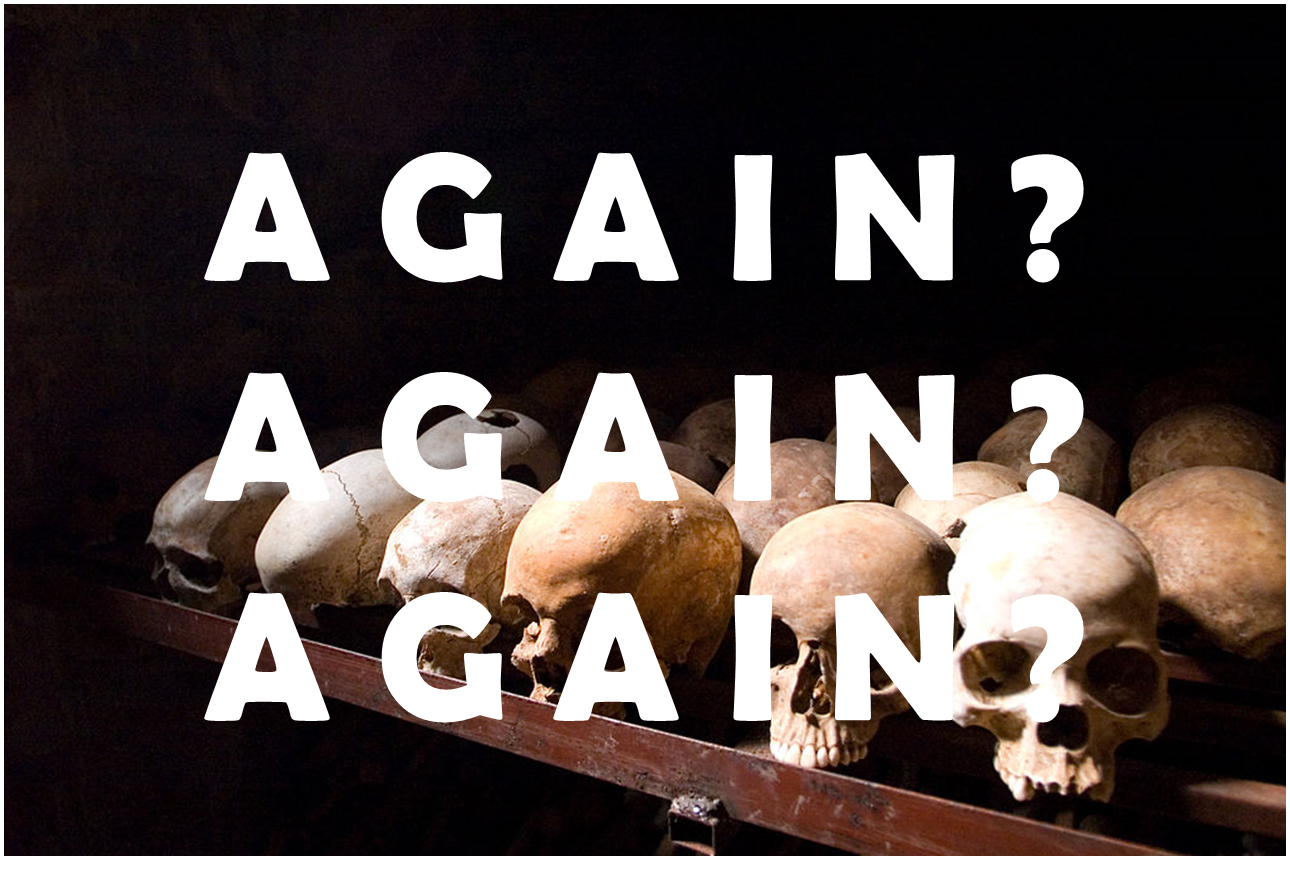
The events unfolding in Myanmar at present have all the worst ingredients of a tragedy after which we will solemnly intone “Never Again”. A complex history, a world distracted by other things, and, worst of all, geographical distance – which is a tactful way of saying that since neither the victims nor the perpetrators are European, the violence will probably be allowed to burn itself out, leaving only a gaping hole where the Rohingya should be.
Though its government disputes this, the Rohingya have lived in the area of western Myanmar called Arakan for centuries. The first mention of them in western sources was by the East India Company in 1799. Rohingya were central to the administration of Myanmar (or Burma, as it then was) until 1982, when the military dictatorship removed them from the list of “official” nationality groups. Since then their conditions have steadily deteriorated. As the organisation Global Citizen puts it, they are “unable to claim citizenship in a country that refuses to recognise them.” Forced Migration Review explains how forcing statelessness on people violates both the 1956 Convention relating to the Status of Stateless Persons and the 1961 Convention on the reduction of Statelessness. But we have known what statelessness means far longer than that. As Hannah Arendt wrote in The Origins of Totalitarianism, statelessness means that people are consigned either to the law of exception or complete lawlessness. “Since [the stateless person] was the anomaly for whom the general law did not provide, it was better for [him] to become an anomaly for which it did provide: that of the criminal.”
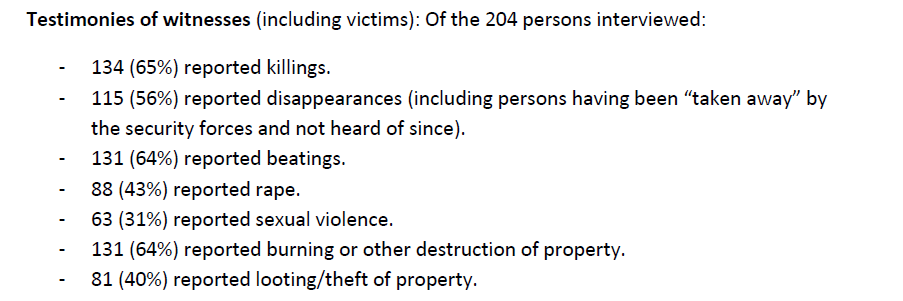
Human Rights Watch and Amnesty have both called for action amid growing concern since October, though some sources highlight that there has been violence since at least 2012. A United Nations report from February did not pull any punches. Based on interviews with more than 200 of the approximately 66,000 refugees to Bangladesh, the evidence they collected was clear.
“According to the testimonies gathered, the following types of violations were reported and experienced frequently in that area: Extrajudicial executions or other killings, including by random shooting; enforced disappearance and arbitrary detention; rape, including gang rape, and other forms of sexual violence; physical assault including beatings; torture, cruel, inhuman or degrading treatment or punishment; looting and occupation of property; destruction of property; and ethnic and religious discrimination and persecution.” (p. 40)
What this means on a human level is, as always, perhaps beyond description if not beyond words. Even the bald breakdown of the testimonies makes for hard reading:
Extracts from a few of the testimonies follow. Please be warned, they are not subtle, though these are some of the least graphic. Page references are to the OHCHR Report.
“The day the army attacked my village, my father and I had just come out of prayers, when we heard sounds of shooting. We had just walked to a farm, where we were sitting and talking to the owner of the farm. While the firing was still going on, my father stood up, which is when a grenade came and exploded close to us, killing my father, the farm owner’s son, and severely injuring me and the farm owner.” (p.14)
“I was in front of [my grandmother’s] house, playing with some other boys when the helicopter came. I was shot from the helicopter, other boys were too. Six or seven of us were hit by bullets from the helicopter.”
“When my two sisters, 8 and 10 years old, were running away from the house, having seen the military come, they were killed. They were not shot dead, but slaughtered with knives.”
The report is equally blunt about the possibility that the statistics derived from these testimonies are just the tip of the iceberg. They emphasise not just that they are only reporting what they have testimony to support, but also that the sexual nature of the crimes means many victims are too traumatised or ashamed to speak of what has happened to them.
In terms of perpetrators, the report is clear that they include members of the Myanmar armed forces, border guards and police, along with ‘irregular’ units of armed locals, sometimes wearing borrowed uniforms. As is depressingly standard in such cases, witnesses knew some of these to be civilians because they were their neighbours.
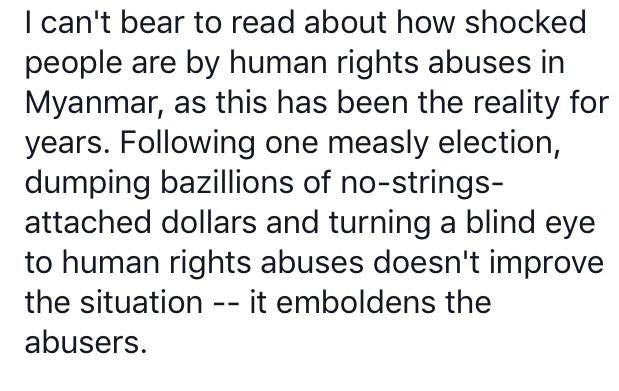
The response from Aung San Suu Kyi, the former dissident, Nobel laureate and human rights activist who now de facto leads the civilian administration, has been disappointing, to say the least. In a conversation with Turkish President Erdogan, she blamed “fake news” and in a press conference she claimed the government was still trying to decide “how to differentiate terrorists from innocents.” A place to start might be asking them their age.
The UN report stops short of terming the persecution genocide, though it makes clear that the events constitute “[what] has been described in other contexts as ethnic cleansing.” (p. 42)
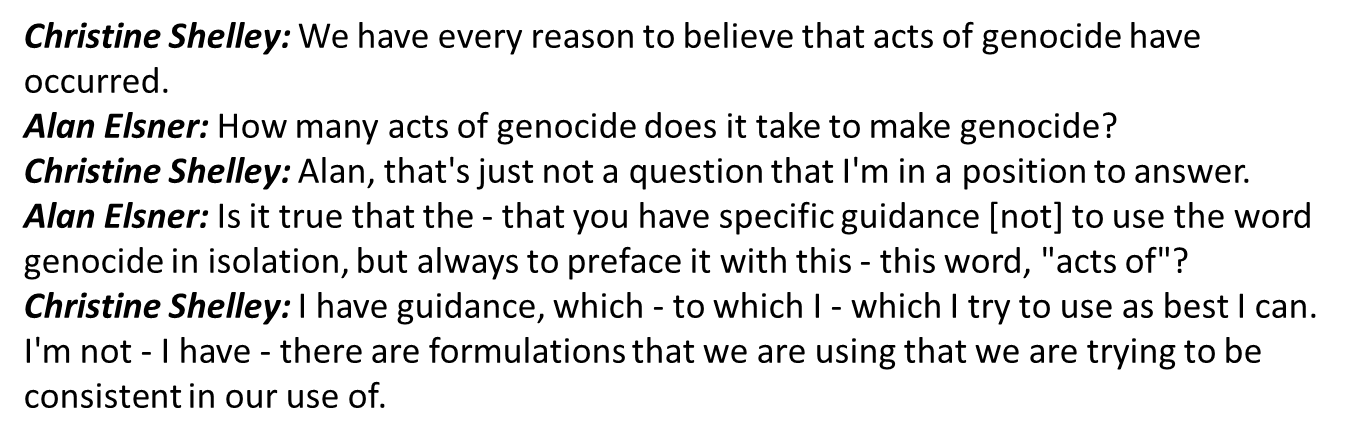
Definitions are both problematic and essential. For us to respond, we must name what is happening, thus fully bringing it into reality. By naming a crime, we identify it and can prosecute it. Genocide and ethnic cleansing, because they are definitions devised partly in order to suspend the normal rules of sovereignty, are likely to be applied too late: we only know for sure with the dreadful clarity of hindsight. Though one should always remember the macabre evasions of the Clinton White House during the Rwandan Genocide of 2004. A particular exchange between Press Secretary Christine Shelley and reporter Alan Elsner has acquired almost iconic status (some readers may recognise the dialogue from an episode of The West Wing). There is video of the exchange on YouTube.
In fact, a State Department document very clearly stated “Be careful … Genocide finding could commit U.S.G. to actually ‘do something.'” As we know now, the cost of the ‘formulations’ was between 500,000 and 1,000,000 deaths in just under three months: a rate of killing which outstripped that of the Nazi death camps. At that rate of slaughter, all of the 2,000,000 Rohingya could be dead in six months. In Rwanda, the bodies of men, women and children clogged rivers as the world debated definitions. As a survivor who spoke to the playwright J.T. Rogers for his play The Overwhelming prophesied, the cycle of violence has not stopped: “Now it is two hundred percent safe here. But until when, I don’t know. Rwanda is like a fire underground: the killings will come again.”
There are always (frequently craven) reasons not to intervene. There are always (weak) arguments for waiting. There is no defence, however, for saying nothing. The preoccupation of British politics with the EU withdrawal process is crowding out any other discussion. This must stop. Sign the petition. Demand action. When the petitions committee reconvenes this month to start a new session, I’m going to start a parliamentary petition (if an NGO doesn’t get there first) to demand that our elected representatives are at least forced to consider what they refuse to act upon. For now, there is a change.org petition gathering signatures and a letter from the All-Parliamentary Group for Democracy in Burma. We know more than enough, about both genocide in general and this crisis in particular, to expect more than the silence the Prime Minister has so far responded with.
I want to finish with some words from the Nobel Lecture by Aung San Suu Kyi in 2012. Remember her acceptance of the prize in 1991 was made by her son: her lecture was made possible by the pressure from governments and thousands of individuals to free her from house arrest:
“To be forgotten. The French say that to part is to die a little. To be forgotten too is to die a little. It is to lose some of the links that anchor us to the rest of humanity. When I met Burmese migrant workers and refugees during my recent visit to Thailand, many cried out: “Don’t forget us!” They meant: “don’t forget our plight, don’t forget to do what you can to help us, don’t forget we also belong to your world.” When the Nobel Committee awarded the Peace Prize to me they were recognizing that the oppressed and the isolated in Burma were also a part of the world, they were recognizing the oneness of humanity. So for me receiving the Nobel Peace Prize means personally extending my concerns for democracy and human rights beyond national borders. The Nobel Peace Prize opened up a door in my heart.”
A door in the heart should not wait for definitions to be confirmed before opening once again. Words will never be enough. But they may be a start.
Postscript: like many of us, I’m guilty at times of the delusion that things only happen when I’m looking. A friend of mine, a passionate advocate of and activist for peace, wrote this and I thought it should be attached to this piece: a reminder that terrible things are happening all the time and that the work of trying to stop them is constant.
The title story of The Pier Falls by Mark Haddon (Vintage, £8.99), 347 pp.) is a harrowing account of how an idyllic seaside afternoon in the 1970s turns to tragedy. In spare, compelling prose, Haddon describes the initial warnings as the rivets holding the pier together progressively fail. (“There is a faint tremor underfoot as if a suitcase or stepladder has been dropped somewhere nearby.”) He describes in merciless detail the fracturing of a summer afternoon into fragments, neatly chronicling each death and the aftermath as normality slowly settles over those left apparently unscathed. (“None of the survivors sleeps well. They wake from dreams in which the floor beneath them vanishes. They wake from dreams of being trapped inside a cat’s cradle of iron and wood as the tide rises.”)
Haddon’s prose captures the way in which trauma is observed from the inside: slowly, but too fast to fully register; completely, but only in hindsight. Another word for this is shock. As Naomi Klein has recently written, “A state of shock is what results when a gap opens up between events and our initial ability to explain them.”
Britain in 2017 feels similar to the disintegrating pier in Haddon’s story, shuddering as the rivets joining us to the EU are worked loose, the fissures in our society are thrown into ever-sharper relief, and international politics seem more and more threatening. It’s the shock that many of us experienced last year in the sweaty early hours of June 24, watching the numbers move like a tide, rolling upward until, as the dawn broke, the result was confirmed.
Many of us experienced that feeling of shock again in November as we watched Hillary Clinton’s chances of being President go from being assured, to doubtful, to impossible. A feeling which deepened in January as Trump’s inaugural speech made clear he intended to govern as he had campaigned: boorish, aggressive, chauvinistic.
Most importantly, it’s the feeling as we watched the flames sweep across Grenfell Tower. Knowing what the inexorable progress of the wall of fire meant – as human beings, unable to stop ourselves imagining ourselves in the place of those inside – but powerless to stop it.
It’s a feeling I’ve revisited many times this summer, as different journeys have taken me past the tower: blackened and silent, the sun still catching on glass that has not been shattered, a grim negative of the neighbouring towers. (“A moment’s weakness had caused this horror, the way a single spark from these struck flints bloomed into the fires that surrounded her.”)
The footage from Houston this week has brought that feeling again. Watching the waters rise and the roads disappear beneath the floods should remind us that we are always vulnerable to the environment we build through and over (instead of around and with). The levees and dams have creaked and overflowed, and the bonds of society have proved correspondingly frail. Looting and unrest have necessitated curfews, as stretched civil authorities focus on the crisis. President Trump’s response, (“The storm, it’s epic what happened. But you know what, it happened in Texas and Texas can handle anything.”) encapsulates the dogma of small government and its failure to appreciate the importance of collective action to avert rather than manage times of crisis. (“He’s never thought it this way, that lives are held in common, that we lose a little something of ourselves with every death.”) In situations like this, the heroism of individuals needs to be backed by the state rather than left to fend for itself. We cannot allow ourselves to be flattered for our self-sufficiency by those whose job is to prepare.
In India, Bangladesh and Nepal, far worse flooding seems to be producing a different reaction to similar problems. The Times of India shows crowds working with rescuers, bringing food and helping to clear rubble. At root, though, the complaints are similar too: “Why does nothing change? Why are we left to fend for ourselves when they had weather forecasts warning them of extremely heavy rainfall?” asked one Indian columnist quoted in the Guardian. The residents of Grenfell know the feeling, as did the inhabitants of New Orleans in 2005.
In Britain, meanwhile, we continue to make our own weather: working toward “freeing” ourselves from the EU. The Brexit negotiations have resumed and it’s clear that this government is determined to ignore the reality that 27:1 make for unhealthy odds. On Ireland, on the single market, on the customs union, on free movement; the position of Her Majesty’s Government is that cake policy must remain separate from eating policy.
A spokeswoman for the Prime Minister said this week that the government was determined to try and discuss the future trading relationship alongside the withdrawal deal, despite the insistence of the EU that this won’t happen. As any country that has negotiated EU accession could tell you, negotiating with the EU on these matters is not a negotiation as conventionally understood. In accession negotiations, the only question is when, not if, individual countries would accept EU law and regulation (this, by the way, is a powerful practical argument for remaining). In our case, we lit the blue touch paper by triggering Article 50 and now require all 27 member nations’ agreement to blow it out again, even temporarily. British inability to understand collective behaviour is quite profound (at least among politicians, who are usually happy to talk about what they claim people want but often less keen to engage with what they need).
Internationally, meanwhile, the Prime Minister arrived in Japan at an interesting moment, her plane presumably virtually banking to avoid a North Korean missile. Asked about the escalating (or at least not subsiding) crisis in South-East Asia, she termed the launch “outrageous” and suggested that the UN Security Council should resolve the problem. Collective solutions are good sometimes, it would seem, though the structure of the Security Council gives Donald Trump (along with Vladimir Putin and Xi Jingping) a veto on any solution, so it’s likely to be a question of state-to-state solutions in the end.
Haddon’s stories have at their core an awareness that traumatic events alter our histories, both individual and collective. (“Today will be different, not simply shocking but one of those moments when time itself seems to fork and fracture and you look back and realise that if things had happened only slightly differently you would be leading one of those other ghost lives speeding away into the dark.”) He skilfully evokes the sensation of escape and the chill of privilege it occasions. (“Everyone can feel the thrilling shiver of the Reaper passing close, dampened rapidly by the thought of those poor people.”)
The stories also underline, however, that those forks and fractures are constructed of choice. Some choices are positive: in the final story, The Weir, a lonely divorcé rescues a young woman from suicide by drowning, forming a friendship that sustains them both. Mostly, though, the choices of Haddon’s characters are negative. In Wodwo, Gavin, a venal middle-class TV presenter, shoots a stranger who interrupts a family Christmas. The stranger makes a macabre recovery, promising to return the following year: Gavin struggles to cope with his actions, becoming homeless before being found by the same stranger and sent back to his family home to interrupt the next Christmas. He approaches the same French window, seeing the changes wrought by the year in his family. And then they look up: he has become the stranger, even to himself. (“The intruder light clicks on. He knocks twice on the glass. As one his family turn to look at him.”) What could he have done differently? What can we do differently? Who’s making the choices? We need answers but first we have to ask the questions.