• Coursework and Dissertation Help
  • About the author…
    • #missinghistories
    • Independent Educator: Research-driven Education and Training
    • Writing and Research
    • Independent Researcher

framingthequestion

~ Reflections on memory, history, photography and culture

framingthequestion

Tag Archives: Infodemic

Cracked Mirror: Holocaust Unconsciousness

Featured

Posted by jaimeashworth in Culture and Politics, Photography and Visual Culture, The Holocaust: Representations and Meanings

≈ 1 Comment

Tags

Auschwitz, Holocaust, Holocaust Education, Holocaust memory, Infodemic, representation

My post the other week about the use of AI to generate images purportedly of the Holocaust has had quite a lot of attention. Some of this has been derived from my posting a link alongside critiques of the images as they’ve appeared (and re-appeared) in my social media. I’ve had three basic responses to these comments:

Firstly, responses by people who are what used to be called “hard” Holocaust deniers. These claim that the images are no more fake than any other image of the Holocaust. This recalls David Irving’s rallying cry to fellow deniers to “Sink the Auschwitz!” Irving said that they had to “make it tasteless” to get attention: a strategy developed by the late (and unlamented) Ernst Zündel, who used publications such as  “Secret Nazi Polar Expeditions” (1978) and “Hitler at the South Pole” (1979) to get himself invited into television studios to “defend” his views. He also doubtless tapped into the subculture of what we might term today credulous edgelords, many of whom probably went on to buy turquoise shell suits in emulation of David Icke. 

(Icke, by the way, has dropped his New Age pretence of trying to create world peace in favour of screaming “Rothschild Zionist!” at pictures of people he disagrees with. No more shell suits either.) 

Secondly, there have been comments espousing “soft” denial, especially minimisation.  One response ran: “the reason they were running low on food was because the allies uS Great Britain Etc [sic.] were bombing the railways. Otherwise it was typhus killing those Jews.” 

Both of these types of comment are to be expected. The effort to distort and deny the scale of the Holocaust started while the Holocaust was still happening, and hasn’t let up since. As Tony Kushner has described, this went alongside a “liberal” suspicion that Jews had brought their fate upon themselves – that there was (and this was an actual phrase used) “no smoke without fire”. Nothing has tortured a certain kind of antisemitic fantasist more than actual Jewish victimhood, often recorded by its perpetrators. That such people seek to muddy the historical waters is not surprising. 

But other kinds of indignation have been less expected, and are much more worrying in strategic terms. I expect to draw the ire of deniers, but the people who’ve rejected my challenges to these fakes as an attack on Holocaust memory have been a shock. Particularly when they claim that the fakes reflect realities they’ve read about or even seen on site visits.

Mostly, those kinds of objections can be met with facts. Since the responder accepts the Holocaust as an item of knowledge, they are usually able to accept arguments based on factual information and evidence (even if this is time-consuming, especially as a volunteer.) 

But the last kind of objection is the most difficult. These claim that any kind of Holocaust remembrance, however divorced from facts, is worthy of reverence. Since I treat fake images of real events (even if rarely referenced or even employing names) as fakes, I am guilty of (at best) carping or (at worst) challenging the reality of the Holocaust. Challenging Holocaust distortion is now (for some people) on a par with (or worse than) Holocaust distortion itself. We are not so much through the looking glass as picking the shards of critical discourse out of our eyes. 

The use of these images is already blurring the boundaries between real and imagined. If it is allowed to go unchallenged it will rapidly become impossible to restrict their use. As we know from the success of The Boy in the Striped Pyjamas, the inadequacy of Holocaust representations is not disqualifying – in fact, it can even be a reason for their success. And there are -as Baudrillard warned – no originals to correct, no negatives to destroy. All we have is experience and expertise, challenges, and the exercise of choice.

The scholar Andy Pearce has done a lot of work on what he terms “Holocaust consciousness” – where the object is simply to create a rather numinous sense of the Holocaust’s reality rather than engage in rigorous education or discussion. We are reaping the fruit of this direction of work, and we need to ask ourselves if we can change course. It is not enough to be aware of the Holocaust; we must ensure that it is known.

Note: I’m now registered with Buy Me a Coffee: if you found this post useful or interesting, please consider sending me a small amount to help me do more. Thank you! https://coff.ee/jaimeashworth

Between the Peak and the Abyss: Conspiracy and Superstition

20 Thursday Aug 2020

Posted by jaimeashworth in Culture and Politics, The Holocaust: Representations and Meanings

≈ Leave a comment

Tags

5G, conspiracy theories, Coronavirus, COVID-19, Holocaust, Holocaust Education, Infodemic, QAnon

Albert Camus wrote The Plague in 1947, as an allegory of French society under German occupation. Reading from 2020, however, it also describes with some accuracy the social impact of an actual epidemic. The sense of time suspended, of activity deferred, of relationships interrupted: “As it was a case of marking time, many hundreds of thousands of people were still kicking their heels for endless weeks […] nothing more important happened than this great marking of time.”

And into this space come comparisons, analogies and theories, to fill the empty time and make sense of the chaos and disruption, invented by the mendacious to manipulate the confused. Camus lists the different types and it is impossible not to recognise the stories in the newspapers that blow down our streets, their relevance superseded by new developments.

Some predictions were based on bizarre calculations involving the number of the year, the number of deaths and the number of months already spent under the plague. Others established comparisons with the great plagues of history, bringing out the similarities (which these prophecies called ‘constants’) and, by means of no less peculiar calculations, claimed to extract information relative to the present outbreak. But the ones that the public liked best were undoubtedly those which, in apocalyptic language, announced a series of events, any one of which might be the one that the town was currently enduring, their complexity allowing for any interpretation. Nostradamus and Saint Odile were thus consulted daily and never in vain. What remained common to all the prophecies was that, in the last resort, they were reassuring. The plague, however, was not.

I wrote a while ago about the parallel infodemic coursing through society, as we all struggle to make sense of the senseless, to order the chaotic. Graphs, charts, dashboards, bulletins, maps, timelines: every manner of device intended to help synthesise and distill the rush of events into orderly narrative and discrete data sets. And as Camus said, these are reassuring: not because of their content but because of their form. A viral contagion can be truly controlled only on the page or the screen: every graphic contributes to our sense that because the situation can be described, it can be (or is being) managed. Every rumour, false hope or faked accusation contributes to a sense that the sky is falling.

For this reason, it is unsurprising that conspiracy theories have been part of the year. In March and April, telephone engineers were assaulted and mobile masts set on fire by people who believed the virus was connected to the 5G network upgrade. Paradoxically, they also think that the electronic media is a good place to promote this: I suspect these people are (because things are their opposite) the most fevered users of electronic devices. They seem to patrol the virtual world as they might have once walked the streets, howling about Armageddon and inveighing against the shadows.

I have seen the low-tech versions too, though. Walking through a locked-down Kentish Town, I saw a flyer pushed through the letterbox of a charity shop, its quality print daring the reader to dismiss it for the ravings it contained. I have seen other slogans and warnings, scrawled on signs and bus shelters, painted on doors. They are the inevitable detritus spawned by confusion and despair. And just as surely as the maps of where the virus has taken the greatest toll, they are indicators of deprivation: warnings and fears given venom by resentment. They are the signs (as in Camus) of “those who are looking for reasons and who are afraid.”

In such a context, it was inevitable that antisemitic conspiracy theories should have a resurgence. The Community Security Trust has published a report on the antisemitic tropes and canards revivified by the pandemic. From positing a Jewish conspiracy behind the virus, to using the virus to celebrating Jewish deaths, to using the virus to kill Jews, all the classic elements of the oldest hatred are present. Whether from the right (QAnon) or the left (AntiVaxx) the elements are tiresomely predictable, and make it hard to tell one from the other. As Robert Eaglestone has observed about varieties of Holocaust denial: “these distinctions are rarely fixed, as they demand too much consistency from the world of bigotry and false argument that these people inhabit.”

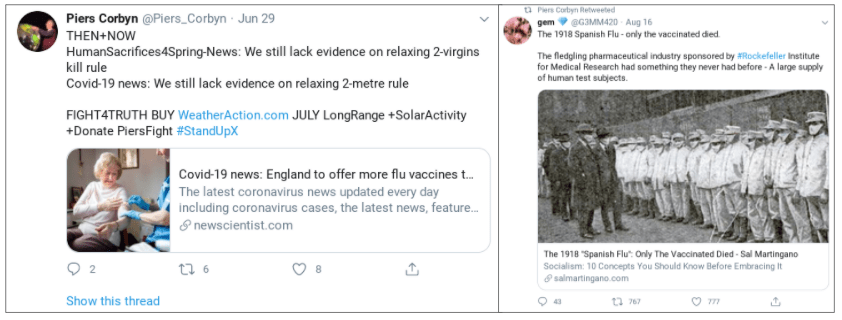
A survey of the Twitter feed of Piers Corbyn, a notable member of the conspiratorial elite, shows the usual distinctions of politics breaking down. Combining the family pastimes of preaching to the choir and never changing his mind, he at once quotes Toby Young and his band of right-wing “Lockdown Sceptics”, argues that Black Lives Matter is a conspiracy funded by big business, claims that man-made climate change is a myth, and that vaccines are designed to control us; and that George Soros, “Rockefeller” or Bill Gates is behind it all.

The left-wing “commentator” Kerry-Anne Mendoza yesterday peddled a more belt-and-braces version of the way the Holocaust can be folded into these discourses of hatred. Not as a conspiracy theory, but just as a lazy juxtaposition. As though the death camps were a punchline rather than an atrocity.

Similarly, the mural Freedom for Humanity by the artist Mear One has been doing the rounds in meme form. This is an image even Piers Corbyn’s brother Jeremy belatedly acknowledged as “deeply disturbing and anti-Semitic” – some years after invoking “Rockerfeller’s” [sic] attack on Diego de Rivera in its defence. Like Mein Kampf, (a major source text for Jewish conspiracy theories) these ideas always find Jews responsible for the evils of the day, placing grimly-eroticised spectres and fantasies of “Jewish influence” where the facts should go.

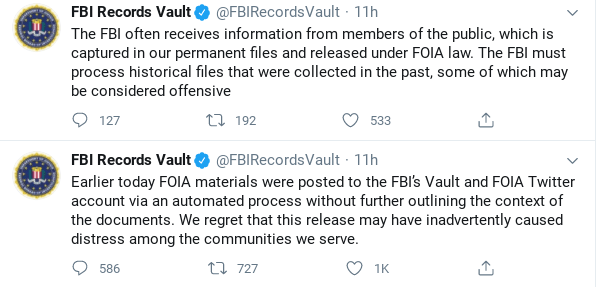
Into this volatile mixture of paranoia, half-truth and pure fantasy, the FBI yesterday decided to publish its records on The Protocols of the Elders of Zion, the antisemitic conspiracy ur-text, without commentary or qualification. When I last checked, the material had been retweeted 16,700 times. By comparison, its belated clarifications (below) had barely been noticed. A lie is, as ever, twice round the world before the truth gets its boots on.

The resurgence of conspiracy theories and panic in a period of intense anxiety and confusion is not a surprise. If you want a funny and informative introduction to why this is the case, follow Marlon Solomon (@supergutman) whose monologue “A Lizard’s Tale” is a chilling and hilarious primer in the back-and forth between claim and counter-claim. Dave Rich (@daverich1) noted in an article published earlier this year that “if it is true that Jews play a central role in conspiracy theories, it is also true that the concept of a conspiracy plays a central role in the history of antisemitism”. Conspiracies and antisemitism are linked by methodology, purpose and personnel.

But nor, it should be underlined, do these theories and fantasies restrict themselves to antisemitism. As documented by the charity TellMama, COVID-19 has prompted attacks and libels on Muslim communities. Stonewall documents the impact of the pandemic on LGBT individuals and communities. As so often, the events of this year show that hatred knows few distinctions and appeals to no logic other than the belief that since the individual is powerless in the face of events, those events must be controlled by the powerful. And since there is nothing more powerful than that which provokes fear, the two must be identical. “It is very tiring to be a plague victim,” wrote Camus, “but it is still more tiring not to want to be one.” And given time to brood, the most illogical solutions acquire the clarity of mathematical proofs. But for the conspiracist, as for their cousin, the perfect Orwellian product of totalitarianism, if the right person says it, 2+2=5.

So what can we do against this tide of reckless hate and thoughtless invective? As Camus recognised, the purpose of these ravings is to provide reassurance against the unpredictable and invisible workings of fate. And like his hero (and unreliable narrator) Rieux, we have to recognise that the answers are not glamorous: “this whole thing is not about heroism. It’s about decency. It may seem a ridiculous idea, but the only way to fight the plague is with decency.” We carry on, we do our best, we remember that common humanity and common confusion are often the same thing, and we do our jobs, however small, to make the world better.

Meme Fever

22 Wednesday Jul 2020

Posted by jaimeashworth in Culture and Politics, The Holocaust: Representations and Meanings, Uncategorized

≈ Leave a comment

Tags

Coronavirus, COVID-19, COVID19, Holocaust, Holocaust Education, Holocaust memory, Infodemic, Pandemic

Photo: Jaime Ashworth, 2020.

The era of COVID-19 has seen two processes of contagion. The first is, of course, the disease itself, with its terrible toll on individuals, communities and nations. The second, however, is what the WHO and others have termed an infodemic: defined very precisely a couple of weeks ago by a working group.

An infodemic is an overabundance of information—some accurate and some not—that occurs during an epidemic. In a similar manner to an epidemic, it spreads between humans via digital and physical information systems. It makes it hard for people to find trustworthy sources and reliable guidance when they need it. (Tangcharoensathien et al., 2020)

I’m working on a more detailed piece about the infodemic, to go alongside a collection of my photos from this year. In the meantime, however, I’ve been looking at the memes shared in my social media echo chambers. Sometimes they make me laugh but as a class of discourse they make me profoundly uneasy.

Memes are directly compared to viruses by the epidemiologist Adam Kucharski in his book, The Rules of Contagion (2020). He notes the problems posed by “simplistic anecdotes and ineffective solutions” for disease control and begins the book with an account of how he (accidentally) caused “a small outbreak of misinformation.”

The irony is that memes are simplistic anecdotes masquerading as panaceas. Like viruses, memes have no function but their own reproduction with no regard for the health of the host. Matters are further complicated by the fact that social media offer a perfect environment for them to thrive. Back in the day, “Frankie Says” was a meme, but it’s harder to edit a t-shirt than it is to share something online. One meme in particular recently caught my eye.

This meme is part of longer and bigger debates about education, race and identity. I do not claim any priority for this meme’s importance other than the fact I’ve spent my adult life teaching and learning about the Holocaust and for that reason find it deeply problematic, educationally and philosophically. My experience allows me to locate the sources of my ire because I have expertise: itself a suggestion that the reduction of history to lessons without content is not very practical. But I digress.

Firstly, the idea that the second and third parts of the statement can be accomplished without the first is problematic. Without the murder of six million Jews being remembered, the second statement makes no sense: what is the “it” that was required? And in the third statement, the “history repeating itself” is the murder of six million Jews that apparently the author thinks is optional to remember.

Second, and much more problematic, is the weasel formulation of the first statement. If the word “only” or “just” were added, the sentiment might make more sense (though as I’ve just explained I don’t think it really does). But as written it comes very close not to suggesting that education cannot be reduced to simply memorising (which of course is true and something that all good teachers work hard to ensure) but that education equals not remembering the murder of six million Jews.

This ambiguity is difficult because with a negative reading of an oddly formed sentence, the meme seems to be suggesting that instead of anchoring our understanding of the world to historical facts and debates, it should instead come from belief in an unstated mechanism that led “ordinary Germans” to be “convinced that it was required”. Setting aside the complex historical debate about degrees of knowledge, cooperation, acceptance and resistance this dismisses (the author of the meme can’t be bothered so why should I?), the implication is that children should be “educated” in some unstated monocausal view. Another word for this is indoctrination.

One of the key aspects of indoctrination is ignoring facts in the interests of clarity: such as, for example, downplaying the importance of the victim group of “what happened”. The sleight-of-hand with which this example severs meaning from content (thus rendering it meaningless) is the primary source of my anger.

Ironically, the indoctrinated have historically been very bad at spotting the writing on the wall because, well, they were indoctrinated to believe it wasn’t important. Such a process seems to have taken place very imperfectly in Nazi Germany, chiefly because the Third Reich only lasted twelve years. The debate about why and how this happened, which the author of this meme either doesn’t understand or doesn’t care about, is ongoing. But the desire to present children with “lessons” without evidence is certainly among the phenomena involved: along with ensuring that the benefits of oppression and murder were widely shared, and that perpetrators were placed in stressful, confusing situations with alcohol to dull the senses when reality could no longer be explained but simply avoided. But reiterating the nature of that reality is crucial, educationally, because without it, the question “Why is this important?” is hard to really answer.

Because, finally, let’s not forget that forgetting victims is only in the interests of the perpetrators. Himmler termed the murder of European Jewry “a glorious page in our history that can never be written”. Hitler asked “Who now remembers the Armenians?” This meme asks us to forget the Jews and replace them with an amorphous “victim” group that makes the “lessons” meaningless. The Nazis oppressed and murdered a whole range of groups and individuals, but to try and remove their primary victim group is an assault on memory and an abuse of education. Subject (the Nazis) verb (murdered) and object (six million Jews) are all required for any conclusions to have any relevance. This is true, by the way, in teaching anybody about anything. The nature of the offence is a fundamental part of teaching to understand the past and (hopefully) avoid its repetition.

This is just one meme in an ocean of memes. As in Hamlet’s soliloquy, it is tempting to think we can “take arms against a sea of troubles and, by opposing, end them.” But this is a metaphor for futility. We are adrift and lost: what we can do (all we can do, perhaps) is sound out the ideas beneath the surface of individual examples in the hope we will find solid ground underneath.

Recent Posts

  • The Holocaust and its Perpetrators: A Response to Douglas Murray and Andrew Roberts
  • Cracked Mirror: Holocaust Unconsciousness
  • The Price of Memory
  • Simulated Horror: AI and the Holocaust
  • Through the glass, darkly: a warning against Holocaust Distortion

Archives

  • September 2025
  • July 2025
  • June 2025
  • February 2025
  • January 2025
  • November 2024
  • February 2024
  • January 2023
  • January 2022
  • October 2021
  • September 2021
  • June 2021
  • August 2020
  • July 2020
  • March 2020
  • January 2020
  • January 2019
  • November 2018
  • January 2018
  • September 2017
  • August 2017
  • February 2017
  • January 2017
  • August 2016
  • March 2016
  • August 2015
  • August 2014
  • June 2013
  • May 2013
  • April 2013
  • February 2013
  • January 2013

Categories

  • Book Reviews
  • Culture and Politics
  • Heritage Politics
  • missinghistories
  • Photography and Visual Culture
  • The Holocaust: Representations and Meanings
  • Uncategorized

Meta

  • Create account
  • Log in
  • Entries feed
  • Comments feed
  • WordPress.com

Blog at WordPress.com.

  • Subscribe Subscribed
    • framingthequestion
    • Already have a WordPress.com account? Log in now.
    • framingthequestion
    • Subscribe Subscribed
    • Sign up
    • Log in
    • Report this content
    • View site in Reader
    • Manage subscriptions
    • Collapse this bar
 

Loading Comments...