• Coursework and Dissertation Help
  • About the author…
    • #missinghistories
    • Independent Educator: Research-driven Education and Training
    • Writing and Research
    • Independent Researcher

framingthequestion

~ Reflections on memory, history, photography and culture

framingthequestion

Tag Archives: Holocaust

We Know Now

27 Thursday Aug 2020

Posted by jaimeashworth in Photography and Visual Culture, The Holocaust: Representations and Meanings

≈ Leave a comment

Tags

1948 Genocide Convention, Auschwitz, Bombing of Auschwitz, Holocaust, Holocaust Education, Holocaust memory, Uighur, Uighurs, Universal Declaration of Human Rights, Xinjiang

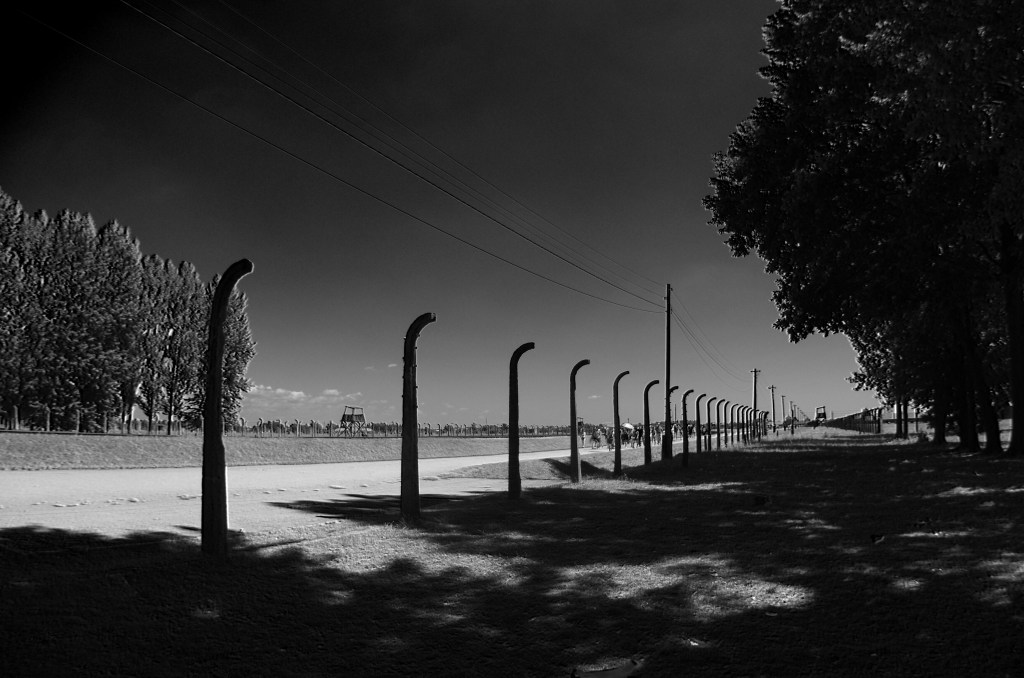
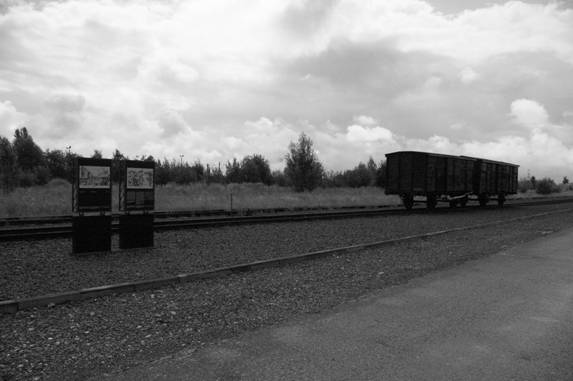
Auschwitz-II Birkenau, July 2015. Photo: Jaime Ashworth.

Among the most compelling of the exhibits at the Auschwitz Museum are the aerial photographs of the Auschwitz, Birkenau and Monowitz Camps taken by Allied reconnaissance in 1944 and early 1945. The images show the camps during some of their busiest – and bloodiest – periods of operation. If sufficiently magnified, it is possible to see groups of people walking from the trains to the crematoria and gas chambers. We can count the openings in the ceilings of the gas chambers of Crematoria II and III through which pellets of Zyklon-B were introduced. Visitors often leave, encouraged by their guides, with the sense that the world knew what was happening and remained silent.

A detail from an aerial photograph taken in August 1944. The red circle highlights the opening in the roof of the gas chamber of Crematorium II. The blue circle shows a group of deportees approaching the crematorium compound.

In fact, the truth is more complex. The images were taken using film cameras set to take constant exposures over many miles. The “target” of the surveillance was the chemical factory at Monowitz: built by prisoners in the adjoining Auschwitz III camp, the factory was built by the chemical combine IG Farben to produce synthetic rubber. At the confluence of the Vistula and Sola rivers, and located in a coal-mining region, the site was tailor-made for such a plant. The availability of cheap labour – the SS charged a fee to use prisoner labour – meant that the project could be completed relatively quickly and on a short budget. Although the Bunawerke factory never produced any Buna (synthetic rubber) it was a strategic target. In fact, it was bombed four times: twice in August 1944, once in September, and once in December.

The bombing of Monowitz is one of the most contentious episodes in the history of WW2. Why, critics ask, could the Auschwitz and Birkenau camps not have been bombed as well? In fact, stray bombs from one of the raids did fall on Birkenau, as recorded by survivor testimonies. A conference was organised at the United States Holocaust Memorial Museum in Washington in the late 1990s, with a volume of proceedings published in 2000. A short summary of a complex debate breaks down as follows:

Firstly, knowledge of Auschwitz was both plentiful and of questionable accuracy. Reports by escaped prisoners such as Rudolf Vrba and Alfred Wetzler made clear that mass murder was being carried out. But rumours of death by electrocution or burning were not accurate, and their estimates of numbers were (understandably) excessive. To prisoners caught up in hell, the constant stream of arrivals and the smoking chimneys must have made it impossible to say for certain more than that a very large number of people were being killed. Even perpetrators were unsure of the numbers. At Nuremberg, Rudolf Hoess, the commandant of Auschwitz, estimated that the dead in the camp totalled around 3,000,000. Research conducted in Poland in the early 1990s, however, demonstrated conclusively that approximately 1,500,000 people were deported to the camp, and of those around 1,100,000 were killed. But in 1944, at the closing stages of the war, the facts were unclear and resources at a premium. Auschwitz was at the very edge of operational range, and required a dangerous mission back and forth across Germany.

Secondly, there is the question of technological capability. The key idea here is Circular Error Probable: the likelihood of a given bomb hitting within a reasonable range of its target. Accustomed to footage of munitions that can virtually turn corners to match traffic lights, we forget that in 1944 a bomb was simply explosives set to blow up when it completed its vertical drop. To hit the crematoria, or the railway lines, or any other target, was difficult. The controversial Allied strategy of bombing German cities was employed because the technology made precision difficult unless flying by day – which increased the risk to aircrew. And this is before any thought is given to the likely cost in prisoner lives of any full-scale raids on the camp. Survivors may say that they would have welcomed it – but I am glad they are here to tell the story, rather than blown to smithereens by Allied bombs.

Thirdly, the intellectual framework did not exist to really comprehend what was in the images, even if someone had looked. It had not, as Primo Levi wrote, yet “been introduced irrevocably into the world of things that exist”. There was plentiful information about the Holocaust in both the popular press and the corridors of power, but it was not acted upon in the most basic way. It was not accepted as fact that the German intention was to exterminate the Jews of Europe. Assertions that it was, in the minds of decision-makers, belonged in newspaper headlines and lurid magazine articles, not the formulation of policy. A significant measure of antisemitism also contributed. Surely, some argued, this was just Jewish imagination at work, a persecution complex caught up in the war? In August 1942, Gerhart Riegner of the World Jewish Congress sent a telegram to Sidney Silverman MP, the WJC representative in London:

The Riegner Telegram (UK National Archives FO371/30917)

The ensuing five-day correspondence among officials acknowledged “numerous reports of large scale massacres of Jews” but focused on attempting to verify Riegner’s identity (“Eastern Dept. have no knowledge of Mr Riegner”) and ended with the following remark:

I do not see how we can hold up this message much longer, although I fear it may provoke embarrassing repercussions. Naturally we have no information bearing on this story.

Later in 1942, the activist Rev. James Parkes despaired that “The continued silence of the government in relation to the massacres is evidence of the strength in places of power of reactionary forces – from whom we have nothing to hope.”

But how then can we explain the pictures? Surely these images show that we knew exactly what was happening? There it is, in black and white, neatly labelled.

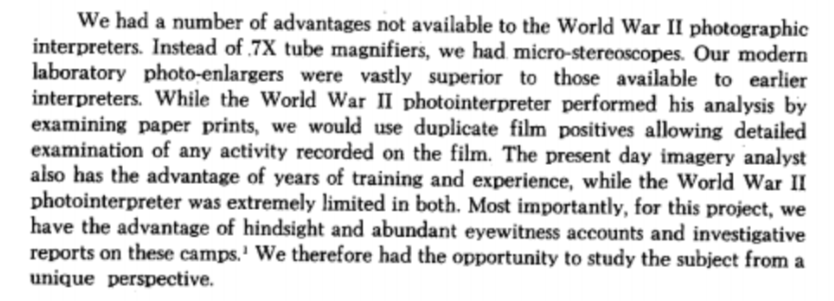
In fact, this is misleading. As I said above, the photographs were taken on huge rolls of film, covering many miles. The images of Auschwitz and Birkenau were at the end of these reels, after the “target” images of Monowitz. During the war, they were overlooked because analysts were not detailed to look. The images we are familiar with were only produced in the 1970s, when two CIA analysts named Dino A. Brugioni and Robert G. Poirier examined the images and conducted a retrospective analysis, uncovering many of the details that strike the visitor or viewer today. As they said in their report:

Extract from Dino A. Brugioni and Robert G. Poirier, “The Holocaust Revisited: A Retrospective Analysis of the Auschwitz-Birkenau Extermination Complex” (CIA, 1979)

In a variety of ways therefore, both technical and historical, not only were the images not looked at until the 1970s, they could not have been looked at earlier. The report also served another purpose than historical reconstruction. The pointed reference to the CIA’s photo-reconnaissance capability was meant to be understood most directly in Moscow: the clear message being that Russian military installations could be spotted, analysed and potentially destroyed.

Why is this important today? A BuzzFeed article prompted these reflections: an article about the treatment of the Uighurs in China. BuzzFeed used commercial technology to identify 268 sites, and was able to confirm that 92 of these are detention centres using documents, eyewitness testimony and academic research. Authorities in the region termed the claims of persecution as “a groundless lie”: “the issue concerning Xinjiang is by no means about human rights, religion or ethnicity, but about combating violent terrorism and separatism”. Some of these sites are sufficient to hold 10,000 people. The testimonies of those who have emerged from the camps to tell the tale are horrendous.

One of the detention sites identified by BuzzFeed.

This month, an open letter was sent to the government by more than 70 faith leaders, calling on the UK government “to investigate these crimes, hold those responsible to account and establish a path towards the restoration of human dignity.” The letter invoked the Holocaust, once more demanding that “Never Again” finally – this time – have some meaning.

In 1945, Primo Levi wrote that his liberators were oppressed by the evidence of the crime, “the shame the Germans did not know, that the just man feels at another man’s crime.” But this crime in many ways had only just been introduced into the “world of things that exist”. The legal measures of the late 1940s, the Genocide Convention and Universal Declaration of Human Rights, were landmarks, acknowledging for the first time that rights are human and transnational, that mass death is wrong, and that leaders cannot hide behind the state to evade responsibility. James Fawcett, one of the British contributors to these laws (and grandfather of our current Prime Minister), said in 1961 that their purpose was to ensure that “Sharpeville, Angola, Tibet, are all matters of international concern, though they happen within the jurisdiction of a particular state.” That these lessons were learnt while mired in the hypocrisy and crime of Empire does not detract from the imaginative, moral, ethical and philosophical leap they were.

But that leap was made for us. Now we know. Now, it is other words from Primo Levi that we must remember, before we once more say “Never Again”: “It happened, therefore it can happen again.” It is happening again: once more, as Levi wrote, the lords of death are waiting by the trains. It is our job to try and stop them leaving the station. Knowing is not enough: now we must act.

Between the Peak and the Abyss: Conspiracy and Superstition

20 Thursday Aug 2020

Posted by jaimeashworth in Culture and Politics, The Holocaust: Representations and Meanings

≈ Leave a comment

Tags

5G, conspiracy theories, Coronavirus, COVID-19, Holocaust, Holocaust Education, Infodemic, QAnon

Albert Camus wrote The Plague in 1947, as an allegory of French society under German occupation. Reading from 2020, however, it also describes with some accuracy the social impact of an actual epidemic. The sense of time suspended, of activity deferred, of relationships interrupted: “As it was a case of marking time, many hundreds of thousands of people were still kicking their heels for endless weeks […] nothing more important happened than this great marking of time.”

And into this space come comparisons, analogies and theories, to fill the empty time and make sense of the chaos and disruption, invented by the mendacious to manipulate the confused. Camus lists the different types and it is impossible not to recognise the stories in the newspapers that blow down our streets, their relevance superseded by new developments.

Some predictions were based on bizarre calculations involving the number of the year, the number of deaths and the number of months already spent under the plague. Others established comparisons with the great plagues of history, bringing out the similarities (which these prophecies called ‘constants’) and, by means of no less peculiar calculations, claimed to extract information relative to the present outbreak. But the ones that the public liked best were undoubtedly those which, in apocalyptic language, announced a series of events, any one of which might be the one that the town was currently enduring, their complexity allowing for any interpretation. Nostradamus and Saint Odile were thus consulted daily and never in vain. What remained common to all the prophecies was that, in the last resort, they were reassuring. The plague, however, was not.

I wrote a while ago about the parallel infodemic coursing through society, as we all struggle to make sense of the senseless, to order the chaotic. Graphs, charts, dashboards, bulletins, maps, timelines: every manner of device intended to help synthesise and distill the rush of events into orderly narrative and discrete data sets. And as Camus said, these are reassuring: not because of their content but because of their form. A viral contagion can be truly controlled only on the page or the screen: every graphic contributes to our sense that because the situation can be described, it can be (or is being) managed. Every rumour, false hope or faked accusation contributes to a sense that the sky is falling.

For this reason, it is unsurprising that conspiracy theories have been part of the year. In March and April, telephone engineers were assaulted and mobile masts set on fire by people who believed the virus was connected to the 5G network upgrade. Paradoxically, they also think that the electronic media is a good place to promote this: I suspect these people are (because things are their opposite) the most fevered users of electronic devices. They seem to patrol the virtual world as they might have once walked the streets, howling about Armageddon and inveighing against the shadows.

I have seen the low-tech versions too, though. Walking through a locked-down Kentish Town, I saw a flyer pushed through the letterbox of a charity shop, its quality print daring the reader to dismiss it for the ravings it contained. I have seen other slogans and warnings, scrawled on signs and bus shelters, painted on doors. They are the inevitable detritus spawned by confusion and despair. And just as surely as the maps of where the virus has taken the greatest toll, they are indicators of deprivation: warnings and fears given venom by resentment. They are the signs (as in Camus) of “those who are looking for reasons and who are afraid.”

In such a context, it was inevitable that antisemitic conspiracy theories should have a resurgence. The Community Security Trust has published a report on the antisemitic tropes and canards revivified by the pandemic. From positing a Jewish conspiracy behind the virus, to using the virus to celebrating Jewish deaths, to using the virus to kill Jews, all the classic elements of the oldest hatred are present. Whether from the right (QAnon) or the left (AntiVaxx) the elements are tiresomely predictable, and make it hard to tell one from the other. As Robert Eaglestone has observed about varieties of Holocaust denial: “these distinctions are rarely fixed, as they demand too much consistency from the world of bigotry and false argument that these people inhabit.”

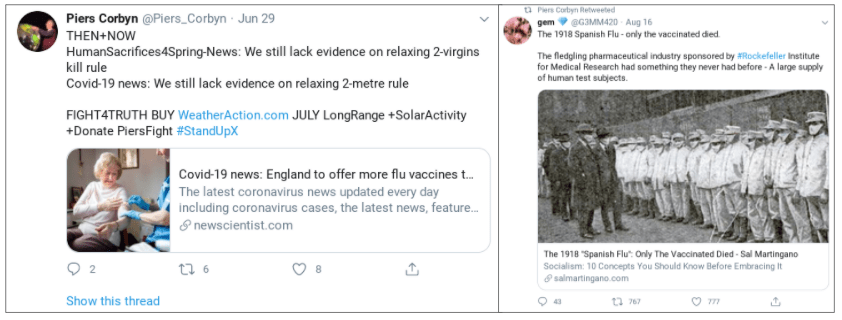
A survey of the Twitter feed of Piers Corbyn, a notable member of the conspiratorial elite, shows the usual distinctions of politics breaking down. Combining the family pastimes of preaching to the choir and never changing his mind, he at once quotes Toby Young and his band of right-wing “Lockdown Sceptics”, argues that Black Lives Matter is a conspiracy funded by big business, claims that man-made climate change is a myth, and that vaccines are designed to control us; and that George Soros, “Rockefeller” or Bill Gates is behind it all.

The left-wing “commentator” Kerry-Anne Mendoza yesterday peddled a more belt-and-braces version of the way the Holocaust can be folded into these discourses of hatred. Not as a conspiracy theory, but just as a lazy juxtaposition. As though the death camps were a punchline rather than an atrocity.

Similarly, the mural Freedom for Humanity by the artist Mear One has been doing the rounds in meme form. This is an image even Piers Corbyn’s brother Jeremy belatedly acknowledged as “deeply disturbing and anti-Semitic” – some years after invoking “Rockerfeller’s” [sic] attack on Diego de Rivera in its defence. Like Mein Kampf, (a major source text for Jewish conspiracy theories) these ideas always find Jews responsible for the evils of the day, placing grimly-eroticised spectres and fantasies of “Jewish influence” where the facts should go.

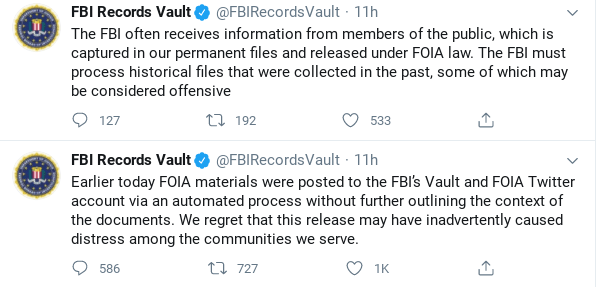
Into this volatile mixture of paranoia, half-truth and pure fantasy, the FBI yesterday decided to publish its records on The Protocols of the Elders of Zion, the antisemitic conspiracy ur-text, without commentary or qualification. When I last checked, the material had been retweeted 16,700 times. By comparison, its belated clarifications (below) had barely been noticed. A lie is, as ever, twice round the world before the truth gets its boots on.

The resurgence of conspiracy theories and panic in a period of intense anxiety and confusion is not a surprise. If you want a funny and informative introduction to why this is the case, follow Marlon Solomon (@supergutman) whose monologue “A Lizard’s Tale” is a chilling and hilarious primer in the back-and forth between claim and counter-claim. Dave Rich (@daverich1) noted in an article published earlier this year that “if it is true that Jews play a central role in conspiracy theories, it is also true that the concept of a conspiracy plays a central role in the history of antisemitism”. Conspiracies and antisemitism are linked by methodology, purpose and personnel.

But nor, it should be underlined, do these theories and fantasies restrict themselves to antisemitism. As documented by the charity TellMama, COVID-19 has prompted attacks and libels on Muslim communities. Stonewall documents the impact of the pandemic on LGBT individuals and communities. As so often, the events of this year show that hatred knows few distinctions and appeals to no logic other than the belief that since the individual is powerless in the face of events, those events must be controlled by the powerful. And since there is nothing more powerful than that which provokes fear, the two must be identical. “It is very tiring to be a plague victim,” wrote Camus, “but it is still more tiring not to want to be one.” And given time to brood, the most illogical solutions acquire the clarity of mathematical proofs. But for the conspiracist, as for their cousin, the perfect Orwellian product of totalitarianism, if the right person says it, 2+2=5.

So what can we do against this tide of reckless hate and thoughtless invective? As Camus recognised, the purpose of these ravings is to provide reassurance against the unpredictable and invisible workings of fate. And like his hero (and unreliable narrator) Rieux, we have to recognise that the answers are not glamorous: “this whole thing is not about heroism. It’s about decency. It may seem a ridiculous idea, but the only way to fight the plague is with decency.” We carry on, we do our best, we remember that common humanity and common confusion are often the same thing, and we do our jobs, however small, to make the world better.

Meme Fever

22 Wednesday Jul 2020

Posted by jaimeashworth in Culture and Politics, The Holocaust: Representations and Meanings, Uncategorized

≈ Leave a comment

Tags

Coronavirus, COVID-19, COVID19, Holocaust, Holocaust Education, Holocaust memory, Infodemic, Pandemic

Photo: Jaime Ashworth, 2020.

The era of COVID-19 has seen two processes of contagion. The first is, of course, the disease itself, with its terrible toll on individuals, communities and nations. The second, however, is what the WHO and others have termed an infodemic: defined very precisely a couple of weeks ago by a working group.

An infodemic is an overabundance of information—some accurate and some not—that occurs during an epidemic. In a similar manner to an epidemic, it spreads between humans via digital and physical information systems. It makes it hard for people to find trustworthy sources and reliable guidance when they need it. (Tangcharoensathien et al., 2020)

I’m working on a more detailed piece about the infodemic, to go alongside a collection of my photos from this year. In the meantime, however, I’ve been looking at the memes shared in my social media echo chambers. Sometimes they make me laugh but as a class of discourse they make me profoundly uneasy.

Memes are directly compared to viruses by the epidemiologist Adam Kucharski in his book, The Rules of Contagion (2020). He notes the problems posed by “simplistic anecdotes and ineffective solutions” for disease control and begins the book with an account of how he (accidentally) caused “a small outbreak of misinformation.”

The irony is that memes are simplistic anecdotes masquerading as panaceas. Like viruses, memes have no function but their own reproduction with no regard for the health of the host. Matters are further complicated by the fact that social media offer a perfect environment for them to thrive. Back in the day, “Frankie Says” was a meme, but it’s harder to edit a t-shirt than it is to share something online. One meme in particular recently caught my eye.

This meme is part of longer and bigger debates about education, race and identity. I do not claim any priority for this meme’s importance other than the fact I’ve spent my adult life teaching and learning about the Holocaust and for that reason find it deeply problematic, educationally and philosophically. My experience allows me to locate the sources of my ire because I have expertise: itself a suggestion that the reduction of history to lessons without content is not very practical. But I digress.

Firstly, the idea that the second and third parts of the statement can be accomplished without the first is problematic. Without the murder of six million Jews being remembered, the second statement makes no sense: what is the “it” that was required? And in the third statement, the “history repeating itself” is the murder of six million Jews that apparently the author thinks is optional to remember.

Second, and much more problematic, is the weasel formulation of the first statement. If the word “only” or “just” were added, the sentiment might make more sense (though as I’ve just explained I don’t think it really does). But as written it comes very close not to suggesting that education cannot be reduced to simply memorising (which of course is true and something that all good teachers work hard to ensure) but that education equals not remembering the murder of six million Jews.

This ambiguity is difficult because with a negative reading of an oddly formed sentence, the meme seems to be suggesting that instead of anchoring our understanding of the world to historical facts and debates, it should instead come from belief in an unstated mechanism that led “ordinary Germans” to be “convinced that it was required”. Setting aside the complex historical debate about degrees of knowledge, cooperation, acceptance and resistance this dismisses (the author of the meme can’t be bothered so why should I?), the implication is that children should be “educated” in some unstated monocausal view. Another word for this is indoctrination.

One of the key aspects of indoctrination is ignoring facts in the interests of clarity: such as, for example, downplaying the importance of the victim group of “what happened”. The sleight-of-hand with which this example severs meaning from content (thus rendering it meaningless) is the primary source of my anger.

Ironically, the indoctrinated have historically been very bad at spotting the writing on the wall because, well, they were indoctrinated to believe it wasn’t important. Such a process seems to have taken place very imperfectly in Nazi Germany, chiefly because the Third Reich only lasted twelve years. The debate about why and how this happened, which the author of this meme either doesn’t understand or doesn’t care about, is ongoing. But the desire to present children with “lessons” without evidence is certainly among the phenomena involved: along with ensuring that the benefits of oppression and murder were widely shared, and that perpetrators were placed in stressful, confusing situations with alcohol to dull the senses when reality could no longer be explained but simply avoided. But reiterating the nature of that reality is crucial, educationally, because without it, the question “Why is this important?” is hard to really answer.

Because, finally, let’s not forget that forgetting victims is only in the interests of the perpetrators. Himmler termed the murder of European Jewry “a glorious page in our history that can never be written”. Hitler asked “Who now remembers the Armenians?” This meme asks us to forget the Jews and replace them with an amorphous “victim” group that makes the “lessons” meaningless. The Nazis oppressed and murdered a whole range of groups and individuals, but to try and remove their primary victim group is an assault on memory and an abuse of education. Subject (the Nazis) verb (murdered) and object (six million Jews) are all required for any conclusions to have any relevance. This is true, by the way, in teaching anybody about anything. The nature of the offence is a fundamental part of teaching to understand the past and (hopefully) avoid its repetition.

This is just one meme in an ocean of memes. As in Hamlet’s soliloquy, it is tempting to think we can “take arms against a sea of troubles and, by opposing, end them.” But this is a metaphor for futility. We are adrift and lost: what we can do (all we can do, perhaps) is sound out the ideas beneath the surface of individual examples in the hope we will find solid ground underneath.

Three Stories: Reflections on Lessons from Auschwitz

29 Sunday Mar 2020

Posted by jaimeashworth in The Holocaust: Representations and Meanings

≈ 1 Comment

Tags

Auschwitz, COVID-19, Holocaust, Holocaust Education

Working as a Freelance Educator on the Holocaust Educational Trust’s Lessons from Auschwitz project is probably the most rewarding and important thing I do. When COVID-19 interrupted all our lives, I was part of the way through an exceptionally busy term with two visits completed and two to come. While this letter is addressed to one group in particular (with whom I was hoping to do a follow-up seminar) it is also meant for all the groups I’ve worked with.

The main gate to Auschwitz II-Birkenau, March 2020. Photo: Jaime Ashworth

Dear Group Five,

First, let me say that you were lovely. Bright, curious, open to learning new things, as groups so often are. It’s just one of the reasons I love working as an Educator on the project. But you had something else in addition: an emotional grasp of what the trip meant that I’ve only rarely encountered and a willingness to share that with me and each other that was beautiful and inspiring to work with.

I am, quite simply, gutted that I haven’t been able to complete my sections of your LFA journey. I was looking forward to hearing your reflections and insights and getting a glimpse of your next steps. I don’t think anyone knows when or how that may happen – though I’m sure the logistics team that do everything to manage the seminars and trips are working to answer that question. In advance of that possibility I want to share some ideas about the possibilities and challenges that lie ahead in your next steps. 

On a personal level I am wary of the idea of lessons. Michael Marrus, a distinguished scholar of the Holocaust and its history, wrote in his memoir that lessons are problematic, often telling us more about the person drawing the lesson than the past itself. I agree. But if we don’t try to draw lessons all we are left with is horror. So we have to strike a balance.

Certainly the idea that we can easily draw inspirational lessons is to be approached with caution. After hearing the testimony of Steven Frank, you identified that the most important factor in his survival was luck. Yes, he was young and healthy. Yes, he was resilient. Yes, he enjoyed the support of a parent who was also spared. But so did many others. As we are discovering, there is by definition no logic to catastrophe. Kings and beggars, villains and saints – all perished, the remainder saved only by capricious chance. As Primo Levi reminded us in his final book, The Drowned and the Saved:

We, the survivors, are not only a tiny but also an anomalous minority. We are those who, through prevarication, skill or luck, never touched bottom. Those who have, and who have seen the face of the Gorgon, did not return, or returned wordless.

Shortly after finishing the book, Levi died, falling down the lift shaft of his apartment building in Turin. There is a debate about whether he fell or jumped. I’m not sure it matters: he had spent a lifetime contesting the verdict on himself he had pronounced in the camp, convicted in his own mind by the fact of his survival. He had acted as best he could, but remained concerned that this had still been at the cost of others’ survival. As the Polish writer (and Auschwitz inmate) Tadeusz Borowski described so well, the camp experience involved everyone in the crime. One could not emerge from it without, however inadvertently, being tarnished. Because if you survived, someone else hadn’t. This is why understandings of survivors now focus more on shame than guilt. Guilt might be contested, shame enters the skin, as indelible as a tattoo.

Lessons need to be approached carefully, mindful of the facts and their complexity. Perhaps the only lesson that really matters is to see humanity and potential in everyone. That’s why the emphasis is on rehumanising the victims: because you can’t see the humanity in a statistic. But you might glimpse it in a market square or the site of a synagogue. Or in the objects brought by deportees, proclaiming their faith in the simple belief that life would go on, with prayers to be said, meals to be cooked and teeth to be brushed. And the reassurance of house keys in their pocket.

And what of the perpetrators? Should we see them as human? The Polish epigram Ludzie ludziom zgotowali ten los, coined by the writer Zofia Nałkowska while investigating Nazi crimes, is often translated as “man prepared this fate for man”. Which I suppose has a certain cadence in English. But in fact it is literally “People prepared this fate for people.” The first translation may look better carved in a stone tablet but it detaches the actors from their actions. People did this: people like you, people like me. And as Jonathan Littell notes in his novel The Kindly Ones:

If you were born in a country or at a time not only when nobody comes to kill your wife and your children, but also nobody comes to ask you to kill the wives and children of others, then render thanks to God and go in peace. But always keep this thought in mind: you might be luckier than I, but you’re not a better person.

So where do we go from here? Primo Levi wrote of the shame of the liberators as they entered the camp, their eyes downcast because this had happened, that such crimes had entered the world of existing things. A sense of shame at humanity is a common response to Auschwitz even today, 75 years later. And it is both correct and just the beginning of the story. You are it’s next step.

I often tell three stories when saying goodbye to groups.

The first is by Elie Wiesel and concerns the trial of God. A trial in the barracks of Birkenau where the inmates found God either guilty or absent. But then it was time for prayers, so they prayed. Sometimes we carry on despite our conviction that things are worthless – because sometimes that’s all there is to do.

Elie Wiesel was liberated in Buchenwald, aged sixteen. He spent a lifetime trying to explain Auschwitz but often resorted to the aphorism that “The truth of Auschwitz lies in silence”. It’s another good phrase that looks very impressive carved in stone. But here’s my question: if the truth of Auschwitz lies in silence, how do we tell it? 

The final story is from the late Clive James. On a visit to Munich on assignment for the Observer in 1983, he visited Dachau. His description is characteristically both beautiful and learned.

There is a place in Virgil’s Aeneid called the broken-hearted fields. Standing in that snow-covered space I could think of no better description. Nor was there any point in reproaching oneself for being unable to shed tears: if we could truly imagine what it was like, we would die of grief.

I often think of these words when I talk to students worrying about whether their next steps will be enough or hear educators fret about whether they covered everything, whether they did justice to the facts. Of course they didn’t, because nobody can. We ask you to bear witness to Auschwitz, knowing that it’s really beyond description; because it’s the attempt that matters.

And so I suggest one final lesson from Auschwitz: it is better to speak than to remain silent. And you must trust that whatever you say will be perfect – because the alternative is saying nothing at all. The rest, as Rabbi Hillel said, is commentary: now go study. 

Wishing you safe passage and a prosperous voyage in these troubled times. 

Jaime

London, March 2020

On Holocaust Memorial Day 2020: Stand Together

24 Friday Jan 2020

Posted by jaimeashworth in Heritage Politics, The Holocaust: Representations and Meanings, Uncategorized

≈ 2 Comments

Tags

#StandTogether, aboutholocaust.org, Child Refugees, HMD2020, Holocaust, Holocaust Memorial Day, Kindertransport, Leo Baeck, Regina Jonas

The Book of Names in Block 27 at Auschwitz. Photo: Jaime Ashworth, 2015.

Yesterday, at a ceremony hosted by the Association of Jewish Refugees at Belsize Square Synagogue, I listened to testimony from Frank Bright, a survivor of Theresienstadt and Auschwitz. Aged 91 and frail, he began by asking the room “Can you hear me?” The plaintive yet essential nature of his question took me aback for a moment.

The theme for Holocaust Memorial Day asks us to #StandTogether, but what does this mean? Are we listening?

In the last year, I have spent a lot of time working on the aboutholocaust.org project for the World Jewish Congress and UNESCO. The website contains a range of questions and answers which aim to explain key concepts and key events, and which illustrate them through the life stories of individuals.

As part of this, individuals who have been familiar names have also been developed into full personalities: the humanisation of the Holocaust is more than knowing a name, it is becoming aware of who that person was. The American science-fiction writer Orson Scott Card has many views which I profoundly reject, but his description in the novel Speaker for the Dead of how we should understand the people of the past continues to be something I try and live up to:

…to understand who a person really was, what his or her life really meant, the speaker for the dead would have to explain their self-story – what they meant to do, what they actually did, what they regretted, what they rejoiced in. That’s the story that we never know, the story that we never can know – and yet, at the time of death, it’s the only story truly worth telling.

To fulfil this task for the victims of the Holocaust would take centuries. The Book of Names produced by Yad Vashem, the Israeli Holocaust memorial, and kept in the Jewish Exhibition at Auschwitz, contains four million names of victims. Speaking to students, I point out that it actually commemorates three groups: those who died and whose names are recorded (Yad Vashem is taken from the Book of Isaiah and means “a monument and a name”); the space at its front where the other two million names we may never know, or even be able to guess at, should go; and the surviving family members whose pages of testimony are condensed into this vast artefact. And these are the barest of details: names, dates, place of birth, place of death (if this is even known). Their hopes, their fears, their aspirations and their regrets all went up, quite literally, in smoke. Telling some of their stories is the only way I can stand with them.

Three of the questions I have answered this year for aboutholocaust have stuck in my mind as I’ve reflected upon the idea of standing together.

Firstly, “Did you know that thousands of Jewish children left Germany without their parents to escape Nazi persecution?” The story of the Kindertransport is well-known and often used to justify a narrative of British moral superiority. The footage of the late Sir Nicholas Winton on That’s Life! in the 1980s, surrounded by the adults he saved as children, is incredibly moving. But for every child who came, many more did not, to say nothing of the parents who were forced to accept separation, usually permanent, as the price of securing their children’s safety. This week, as I sat in a room with some of them in Belsize Square, another of those children, Lord Dubs, was definitively frustrated in his campaign to ensure the safety and security of child refugees separated from their families. We must ask with whom we are standing, and why, and whether the cause of unity for its own sake is worth it. I stand with the children.

Secondly, “Why were there more Jews in Albania in 1945 than before WW2?” in 1938, the Jewish population of Albania was around 200 people. At the end of the war, it was around 1800, as Jews from Germany, Austria, Serbia, Greece and Yugoslavia arrived, in transit to the Americas, Turkey and Mandate Palestine. They had been kept safe by a code of toleration and hospitality called Besa, which means “to keep the promise”. As Lime Balla, one of the rescuers, described it:

We were poor – we didn’t even have a dining table – but we never allowed them to pay for the food or shelter. I went into the forest to chop wood and haul water. We grew vegetables in our garden so we all had plenty to eat. The Jews were sheltered in our village for fifteen months. We dressed them all as farmers, like us. Even the local police knew that the villagers were sheltering Jews.

To stand together is not just a matter of symbolism. It is to act as well, whatever our circumstances, recognising the capacity that each of us has to do something.

Finally, the work on Rabbi Leo Baeck was inspiring. The leader of German Jewry in the 1930s, Baeck chose to stay with his community, as did Rabbi Regina Jonas, a pioneering female rabbi. Both were deported to Theresienstadt, from where Jonas was deported to Auschwitz and murdered in late 1944. I searched in vain for a statement of why they chose to stand together with their community, when in both cases they had options of hiding or escape. The closest I came was the prayer written by Baeck for Yom Kippur in 1935:

Our history is the history of the grandeur of the human soul and the dignity of human life. In this day of sorrow and pain, surrounded by infamy and shame, we will turn our eyes to the days of old. From generation to generation God redeemed our fathers, and he will redeem us in the days to come. We bow our heads before God and remain upright and erect before man. We know our way and we see the road to our goal.

In short, to stand together is sometimes all we can do, recognising that we do so on a road whose ultimate destination is impossible to know. So we must hold hands as we go.

The Boy Who Cried Nazi

17 Thursday Aug 2017

Posted by jaimeashworth in Culture and Politics, The Holocaust: Representations and Meanings

≈ 2 Comments

Tags

Antisemitism, Charlottesville, Holocaust, Roland Barthes, Trump, Women's March London, World War 2

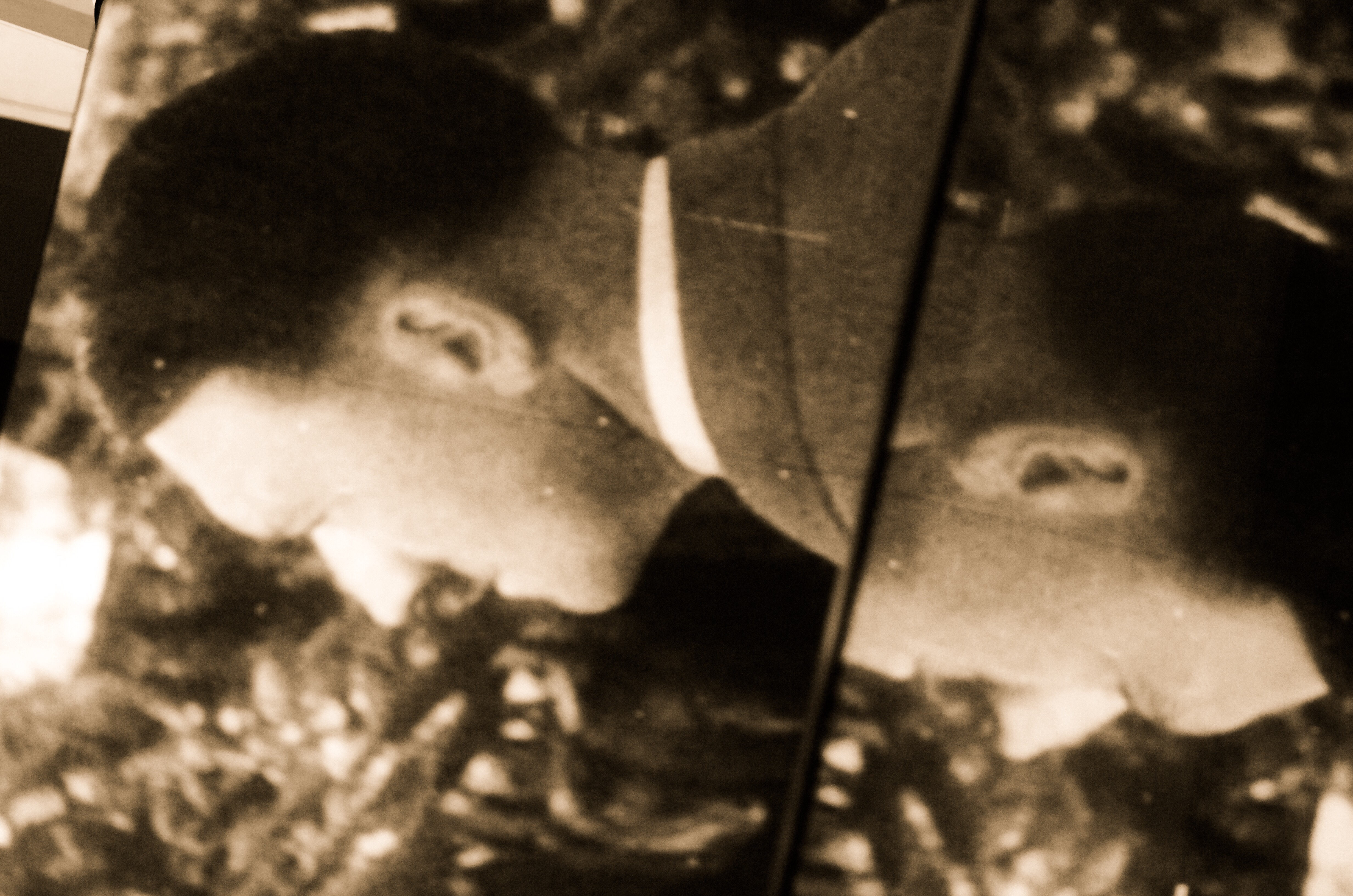
Footage of Hitler reflected in a glass display, IWM 2016. Photo: Jaime Ashworth.

As a blogger with a background in Holocaust Studies, Godwin’s Law (sometimes the authoritative-sounding reductio ad Hitlerum) presents some problems for me. As originally formulated by Mike Godwin in 1990, it runs:

As an online discussion grows longer, the probability of a comparison involving Hitler approaches 1.

While I appreciate that as a Holocaust scholar and educator I’m a bit of a niche market, this commonplace of Twitter put-downs raises some problems for me.

First, from my perspective, there’s the problem that since I’ve invested an awful lot of time and effort in trying to understand the Holocaust and the Third Reich, the likelihood of my seeing resemblances that others don’t is slightly higher than average. At a recent session run by Robert Eaglestone of Royal Holloway on the cultural impact of the Holocaust, he asked the group to identify resonances between the Third Reich and the Harry Potter books. He said there were eight. I got to ten at a rate that slightly alarmed my ‘pair’ – though this may have been the fact that a grown man is so familiar with the differences between Purebloods, Half-bloods and Muggle-borns. (I will obviously refrain from repeating what Malfoy calls Hermione in Chamber of Secrets.)

The point here, though, is that neither I nor Eaglestone is suggesting that one has to read Harry Potter either as a neo-Nazi code or a passionate anti fascist parable. We’re suggesting that ideas and images from the Third Reich, World War II and the Holocaust have woven themselves deep into our subconscious, both individual and collective. Eaglestone’s most recent work takes as its starting-point the words of the late Nobel laureate and Auschwitz survivor Imre Kertesz, who in his 2002 Nobel Prize speech spoke of the “broken voice that has dominated European art for decades”.

My work, as I have described before, is concerned with the ways the Holocaust has become a mythology – in the sense used by Roland Barthes of “a language in which one speaks” of other things. In this sense, resonances and echoes are what I look for. Sometimes this is educationally effective, as when pointing out the “magical thinking” in the term “brainwashing” which many students use to talk about attitudes to persecution amongst “ordinary” Germans. Some of the problems faced by those who attempted to try and apportion responsibility for the Nazi era can be seen in the comment by Barty Crouch Junior (while disguised as Alastor ‘Mad-Eye’ Moody) in Goblet of Fire:

Scores of witches and wizards have claimed that they only did You-Know-Who’s bidding under the influence of the Imperius Curse. But here’s the rub: how do we sort out the liars?

To be clear: I wouldn’t suggest anyone quoted this in their History exams, or that the world created by J.K. Rowling is simply a vehicle for allegory. There are, however, some obvious ways in which the Harry Potter books are (in Eva Hoffman’s phrase) after such knowledge. Rowling’s magical hierarchy is, consciously or otherwise, very similar to the race laws of the Third Reich. That such pseudo-mathematical pigeonholing of human beings is not confined to that era (look up the word octaroon) also means, though, that we have to ask why these atrocities have caught our imaginations, both cultural and individual, so powerfully.

But that doesn’t mean we can’t draw attention to the resemblances where they occur. Not least because it allows us to critique more problematic examples of Holocaust discourse, such as John Boyne’s The Boy in the Striped Pyjamas, which is most intelligible as a sentimentalised garbling of Holocaust representations rather than a response to the history itself.

In addition to the presence of Holocaust consciousness in fiction, there is a long history of invoking the Holocaust to describe the present in ways that are problematic. Peter Novick, in The Holocaust and American Life (1999), wrote of the ways in which the Holocaust had been instrumentalised by different causes: right, left and centre. Michael Marrus (in his 2016 Lessons of the Holocaust) has also questioned whether “universal lessons” are easily drawn, arguing that “lesson seeking often misshapes what we know about the event itself in order to fit particular causes and objectives [with] frequent unreliable basis in historical evidence and their unmistakable invitation to avoid nuance.”

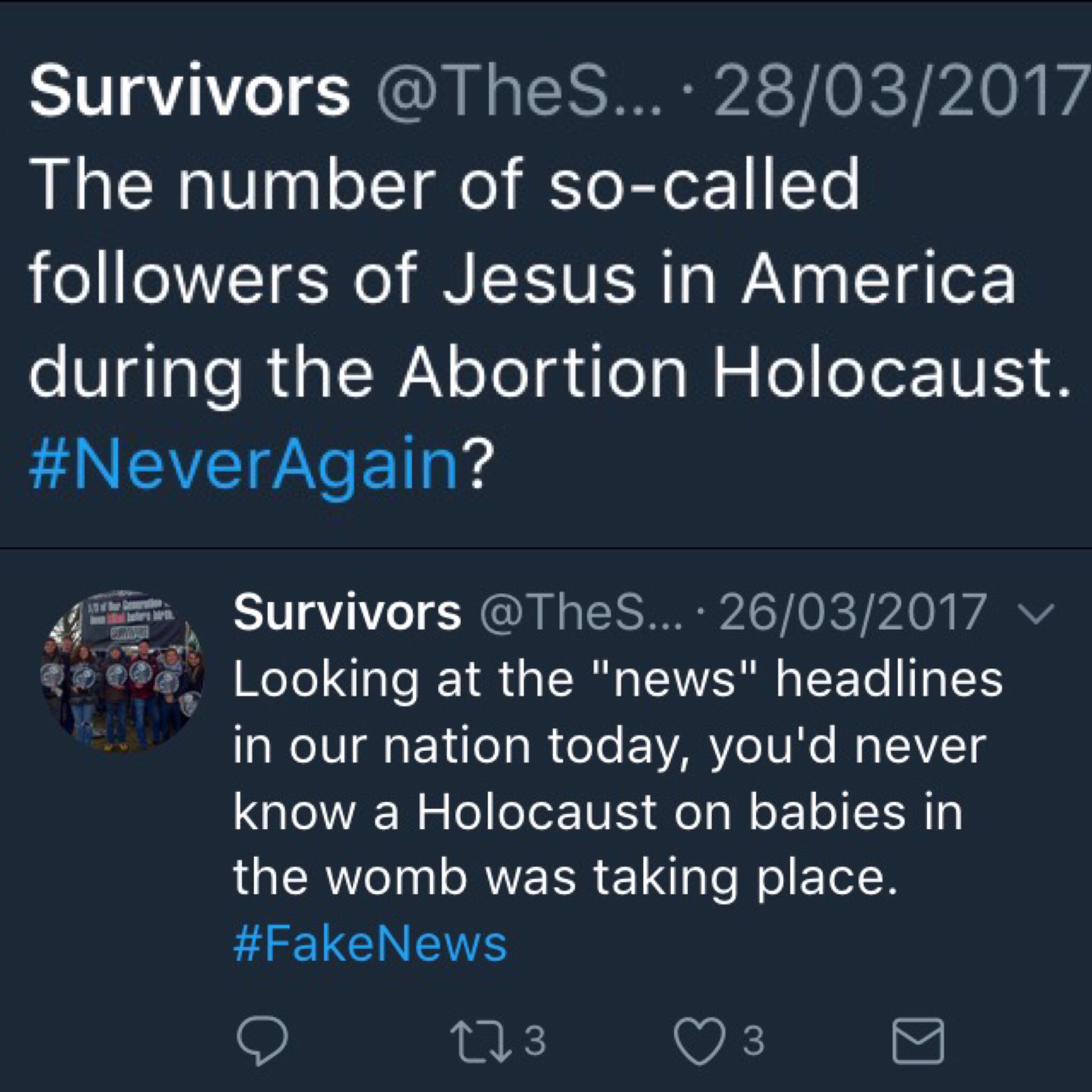
A quick google of ‘abortion holocaust’ (a target of Novick’s) provides a case in point. Survivors of the Abortion Holocaust attempts to mobilise support to restrict the rights of women through a twisted appeal to high school social studies. Its assertion that “Any person born after January 22, 1973 is a survivor of the abortion holocaust” is as mendacious as any Holocaust denial website but in its cadences and vocabulary mimics the rhetoric of Holocaust remembrance just as its website attempts to mimic graffiti. Their Twitter feed also provides examples of Holocaust discourse, as well as sub-Trumpian attacks on “fake news” and Hillary Clinton: dire warnings of what would happen (in their view) if a woman’s right to choose stretched as far as holding high political office.

In instances like this, Godwin’s Law is not just a useful reminder that comparison can be emotive rather than accurate or helpful. It’s actually an alarm for dishonesty.

But this doesn’t address the real problem of whether a particular group can be termed “Nazi” or “fascist”. It does, though, bring into focus that Holocaust discourse and imagery is employed in many ways that stretch the facts. I became concerned that I had broken Godwin’s Law last week in referring to the events in Charlottesville as a “Neo-Nazi” demonstration. Was I ramping up the rhetoric without sufficient basis?

In the case of Charlottesville it seems that there were a variety of extremists present. Its very title, “Unite the Right”, indicates that it was intended to bring together disparate factions. The cause around which they came together, the statue of Robert E. Lee, was an American one. Images suggest the Confederate flag was as popular as any – though unambiguously Nazi imagery was certainly also present.

This diversity of extremity has made the search for an umbrella term rather difficult, not helped by the White House’s struggle to formulate a response that reaches (let alone goes beyond) equivocation. Not Nazis or fascists or white supremacists, they insist, but the “Alt-Right”.

(Only yesterday, He-who-should-not-be-president has attacked the removal of these monuments as “the history and culture of our great country” being “ripped apart”. Rather appropriately, his stance on this could be a line dance: one step forward and two steps back.)

But what does that mean? Does “Alt-Right” denote something new and different or is it just a marketing exercise; a veneer of respectability over old nastiness?

Part of the problem is that defining what MacGregor Knox termed the “fascist minimum” is not straightforward, since far-right movements are much more locally specific than others. If as Roger Griffin suggests, “palingenetic ultra-nationalism” (the extreme nationalism of national rebirth) is a good working definition, then umbrella terms will always be difficult to find. An Italian Fascist was different from a German Nazi, and both were different from a Spanish Falangist. Insistence on local difference and superiority will mean that “fascist” is likely to be an adjective ascribed by others rather than a name chosen by the group or individual in question. Though I would also point to images from Charlottesville which suggest there were plenty of people apparently flaunting their fascist or Nazi beliefs.

On these grounds, I’m happy to describe “Alt-Right” as an American fascism: insisting on a vision of racial superiority and the restoration of a mythical past (former “greatness”) through violence while positing “degeneracy” (of others, of course) as the root of all that is wrong: thanks to Rebecka Klette for highlighting this element.

That these views find expression amongst those who feel economically dispossessed and disconnected, and/or threatened by progress in social relations, merely lends weight to the comparison. An apparent obsession with a particular version of muscular, military, anti-intellectual masculinity lends more. The first target of Nazi book-burning was the Institute for Sexual Science run by Dr Magnus Hirschfeld: fear of other sexualities was a major part of the Nazi profile. Finally, one should remember that links between these examples go both ways: eugenics and biological racism were essential parts of the American view on race and German “racial science” acknowledged the debt.

But does this still make the label “neo-Nazi” overly reductive and unhelpful? Perhaps, but here’s the rub. If “Alt-Right” is the label these people prefer, then I choose to find something else, something less palatable in Peoria. If “neo-Nazi” causes the biggest shrieks of indignation and the most absurd verbal gymnastics to refute it, then I’ll use that, on the grounds that it clearly touches a nerve. In this instance, I’m with Mike Godwin, who tweeted the other day: “Referencing the Nazis when talking about racist white nationalists does not raise a particularly difficult taxonomic problem.”

Sign at the Womens’ March London, January 2017. Photo: Jaime Ashworth. 

Historical comparison is never exact and always requires a light touch: the sign above from the London Women’s March does the job with admirable clarity and a touch of humour. Situations arise in unique combinations and contexts, the actors similarly unique. But as long as we recognise that, we can also do what humans do best: use lessons from the past to guide future action.

To address the title of this piece: it should be remembered that the boy who cried wolf was eventually faced with a wolf. I suspect that we may have come to that point: whether all of those who gathered in Charlottesville last week were programmatic Nazis is beside the point. That their agenda and actions were not immediately and roundly called out by those in power is the problem. Keep shouting “Nazi”: even Mike Godwin is ok with that.

Instameaning

24 Thursday Mar 2016

Posted by jaimeashworth in Culture and Politics, Photography and Visual Culture, The Holocaust: Representations and Meanings

≈ 1 Comment

Tags

Brussels attacks, Holocaust, icon, images of terror, PrayForNidhi, representation, Zaventem

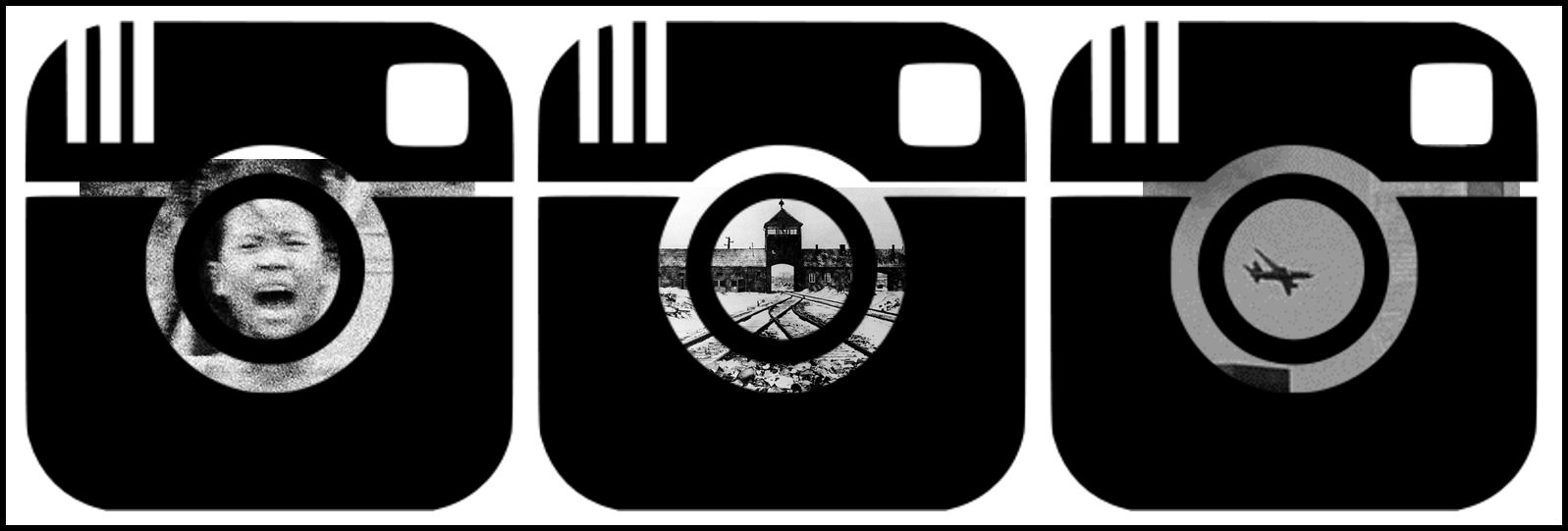
instameaning

The attacks in Belgium this week have brought with them a fresh set of images showing the immediate effects of the bombs, commemoration on the streets of major cities, of those responsible and of those killed and injured. At the same time, cartoonists and illustrators have responded to the challenge of summarising the day in a single graphic response.

One image singled out in a Guardian article was that of an Indian air stewardess, Nidhi Chaphekar, sitting stunned and bleeding in the departure hall of Zaventem airport in the immediate aftermath of the explosions. Taken by Ketevan Kardava, a Georgian journalist, the image made the front pages of several newspapers the following morning and the hashtag #PrayforNidhi started trending on Twitter. So far, so understandable: I hope she’s alright and wish her a speedy and full recovery.

What has struck me is the tone of some of the stories about the image and its subject. A Guardian article by Nadia Khomami described the image as ‘The photograph that has come to define the horrors of the Brussels attacks’. A piece by Olivier Laurent for TIME said that ‘In just a few hours, her portrait has come to define the March 22 terrorist attacks’: the title of the article described the image as ‘iconic’. Similar sentiments and phrasing ran through the tweets and many of the articles: a Times of India article drew a comparison with other ‘seminal photographs that define historic episodes’, comparing it with ‘the picture of a naked Vietnamese girl running away from a napalm explosion in 1968’ or the picture of Aylan Kurdi drowned on a Turkish beach in 2015 which (reportedly) ‘seared the conscience of the world and moved the West to finally act on Europe’s worst refugee crisis since the World War’.

Images are powerful. Photographs in particular have an immediacy and truth-value which derives from a core belief, unshaken by the ironies and post-ironies of postmodernism that they constitute something ‘stencilled off the real’, as Susan Sontag put it. At the same time, as arrested moments, they solidify into symbols terrifyingly quickly, as the overblown claims of the Times of India demonstrate. Working with Holocaust imagery, I am often struck by the way in which photographic images move between evidence and symbol, often in the same moment. The photograph below of the unloading of a transport of Jews from (what is now) Hungary is a case in point. Here is the original:

USHMM 77241

USHMM 77241: ‘Jews from Subcarrpathian Rus undergo a selection on the ramp at Auschwitz-Birkenau’, May 1944.

Just a short walk from where I sit writing this, the Holocaust gallery of the Jewish Museum London is organised principally around the life of Leon Greenman, born in the East End but raised in Rotterdam, who was deported to Auschwitz in 1943. His wife and son were murdered on arrival but he survived, living in London until his death in 2008, aged 97. The photograph is used here: this time, though, it is captioned as depicting ‘Guards separating new arrivals at Birkenau’. With a different caption the image moves a step away from its particular context into the general. In the moving video testimony by Greenman which is the central feature of the gallery, the image becomes a backdrop to his testimony of arrival and separation from his family. From evidence to symbol, in the blink of an eye: there are no photographs of the Judenrampe between Auschwitz and Birkenau where the Greenmans arrived. The siding the photograph depicts would not be built for another year. Else and Barney Greenman made their way to the gas chamber in a truck along with other women and children: as Leon’s memoir states, ‘Most of them were tired from the journey and a ride was very welcome.’ But this was not pictured, so the transport from 1944 must take its place, allowing us to picture an old man’s pain, narrated in front of us.

File_000

The process by which Holocaust imagery has developed and changed is one which has taken seventy years – so far. The possible number of images is huge – browse the collections of the Imperial War Museum in London, the United States Holocaust Memorial Museum in Washington or Yad Vashem in Jerusalem – but very often we see the same images used again and again. Sometimes because they are powerful images; sometimes because they are the only images we have. Sometimes because, having been shown so often, they signify the event to such an extent that the event might be said to describe them. The gate of Birkenau – one site in the Holocaust, albeit a crucial one – overtakes its context.

But this is a process which happens over time. The coverage of the coverage of the Brussels attacks twenty-four hours later allows no space for reflection, absorption, sifting of the facts, knowledge of the story. Mistakes get made in the rush for an icon: Nick Ut’s photo of Kim Phuc screaming in the distress of her injuries was taken in 1972, not 1968. Did the photograph of Aylan Kurdi really move the West to finally act to end the refugee crisis? Or did it provoke a wave of public sympathy that was bought off by a few quick headlines? Time will tell, but a report by Philippe Fargues for the Migration Policy Centre is laconically titled ‘2015: the year we mistook refugees for invaders’ and suggests the continued ‘wars and conflicts that produce forced migration’ leave ‘little doubt that the refugee movements will continue in Europe’s neighbourhood.’ What is needed, says Fargues, is the political courage to address long-term problems rather than a continued search for a short term fix. There is, he says, little to be found.

At the beginning of researching this piece, I entered ‘Brussels attacks’ into a Google image search to test whether the image of Nidhi Chaphekar was a particularly prominent image. In fact it is one of many, some way down the page.

Brussels Capture 1

Sample of Google Images search: ‘Brussels attacks’, 24 March 2016

Other images included the grainy footage from airport security cameras of the three bombers, wheeling trolleys. Or of Pauline Graystone scrambling on the floor of the airport, ‘keeping small’ as advised by a Guardian article the previous day on how to survive a terror attack, as she told The World at One.

Reading the articles about Nidhi, I was reminded of the coverage of the July 2005 attacks in London. In particular, the image of John Tulloch, a Professor of Media Studies, bleeding and dazed after the bombs, anchored to a headline on the front page of the Sun: ‘TERROR LAWS: TELL TONY HE’S RIGHT’. As with Nidhi, his image ‘somehow seemed to capture the particular horror of a very banal everyday life interrupted in the most shocking way imaginable.’

But Tulloch’s opinion on the ‘terror laws’ the Sun made him the poster-boy for was the opposite. His brave and fascinating memoir, One Day in July: Surviving 7/7, makes clear his opposition to the process of othering and his commitment to understanding the attackers.

Perhaps Nidhi, once the shock and pain has passed, will embark on a similar journey and believe similar things. Perhaps she won’t: the question is, will we keep asking, once the initial shock is over and absorbed into memes that mix sentiment with a quick moral fix? For now, we have appropriated her image but not heard her voice.

And what questions will we ask of those who did this? Will we ask why they did this, what agenda they thought they pursued in this carnage? Or will we just add their images to the roll call of similar pictures from London, Paris, and New York?

‘Keeping small’, said Pauline Graystone, was the advice from the Guardian on how to get through an attack. Perhaps: but if we are to survive, we need to look for the biggest possible meaning, the most appropriate symbol as related to the fullest and most complex account of the facts we can find, not the instameaning – the portable and disposable short-term framing based on insufficient time and excess adrenaline. The depiction of events such as the Holocaust or World War 1 illustrates that symbolism does become fixed – I argue that it is an element of recovery to ritualise the trauma, locate it within unfolding meaning, turn it, in fact from endless process to limited event – but it must be allowed to do so at its own pace, not turned from breaking news to icon within a news cycle.


On Holocaust Memorial Day, 2013

25 Friday Jan 2013

Posted by jaimeashworth in The Holocaust: Representations and Meanings

≈ Leave a comment

Tags

HMD2013, Holocaust, Holocaust Education, Holocaust Memorial Day

Judenrampe 2009

The ‘Alte Judenrampe’ between Auschwitz I and Auschwitz II-Birkenau: used between 1942 and 1944, hundreds of thousands of deportees arrived here. Photo: author, 2009.

As an academic, my research is concerned with the questions of representation associated with the Holocaust and its aftermath. To do so, I employ the term mythology in the Barthesian sense of ‘a language in which other things are spoken.’ In other words, seeing the representation of the Holocaust as more and more a prism through which other stories and concerns are addressed. Speaking of the Holocaust in Israel is to engage with the foundation of the state; in Britain, the Holocaust and World War II are important signifiers in an ongoing search for a post-imperial role between the United States and Europe; in Poland, the difficulty and controversy in talking about the Holocaust illustrate the ongoing search for an articulation of Polish wartime history that reconciles the facts with the sensibilities of those involved. In all three cases, the Holocaust is a major component of the search for a ‘usable’ past. As Robert Eaglestone observed in The Holocaust and the Postmodern (Oxford 2004) the Holocaust is ‘something wider, more significant, and, precisely because it is so all-pervasive, very much harder to pin down: [part of] a sense of “who we are” and “how the world is for us”’

But focusing exclusively on this sense of the Holocaust’s historical importance and cultural centrality – Holocaust Memorial Day is the only pan-European memorial day, for example – is to (potentially) miss an important truth. In a short and trenchant analysis of Postmodernism and Holocaust Denial (Duxford 2001), Eaglestone interrupts his characteristic eloquence to remind us that ‘writing and reading about the Holocaust is, and ought to be, distressing.’ He develops a comparison to bring home to the reader what we are talking about – mass murder – and its victims and perpetrators, reminding the reader of accounts of killings in which uniforms were described as ‘saturated with blood’.

So, compare: think about getting blood on your clothes from a nosebleed: think how much, much more blood – the blood of the victims – would ‘saturate with blood’ a thick military uniform. On one day. And the killings, of all sorts, lasted years. (p. 29)

Holocaust Memorial Day serves for me a similar purpose to Eaglestone’s comparison – which he immediately concedes is ‘not even really a comparison.’ It reminds me that fundamentally in researching and teaching about the Holocaust we are remembering the dead and asking that such things never happen again – even if the latter half of the twentieth century and opening decade of the twenty-first suggest that this lesson has been only imperfectly heard and hardly learnt at all. The knowledge that seeing this as a failure is in itself a kind of progress is a hollow sort of satisfaction, though it is better than none at all.

I use ‘mythology’ for a variety of reasons, some of which are set out above. In addition, though, it attracted me because it addressed the kind of incomprehension and sadness I feel when I engage with testimony or images that move or disturb me. To term the Holocaust a modern mythology allows me to reconcile the paradoxes inherent in trying to explain that which will not be explained, and removing any possibility that it might be explained away. Myths are not there to be explained, but instead to be heard: as an early collection of Holocaust literature put it, ‘A whirlwind cannot be taught, it must be experienced.’ And we are left with the knowledge that since we have not (for the most part, thank goodness) experienced it all we can do is try to teach it.

But there are different kinds of teaching. The following excerpt from an eyewitness account of a mass killing in Ukraine in 1942 has made me wonder – still makes me wonder – how we face the apocalypse and if there is a meaning to be found.

 The father held the ten-year-old boy by the hand speaking softly to him. The boy was struggling to hold back his tears. The father pointed a finger at the sky and seemed to be explaining something to him.

More than once, while teaching groups of first-year undergraduates with this and other documents, students began to cry and apologised. It is important to remember that in the face of such things tears need no apology: we should be upset, we should cry, we should mourn. And then we should make sure that we do what we can to make the world better. God willing.

Newer posts →

Recent Posts

  • The Holocaust and its Perpetrators: A Response to Douglas Murray and Andrew Roberts
  • Cracked Mirror: Holocaust Unconsciousness
  • The Price of Memory
  • Simulated Horror: AI and the Holocaust
  • Through the glass, darkly: a warning against Holocaust Distortion

Archives

  • September 2025
  • July 2025
  • June 2025
  • February 2025
  • January 2025
  • November 2024
  • February 2024
  • January 2023
  • January 2022
  • October 2021
  • September 2021
  • June 2021
  • August 2020
  • July 2020
  • March 2020
  • January 2020
  • January 2019
  • November 2018
  • January 2018
  • September 2017
  • August 2017
  • February 2017
  • January 2017
  • August 2016
  • March 2016
  • August 2015
  • August 2014
  • June 2013
  • May 2013
  • April 2013
  • February 2013
  • January 2013

Categories

  • Book Reviews
  • Culture and Politics
  • Heritage Politics
  • missinghistories
  • Photography and Visual Culture
  • The Holocaust: Representations and Meanings
  • Uncategorized

Meta

  • Create account
  • Log in
  • Entries feed
  • Comments feed
  • WordPress.com

Blog at WordPress.com.

  • Subscribe Subscribed
    • framingthequestion
    • Already have a WordPress.com account? Log in now.
    • framingthequestion
    • Subscribe Subscribed
    • Sign up
    • Log in
    • Report this content
    • View site in Reader
    • Manage subscriptions
    • Collapse this bar
 

Loading Comments...