
• Coursework and Dissertation Help
  • About the author…
    • #missinghistories
    • Independent Educator: Research-driven Education and Training
    • Writing and Research
    • Independent Researcher

framingthequestion

~ Reflections on memory, history, photography and culture

framingthequestion

Tag Archives: Holocaust memory

We Know Now

27 Thursday Aug 2020

Posted by jaimeashworth in Photography and Visual Culture, The Holocaust: Representations and Meanings

≈ Leave a comment

Tags

1948 Genocide Convention, Auschwitz, Bombing of Auschwitz, Holocaust, Holocaust Education, Holocaust memory, Uighur, Uighurs, Universal Declaration of Human Rights, Xinjiang
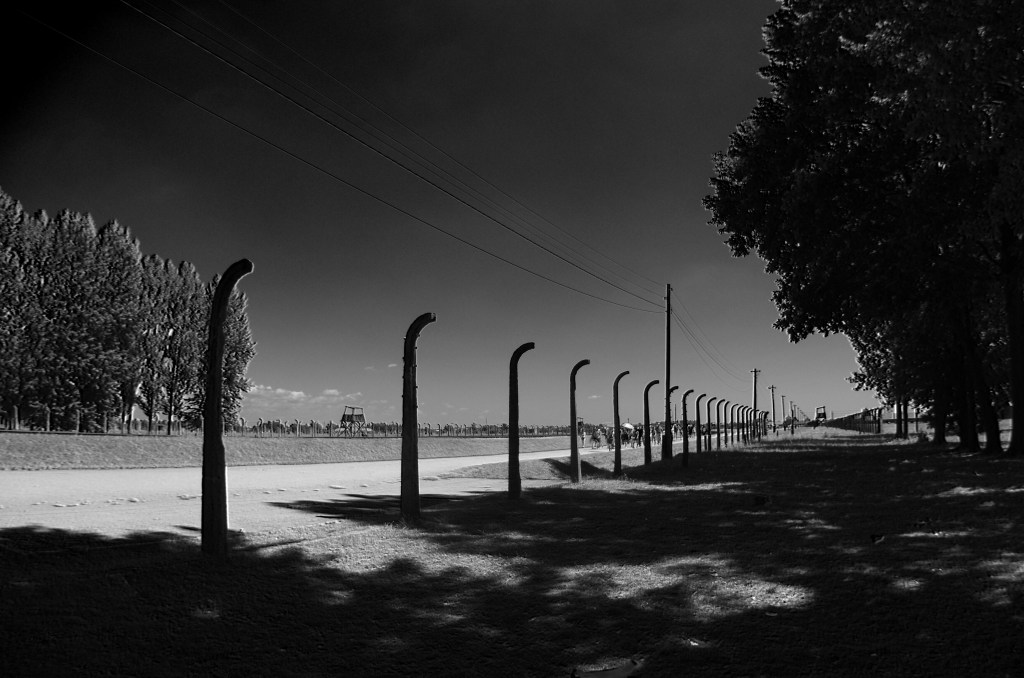
Auschwitz-II Birkenau, July 2015. Photo: Jaime Ashworth.

Among the most compelling of the exhibits at the Auschwitz Museum are the aerial photographs of the Auschwitz, Birkenau and Monowitz Camps taken by Allied reconnaissance in 1944 and early 1945. The images show the camps during some of their busiest – and bloodiest – periods of operation. If sufficiently magnified, it is possible to see groups of people walking from the trains to the crematoria and gas chambers. We can count the openings in the ceilings of the gas chambers of Crematoria II and III through which pellets of Zyklon-B were introduced. Visitors often leave, encouraged by their guides, with the sense that the world knew what was happening and remained silent.

A detail from an aerial photograph taken in August 1944. The red circle highlights the opening in the roof of the gas chamber of Crematorium II. The blue circle shows a group of deportees approaching the crematorium compound.

In fact, the truth is more complex. The images were taken using film cameras set to take constant exposures over many miles. The “target” of the surveillance was the chemical factory at Monowitz: built by prisoners in the adjoining Auschwitz III camp, the factory was built by the chemical combine IG Farben to produce synthetic rubber. At the confluence of the Vistula and Sola rivers, and located in a coal-mining region, the site was tailor-made for such a plant. The availability of cheap labour – the SS charged a fee to use prisoner labour – meant that the project could be completed relatively quickly and on a short budget. Although the Bunawerke factory never produced any Buna (synthetic rubber) it was a strategic target. In fact, it was bombed four times: twice in August 1944, once in September, and once in December.

The bombing of Monowitz is one of the most contentious episodes in the history of WW2. Why, critics ask, could the Auschwitz and Birkenau camps not have been bombed as well? In fact, stray bombs from one of the raids did fall on Birkenau, as recorded by survivor testimonies. A conference was organised at the United States Holocaust Memorial Museum in Washington in the late 1990s, with a volume of proceedings published in 2000. A short summary of a complex debate breaks down as follows:

Firstly, knowledge of Auschwitz was both plentiful and of questionable accuracy. Reports by escaped prisoners such as Rudolf Vrba and Alfred Wetzler made clear that mass murder was being carried out. But rumours of death by electrocution or burning were not accurate, and their estimates of numbers were (understandably) excessive. To prisoners caught up in hell, the constant stream of arrivals and the smoking chimneys must have made it impossible to say for certain more than that a very large number of people were being killed. Even perpetrators were unsure of the numbers. At Nuremberg, Rudolf Hoess, the commandant of Auschwitz, estimated that the dead in the camp totalled around 3,000,000. Research conducted in Poland in the early 1990s, however, demonstrated conclusively that approximately 1,500,000 people were deported to the camp, and of those around 1,100,000 were killed. But in 1944, at the closing stages of the war, the facts were unclear and resources at a premium. Auschwitz was at the very edge of operational range, and required a dangerous mission back and forth across Germany.

Secondly, there is the question of technological capability. The key idea here is Circular Error Probable: the likelihood of a given bomb hitting within a reasonable range of its target. Accustomed to footage of munitions that can virtually turn corners to match traffic lights, we forget that in 1944 a bomb was simply explosives set to blow up when it completed its vertical drop. To hit the crematoria, or the railway lines, or any other target, was difficult. The controversial Allied strategy of bombing German cities was employed because the technology made precision difficult unless flying by day – which increased the risk to aircrew. And this is before any thought is given to the likely cost in prisoner lives of any full-scale raids on the camp. Survivors may say that they would have welcomed it – but I am glad they are here to tell the story, rather than blown to smithereens by Allied bombs.

Thirdly, the intellectual framework did not exist to really comprehend what was in the images, even if someone had looked. It had not, as Primo Levi wrote, yet “been introduced irrevocably into the world of things that exist”. There was plentiful information about the Holocaust in both the popular press and the corridors of power, but it was not acted upon in the most basic way. It was not accepted as fact that the German intention was to exterminate the Jews of Europe. Assertions that it was, in the minds of decision-makers, belonged in newspaper headlines and lurid magazine articles, not the formulation of policy. A significant measure of antisemitism also contributed. Surely, some argued, this was just Jewish imagination at work, a persecution complex caught up in the war? In August 1942, Gerhart Riegner of the World Jewish Congress sent a telegram to Sidney Silverman MP, the WJC representative in London:

The Riegner Telegram (UK National Archives FO371/30917)

The ensuing five-day correspondence among officials acknowledged “numerous reports of large scale massacres of Jews” but focused on attempting to verify Riegner’s identity (“Eastern Dept. have no knowledge of Mr Riegner”) and ended with the following remark:

I do not see how we can hold up this message much longer, although I fear it may provoke embarrassing repercussions. Naturally we have no information bearing on this story.

Later in 1942, the activist Rev. James Parkes despaired that “The continued silence of the government in relation to the massacres is evidence of the strength in places of power of reactionary forces – from whom we have nothing to hope.”

But how then can we explain the pictures? Surely these images show that we knew exactly what was happening? There it is, in black and white, neatly labelled.

In fact, this is misleading. As I said above, the photographs were taken on huge rolls of film, covering many miles. The images of Auschwitz and Birkenau were at the end of these reels, after the “target” images of Monowitz. During the war, they were overlooked because analysts were not detailed to look. The images we are familiar with were only produced in the 1970s, when two CIA analysts named Dino A. Brugioni and Robert G. Poirier examined the images and conducted a retrospective analysis, uncovering many of the details that strike the visitor or viewer today. As they said in their report:
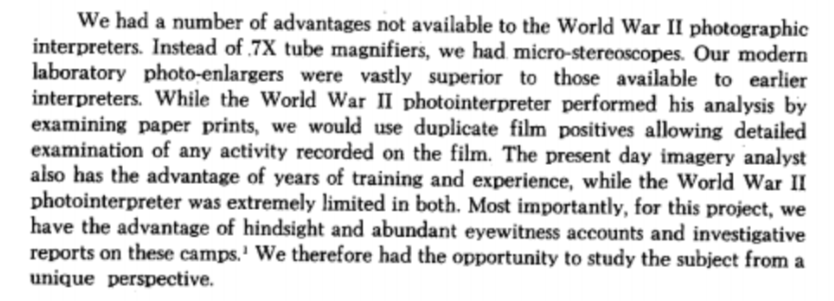
Extract from Dino A. Brugioni and Robert G. Poirier, “The Holocaust Revisited: A Retrospective Analysis of the Auschwitz-Birkenau Extermination Complex” (CIA, 1979)

In a variety of ways therefore, both technical and historical, not only were the images not looked at until the 1970s, they could not have been looked at earlier. The report also served another purpose than historical reconstruction. The pointed reference to the CIA’s photo-reconnaissance capability was meant to be understood most directly in Moscow: the clear message being that Russian military installations could be spotted, analysed and potentially destroyed.

Why is this important today? A BuzzFeed article prompted these reflections: an article about the treatment of the Uighurs in China. BuzzFeed used commercial technology to identify 268 sites, and was able to confirm that 92 of these are detention centres using documents, eyewitness testimony and academic research. Authorities in the region termed the claims of persecution as “a groundless lie”: “the issue concerning Xinjiang is by no means about human rights, religion or ethnicity, but about combating violent terrorism and separatism”. Some of these sites are sufficient to hold 10,000 people. The testimonies of those who have emerged from the camps to tell the tale are horrendous.

One of the detention sites identified by BuzzFeed.

This month, an open letter was sent to the government by more than 70 faith leaders, calling on the UK government “to investigate these crimes, hold those responsible to account and establish a path towards the restoration of human dignity.” The letter invoked the Holocaust, once more demanding that “Never Again” finally – this time – have some meaning.

In 1945, Primo Levi wrote that his liberators were oppressed by the evidence of the crime, “the shame the Germans did not know, that the just man feels at another man’s crime.” But this crime in many ways had only just been introduced into the “world of things that exist”. The legal measures of the late 1940s, the Genocide Convention and Universal Declaration of Human Rights, were landmarks, acknowledging for the first time that rights are human and transnational, that mass death is wrong, and that leaders cannot hide behind the state to evade responsibility. James Fawcett, one of the British contributors to these laws (and grandfather of our current Prime Minister), said in 1961 that their purpose was to ensure that “Sharpeville, Angola, Tibet, are all matters of international concern, though they happen within the jurisdiction of a particular state.” That these lessons were learnt while mired in the hypocrisy and crime of Empire does not detract from the imaginative, moral, ethical and philosophical leap they were.

But that leap was made for us. Now we know. Now, it is other words from Primo Levi that we must remember, before we once more say “Never Again”: “It happened, therefore it can happen again.” It is happening again: once more, as Levi wrote, the lords of death are waiting by the trains. It is our job to try and stop them leaving the station. Knowing is not enough: now we must act.

Meme Fever

22 Wednesday Jul 2020

Posted by jaimeashworth in Culture and Politics, The Holocaust: Representations and Meanings, Uncategorized

≈ Leave a comment

Tags

Coronavirus, COVID-19, COVID19, Holocaust, Holocaust Education, Holocaust memory, Infodemic, Pandemic

Photo: Jaime Ashworth, 2020.

The era of COVID-19 has seen two processes of contagion. The first is, of course, the disease itself, with its terrible toll on individuals, communities and nations. The second, however, is what the WHO and others have termed an infodemic: defined very precisely a couple of weeks ago by a working group.

An infodemic is an overabundance of information—some accurate and some not—that occurs during an epidemic. In a similar manner to an epidemic, it spreads between humans via digital and physical information systems. It makes it hard for people to find trustworthy sources and reliable guidance when they need it. (Tangcharoensathien et al., 2020)

I’m working on a more detailed piece about the infodemic, to go alongside a collection of my photos from this year. In the meantime, however, I’ve been looking at the memes shared in my social media echo chambers. Sometimes they make me laugh but as a class of discourse they make me profoundly uneasy.

Memes are directly compared to viruses by the epidemiologist Adam Kucharski in his book, The Rules of Contagion (2020). He notes the problems posed by “simplistic anecdotes and ineffective solutions” for disease control and begins the book with an account of how he (accidentally) caused “a small outbreak of misinformation.”

The irony is that memes are simplistic anecdotes masquerading as panaceas. Like viruses, memes have no function but their own reproduction with no regard for the health of the host. Matters are further complicated by the fact that social media offer a perfect environment for them to thrive. Back in the day, “Frankie Says” was a meme, but it’s harder to edit a t-shirt than it is to share something online. One meme in particular recently caught my eye.

This meme is part of longer and bigger debates about education, race and identity. I do not claim any priority for this meme’s importance other than the fact I’ve spent my adult life teaching and learning about the Holocaust and for that reason find it deeply problematic, educationally and philosophically. My experience allows me to locate the sources of my ire because I have expertise: itself a suggestion that the reduction of history to lessons without content is not very practical. But I digress.

Firstly, the idea that the second and third parts of the statement can be accomplished without the first is problematic. Without the murder of six million Jews being remembered, the second statement makes no sense: what is the “it” that was required? And in the third statement, the “history repeating itself” is the murder of six million Jews that apparently the author thinks is optional to remember.

Second, and much more problematic, is the weasel formulation of the first statement. If the word “only” or “just” were added, the sentiment might make more sense (though as I’ve just explained I don’t think it really does). But as written it comes very close not to suggesting that education cannot be reduced to simply memorising (which of course is true and something that all good teachers work hard to ensure) but that education equals not remembering the murder of six million Jews.

This ambiguity is difficult because with a negative reading of an oddly formed sentence, the meme seems to be suggesting that instead of anchoring our understanding of the world to historical facts and debates, it should instead come from belief in an unstated mechanism that led “ordinary Germans” to be “convinced that it was required”. Setting aside the complex historical debate about degrees of knowledge, cooperation, acceptance and resistance this dismisses (the author of the meme can’t be bothered so why should I?), the implication is that children should be “educated” in some unstated monocausal view. Another word for this is indoctrination.

One of the key aspects of indoctrination is ignoring facts in the interests of clarity: such as, for example, downplaying the importance of the victim group of “what happened”. The sleight-of-hand with which this example severs meaning from content (thus rendering it meaningless) is the primary source of my anger.

Ironically, the indoctrinated have historically been very bad at spotting the writing on the wall because, well, they were indoctrinated to believe it wasn’t important. Such a process seems to have taken place very imperfectly in Nazi Germany, chiefly because the Third Reich only lasted twelve years. The debate about why and how this happened, which the author of this meme either doesn’t understand or doesn’t care about, is ongoing. But the desire to present children with “lessons” without evidence is certainly among the phenomena involved: along with ensuring that the benefits of oppression and murder were widely shared, and that perpetrators were placed in stressful, confusing situations with alcohol to dull the senses when reality could no longer be explained but simply avoided. But reiterating the nature of that reality is crucial, educationally, because without it, the question “Why is this important?” is hard to really answer.

Because, finally, let’s not forget that forgetting victims is only in the interests of the perpetrators. Himmler termed the murder of European Jewry “a glorious page in our history that can never be written”. Hitler asked “Who now remembers the Armenians?” This meme asks us to forget the Jews and replace them with an amorphous “victim” group that makes the “lessons” meaningless. The Nazis oppressed and murdered a whole range of groups and individuals, but to try and remove their primary victim group is an assault on memory and an abuse of education. Subject (the Nazis) verb (murdered) and object (six million Jews) are all required for any conclusions to have any relevance. This is true, by the way, in teaching anybody about anything. The nature of the offence is a fundamental part of teaching to understand the past and (hopefully) avoid its repetition.

This is just one meme in an ocean of memes. As in Hamlet’s soliloquy, it is tempting to think we can “take arms against a sea of troubles and, by opposing, end them.” But this is a metaphor for futility. We are adrift and lost: what we can do (all we can do, perhaps) is sound out the ideas beneath the surface of individual examples in the hope we will find solid ground underneath.

On Holocaust Memorial Day, 2018: The Power of Words

26 Friday Jan 2018

Posted by jaimeashworth in The Holocaust: Representations and Meanings

≈ Leave a comment

Tags

HMD 2018, Holocaust memory, Shabbat, Stolpersteine, The Power of Words

IMGP3736

Oswiecim Jewish Cemetery. Photo: Jaime Ashworth, 2015.


I am often reminded of the midrash that says that all Jewish souls (neshamot) were present at Sinai. I remember it every Friday as my partner and I light candles for Shabbat: the words of the blessings over candles, wine and bread linking us not just to Jews all over the world but also through time.

Though I still need transliteration, if I am sufficiently centred I can feel the words coming not from my mouth but through me from a source that stretches back to Sinai. Liturgy as a “portable homeland” is a commonplace of Jewish Studies, but it is also a door through which the whispers of generations can be heard. My partner likes to poke gentle fun at my “authentic” Polish-accented pronunciation but for me, like Polish, the brachot come from a place just beyond conscious memory.

This Friday night also – thinking Jewishly – marks the beginning of Holocaust Memorial Day. This is a curious indicator of the symbolic tension between secular and religious understandings of the Holocaust. Mourning is prohibited on Shabbat – the shiva of eight days following a funeral is suspended for the twenty-five hours between candle-lighting and the resumption of “normal” time at Havdalah. To remember the Holocaust at such a moment, therefore, presents a challenge for observant Jews. How to commemorate slaughter at a moment when they are commanded to live most purely?

This year’s theme is particularly well-suited to reconciling the tension. Words are not (quite) actions, and can be uttered in any spirit. In thinking about the theme of HMD this year, I reflected on four things that they can be used for.

Firstly, and most obviously in a Holocaust context, they can be used to curse. Thomas Pegelow Kaplan has recently explored how language became an everyday vehicle for discrimination and hatred. Teaching about the 1935 Nuremberg Laws, I am often struck by how short they are: just a few hundred words to define and separate a people from work, from family, from relationships. Juden sind hier unerwünscht: Jews not wanted here. Signs with this short phrase demarcated new realities for German Jewry in the 1930s, realities which found ultimate expression in the ghettoes and camps of WW2. This was based on the slogan that was repeated in posters and signs, and repeated at rallies: Die Juden sind unser Unglück; The Jews are our misfortune.

This is connected to the second use of words: to lie. The measure of Nazi shame at what they did can be seen in the linguistic contortions and evasions that were employed. Euphemism became the only way in which what was happening could [not] be described. “Resettlement” meant deportation to murder. “Jewish residential district” signified a ghetto where the inhabitants lived from day to day on borrowed time and stolen hopes. The individual lives and stories consigned to the pits were reduced to “Figuren”: pieces, not people. The tension required to keep this linguistic distortion in place can be seen most clearly in Himmler’s October 1944 Posen speech to senior SS officers, when he referred to “the extermination of the Jews […] a page of glory never mentioned and never to be mentioned.” Himmler knew that his assertion of the ‘glory’ of the Holocaust would not survive the scrutiny: he could only be proud of his crimes if he kept them secret and far from challenge. Language can cover and conceal the facts, even from their authors.

Survivors have long struggled with the challenge posed by this debasement of language, trying to find truth and value in debased coinage. Primo Levi wrote of the realisation after being stripped, shaved, showered, tattooed and thrust into “the blue and icy snow of dawn, barefoot and naked” that “our language lacks words to express this offence, the demolition of a man.” Charlotte Delbo, sent to Auschwitz for her work in the French Resistance, questioned whether one could even speak of “after”:

I’m not alive. People believe memories grow vague, are erased by time, since nothing endures against the passage of time. That’s the difference; time does not pass over me, over us. It doesn’t erase anything, doesn’t undo it. I’m not alive. I died in Auschwitz but no one knows it.

For many – Tadeusz Borowski, Paul Celan, Jean Amery, possibly Levi himself – the sense that something essential of them had died in Auschwitz meant that they could not carry on. In Polish, in German, in French, in Italian, the reality of the Lager eluded description and in doing so meant life, interrupted by Auschwitz, could never really be resumed. Like the matzeva (tombstone) that heads this piece, life was broken and though some details of the life might be glimpsed, the words that might have animated them to live in our minds were lost. We can know she was Rivka, but we cannot know what she meant, to herself or others: though she died before the Holocaust, the deaths of her descendants most likely killed her a second time. Flesh become word, word become trace: the blank flashing of the cursor as we confront what we cannot now know.

For others, however, the struggle to tell the story was its own reason to carry on. The fierce insistence of Elie Wiesel that “A novel about Treblinka is either not a novel or not about Treblinka” did not stand in the way of writing or working and reworking his memoir Night from its Yiddish original to French, and thence from French to English. His wife Marion retranslated it in 2006, returning to the task he began in Paris in the 1940s, trying to “conjure up other verbs, other images, other silent cries”. But they wouldn’t match the words that took his little sister from him, on the ramp in Birkenau: men to the left, women to the right.

Eight words spoken quietly, indifferently, without emotion. Eight simple, short words. Yet that was the moment where I left my mother. There was no time to think, and I already felt my father’s hand press against mine: we were alone. In a fraction of a second I could see my mother, my sisters, move to the right. Tzipora was holding Mother’s hand. I saw them walking farther and farther away; Mother was stroking my sister’s blond hair, as if to protect her. And I walked on with my father, with the men. I didn’t know that this was the moment in time and the place where I was leaving my mother and Tzipora forever. I kept walking, my father holding my hand.

Working with the Holocaust Educational Trust on their Lessons from Auschwitz project, we stand where the words were spoken and read Wiesel’s account. There is often a biting wind, and the students are tiring from the long day. And yet these words cut through: the students’ eyes lift from the ground out of their coats and scarves. Eyes stream from more than the wind and even above the wind you can hear the silence.

The sheer number of Holocaust testimonies is the best testament to the difficulty of putting into words both the experience itself and its meaning afterwards. Paul Steinberg, in his distinctively reflexive memoir Speak You Also tries to unpick his memories of Auschwitz from his depiction by Primo Levi as “Henri”, the quintessential survivor who “closed himself up, as if in armour [fighting] to live without distraction”. Whether or not he found truth he leaves uncertain: with the penultimate sentence he refers to “reflections and intermittent memories” which provide him with what he calls the alibi he needs. Whether it is truth, he is unsure, but it is a verdict; “Officially cleared from the docket […] A delivery, however long overdue, is still a deliverance.”

But this is far short of the final power of words: to heal and bless. It is rather the attenuation and separation of meaning from context imagined by Andre Schwarz-Bart in his final novel, The Morning Star, imagining how a race of immortals might try to understand the massacre, hearing its “drawn-out echo” twisted by distance from their source. “The star-dwellers would say, for instance, to mark the idea of an epitome, of a peculiar intensity: an Auschwitz of gentleness, a Treblinka of joy.” This carries through the idea of his first novel, The Last of the Just, describing how the Holocaust consumes the last of the Levy family, the final Lamed Vav: the last of the righteous men and women whose goodness justifies the purpose of mankind to God. Without the just, words lose their meaning; and without meaning the just lose their lives.

This loss of the meaning of words is a feature of modern life. Post-modernity, with its recognition that neither the tale nor the teller could be entirely trusted, allowed the questioning of established “truths” of relationships between genders, classes, and individuals, even if this has fallen far short of their dismantling. Many authors have commented on the way in which the Holocaust, as it threw into doubt the assumption of European progress, made that questioning and dismantling possible. If the systems that produced our societies produced the death camps, then how could we not question the systems?

But this assumed a world in which the connection between sign and signified was relatively stable. As we consume more and more information at progressively greater remove, we can be less and less sure of provenance, context and corroboration: the constituent parts of what might be termed truth.

In the 1980s, the French philosopher Jean Baudrillard warned of the rise of simulacra: copies for which there was no original. Eight years before the internet, he warned that there was “more and more information, and less and less meaning” and that the confusion of exposure to information with participation in social life carried with it the possibility of a collapse of both. He worried that “meaning is lost and devoured faster than it can be reinjected”.

As Matthew D’Ancona has written, the discrediting of authorities or arbiters has collapsed into “unhealthy relativism, in which the epistemological chase is not only better than the catch – but all that matters.” We have become experts at spotting “bias” or privilege but unable in many cases to distinguish them from perspective or principle. In a world where nothing can be relied on, we have attached ourselves, limpet-like, to what “feels right” or can be argued over what can be proved. “Alternative facts” are preferred to inconvenient truths.

And there is no need for the bureaucracy of an Orwellian state along the lines of 1984. The Ministry of Truth can be built in computer programs and the corrections are seamless, almost impervious to checking. Robots compile stories from building blocks, replacing possibility with doubt, substituting meaning with syntax.

So how can we put that meaning back? The answer is, paradoxically, found in Auschwitz. Each Lessons from Auschwitz trip is accompanied by a rabbi and each trip ends, symbolically at least, with a ceremony at the end of the rail lines in Birkenau. Long since the night has drawn in and with temperatures falling, the group of two hundred people listens to poems and prayers. The rabbi says many things but the core of what he has to say is a single word, which he asks the group to repeat: Zakhor. Remember. Hold on to what you have seen, what you have heard, where you have gone. In the vastness of the Polish sky, the words barely echo, even on the stones. But the word comes out and goes up all the same.

Words travel in unpredictable directions. Two years ago, a postcard sent by my partner’s great-grandparents from Izbica, the last stop on their journey to Sobibor, was found in a German flea-market. The finder found my partner’s mother and the postcard has led to a trip next week to where her mother came from in 1939; from where her grandparents and great-uncle were deported in 1942. We will stand outside their former home and watch as an artist installs Stolpersteine – stumbling stones – in the pavement. Their names, their dates of birth, their deportations and their deaths will become part of the landscape: flesh become word, word become trace, trace become memory. And then, inscribed on the stone as well as in memory, perhaps there will be some kind of peace. Words speak of the possibility of going on; but only if we are present to the truth of what happened, to receive the sparks as they fly outward, so that we may bless them.

Newer posts →

Recent Posts

  • The Holocaust and its Perpetrators: A Response to Douglas Murray and Andrew Roberts
  • Cracked Mirror: Holocaust Unconsciousness
  • The Price of Memory
  • Simulated Horror: AI and the Holocaust
  • Through the glass, darkly: a warning against Holocaust Distortion

Archives

  • September 2025
  • July 2025
  • June 2025
  • February 2025
  • January 2025
  • November 2024
  • February 2024
  • January 2023
  • January 2022
  • October 2021
  • September 2021
  • June 2021
  • August 2020
  • July 2020
  • March 2020
  • January 2020
  • January 2019
  • November 2018
  • January 2018
  • September 2017
  • August 2017
  • February 2017
  • January 2017
  • August 2016
  • March 2016
  • August 2015
  • August 2014
  • June 2013
  • May 2013
  • April 2013
  • February 2013
  • January 2013

Categories

  • Book Reviews
  • Culture and Politics
  • Heritage Politics
  • missinghistories
  • Photography and Visual Culture
  • The Holocaust: Representations and Meanings
  • Uncategorized

Meta

  • Create account
  • Log in
  • Entries feed
  • Comments feed
  • WordPress.com

Blog at WordPress.com.

  • Subscribe Subscribed
    • framingthequestion
    • Already have a WordPress.com account? Log in now.
    • framingthequestion
    • Subscribe Subscribed
    • Sign up
    • Log in
    • Report this content
    • View site in Reader
    • Manage subscriptions
    • Collapse this bar
 

Loading Comments...