• Coursework and Dissertation Help
  • About the author…
    • #missinghistories
    • Independent Educator: Research-driven Education and Training
    • Writing and Research
    • Independent Researcher

framingthequestion

~ Reflections on memory, history, photography and culture

framingthequestion

Tag Archives: Holocaust Education

Three Stories: Reflections on Lessons from Auschwitz

29 Sunday Mar 2020

Posted by jaimeashworth in The Holocaust: Representations and Meanings

≈ 1 Comment

Tags

Auschwitz, COVID-19, Holocaust, Holocaust Education

Working as a Freelance Educator on the Holocaust Educational Trust’s Lessons from Auschwitz project is probably the most rewarding and important thing I do. When COVID-19 interrupted all our lives, I was part of the way through an exceptionally busy term with two visits completed and two to come. While this letter is addressed to one group in particular (with whom I was hoping to do a follow-up seminar) it is also meant for all the groups I’ve worked with.

The main gate to Auschwitz II-Birkenau, March 2020. Photo: Jaime Ashworth

Dear Group Five,

First, let me say that you were lovely. Bright, curious, open to learning new things, as groups so often are. It’s just one of the reasons I love working as an Educator on the project. But you had something else in addition: an emotional grasp of what the trip meant that I’ve only rarely encountered and a willingness to share that with me and each other that was beautiful and inspiring to work with.

I am, quite simply, gutted that I haven’t been able to complete my sections of your LFA journey. I was looking forward to hearing your reflections and insights and getting a glimpse of your next steps. I don’t think anyone knows when or how that may happen – though I’m sure the logistics team that do everything to manage the seminars and trips are working to answer that question. In advance of that possibility I want to share some ideas about the possibilities and challenges that lie ahead in your next steps. 

On a personal level I am wary of the idea of lessons. Michael Marrus, a distinguished scholar of the Holocaust and its history, wrote in his memoir that lessons are problematic, often telling us more about the person drawing the lesson than the past itself. I agree. But if we don’t try to draw lessons all we are left with is horror. So we have to strike a balance.

Certainly the idea that we can easily draw inspirational lessons is to be approached with caution. After hearing the testimony of Steven Frank, you identified that the most important factor in his survival was luck. Yes, he was young and healthy. Yes, he was resilient. Yes, he enjoyed the support of a parent who was also spared. But so did many others. As we are discovering, there is by definition no logic to catastrophe. Kings and beggars, villains and saints – all perished, the remainder saved only by capricious chance. As Primo Levi reminded us in his final book, The Drowned and the Saved:

We, the survivors, are not only a tiny but also an anomalous minority. We are those who, through prevarication, skill or luck, never touched bottom. Those who have, and who have seen the face of the Gorgon, did not return, or returned wordless.

Shortly after finishing the book, Levi died, falling down the lift shaft of his apartment building in Turin. There is a debate about whether he fell or jumped. I’m not sure it matters: he had spent a lifetime contesting the verdict on himself he had pronounced in the camp, convicted in his own mind by the fact of his survival. He had acted as best he could, but remained concerned that this had still been at the cost of others’ survival. As the Polish writer (and Auschwitz inmate) Tadeusz Borowski described so well, the camp experience involved everyone in the crime. One could not emerge from it without, however inadvertently, being tarnished. Because if you survived, someone else hadn’t. This is why understandings of survivors now focus more on shame than guilt. Guilt might be contested, shame enters the skin, as indelible as a tattoo.

Lessons need to be approached carefully, mindful of the facts and their complexity. Perhaps the only lesson that really matters is to see humanity and potential in everyone. That’s why the emphasis is on rehumanising the victims: because you can’t see the humanity in a statistic. But you might glimpse it in a market square or the site of a synagogue. Or in the objects brought by deportees, proclaiming their faith in the simple belief that life would go on, with prayers to be said, meals to be cooked and teeth to be brushed. And the reassurance of house keys in their pocket.

And what of the perpetrators? Should we see them as human? The Polish epigram Ludzie ludziom zgotowali ten los, coined by the writer Zofia Nałkowska while investigating Nazi crimes, is often translated as “man prepared this fate for man”. Which I suppose has a certain cadence in English. But in fact it is literally “People prepared this fate for people.” The first translation may look better carved in a stone tablet but it detaches the actors from their actions. People did this: people like you, people like me. And as Jonathan Littell notes in his novel The Kindly Ones:

If you were born in a country or at a time not only when nobody comes to kill your wife and your children, but also nobody comes to ask you to kill the wives and children of others, then render thanks to God and go in peace. But always keep this thought in mind: you might be luckier than I, but you’re not a better person.

So where do we go from here? Primo Levi wrote of the shame of the liberators as they entered the camp, their eyes downcast because this had happened, that such crimes had entered the world of existing things. A sense of shame at humanity is a common response to Auschwitz even today, 75 years later. And it is both correct and just the beginning of the story. You are it’s next step.

I often tell three stories when saying goodbye to groups.

The first is by Elie Wiesel and concerns the trial of God. A trial in the barracks of Birkenau where the inmates found God either guilty or absent. But then it was time for prayers, so they prayed. Sometimes we carry on despite our conviction that things are worthless – because sometimes that’s all there is to do.

Elie Wiesel was liberated in Buchenwald, aged sixteen. He spent a lifetime trying to explain Auschwitz but often resorted to the aphorism that “The truth of Auschwitz lies in silence”. It’s another good phrase that looks very impressive carved in stone. But here’s my question: if the truth of Auschwitz lies in silence, how do we tell it? 

The final story is from the late Clive James. On a visit to Munich on assignment for the Observer in 1983, he visited Dachau. His description is characteristically both beautiful and learned.

There is a place in Virgil’s Aeneid called the broken-hearted fields. Standing in that snow-covered space I could think of no better description. Nor was there any point in reproaching oneself for being unable to shed tears: if we could truly imagine what it was like, we would die of grief.

I often think of these words when I talk to students worrying about whether their next steps will be enough or hear educators fret about whether they covered everything, whether they did justice to the facts. Of course they didn’t, because nobody can. We ask you to bear witness to Auschwitz, knowing that it’s really beyond description; because it’s the attempt that matters.

And so I suggest one final lesson from Auschwitz: it is better to speak than to remain silent. And you must trust that whatever you say will be perfect – because the alternative is saying nothing at all. The rest, as Rabbi Hillel said, is commentary: now go study. 

Wishing you safe passage and a prosperous voyage in these troubled times. 

Jaime

London, March 2020
Normalisation and its discontents

05 Sunday Feb 2017

Posted by jaimeashworth in Culture and Politics, The Holocaust: Representations and Meanings

≈ Leave a comment

Tags

#MuslimBan, alternative facts, Bowling Green Massacre, Holocaust Education

img_0424

Photo: Jaime Ashworth, 2014.

I like it when my musings on Twitter are acknowledged. The sense that you’re just part of a vast crowd baying at each other subsides and you glimpse the original purpose: to find new ways to connect. Many of my favourite tweeters and I have linked through debate and the recognition that their voice is worth listening to.

I also – I have to be honest – like the micro-massage of my ego that a ‘like’ or a retweet gives. ‘Oh, I might be making some sense is the thought that goes through my mind, though I appreciate that using cyberspace as an arbiter of sense is not a strategy without drawbacks.

But I was nonetheless pleased that a comment I made regarding the Trump presidency and fascism seemed to be picked up, albeit in a small way. To use the rather concerning metaphor of infection that tells us so much about the internet, I was barely communicable, much less viral.img_2470

My opinion, by the way is based on the work of Roger Griffin and Roger Eatwell, as well as twenty years of trying to understand the Nazi regime and its murderous policies. I was pleased that the comment was acknowledged and therefore curious when I received a fairly bald refutation in response.

img_2471I stopped for a while and considered what he had said. Was I becoming obsessed? One of those people who relies on third-hand summaries of second-hand accounts of made-up comments? Or could something else be going on? I retorted and await a response.

I was struck, though, that already the ‘reasonable’ voice is starting to be heard. We should be practical, it says. We should be realistic. We should be sensible. This isn’t fascism because it doesn’t threaten concentration camps or wear a uniform other than cheap baseball caps with a vacuous slogan.img_2473

In the Observer this morning, John Daniel Davidson attempts to argue that this is the hysterical reaction (his misogyny, not mine) of a liberal elite whose grip on power has been shaken by “millions of voters [who] have felt left behind by an economic recovery that largely excluded them, a culture that scoffed at their beliefs and a government that promised change but failed to deliver.” Perhaps if the Republican Congress had passed a better and easier ‘Obamacare’ things would be different. Instead, they shouted ‘Socialism’ very loudly until the cries from the emergency rooms they underfunded were drowned by shots from the guns they wouldn’t control.

In the Sunday Express, the former Archbishop of Canterbury Lord Carey warns of “hysterical overreaction that poses a danger to the kind of constructive relationship we should have with the President.” The newspaper resorts to its favourite bromide in its headline: ‘Keep calm and Carey on’. For myself, the idea of the world’s only remaining superpower abandoning basic standards of truth and decency makes it impossible to keep calm and hard to carry on.

Meanwhile, a US court has upheld the suspension of the immigration ban introduced into law on Holocaust Memorial Day is unconstitutional. A wave of consumers protesting against strike-breaking by Uber seems to have led to its CEO resigning from an economic council advising President Trump. You could be forgiven for thinking that things are settling down, that perhaps the forces of reason are on the move, marching to their inevitable victory.

As a teacher currently dealing with the Nazi era and the early English Reformation, I’m struck by the way my students struggle with the idea of belief. Looking at the persecution of the Observant Friars by Henry VIII, one of my students looked up and, with the dismissive confidence that only teenagers can summon, asked: “What’s the big deal? Why couldn’t they just change their minds?” The idea that people might have believed in these ideas so passionately that they were prepared to suffer or even die for them was utterly alien, to be greeted with rolled eyes and a complacent assertion of modern (or rather, post-modern) superiority. It is this sense of ideology as a joke and the importance of the subjective over the empirical that has paved the way for ‘fake news’ and the peddling of ‘alternative facts’ by senior members of the Trump administration.

Looking at the Third Reich and its maintenance of a peacetime regime, students’ initial responses have (predictably) focused on the terror state. After absorbing the fact that the Third Reich could not have enforced security without the consent and collaboration of large numbers of its population, I have struggled against the notion of brainwashing, as though pervasive propaganda removes the need for moral choice.

Only as we have started to look in more detail at the crimes committed against Jews, Sinti and Roma, the disabled, homosexuals and people of colour have students really considered whether passive acceptance of propaganda is sufficient to explain silence in these things, let alone the cooperation that was required. Lists do not make themselves; doors do not unlock themselves; cars and trucks and trains do not drive themselves. A bullet can only be fired after a finger pulls the trigger. Claudia Koonz wrote in The Nazi Conscience that “what is frightening about the racist public culture within which the Final Solution was conceived is not its extremism but its ordinariness”.

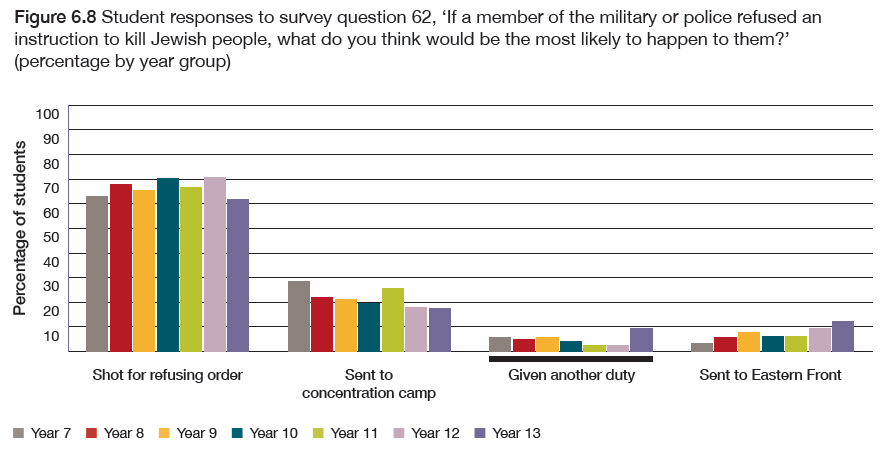
The widespread lack of awareness (see the result below from a nationwide survey of secondary schools) that there is no recorded instance of any perpetrator being punished following a refusal to kill is an important social fact with implications for educators across and beyond disciplinary boundaries. People have choices: the consequences of the perpetrators’ actions and choices were neither remote nor hard to discern.

ucl-hol-perp-results

Stuart Foster et al., What do students know and understand about the Holocaust? Evidence from English secondary schools, UCL Centre for Holocaust Education, London 2015, p. 163.

In February 1933, the Austrian-Jewish journalist Joseph Roth wrote to Stefan Zweig about the Nazi regime:

“You will have realized by now that we are drifting towards great catastrophes. Apart from the private — our literary and financial existence is destroyed — it all leads to a new war. I won’t bet a penny on our lives. They have succeeded in establishing a reign of barbarity. Do not fool yourself. Hell reigns.”

Roth died in Paris in 1939, an alcoholic émigré unable to find work. As I watch the way the media and others are circling to tell us what to think, how to be sensible, I’m reminded of the shattering end to Primo Levi’s essay ‘The Grey Zone’:

“…we too are so dazzled by power and prestige as to forget our essential fragility: willingly or not we come to terms with power, forgetting that we are all in the ghetto, that the ghetto is walled in, that outside the ghetto reign the lords of death and that close by the trains are waiting.”

Yesterday, a friend of mine, the granddaughter on both sides of people who survived the Nazi era despite being marked for death as Jews, described how she was depressed by the constant flow of negativity, writing vividly of jogging through a Berlin forest to escape, finally stopping, hyperventilating into the icy fog of the morning. She concluded, though, by reminding us that “This may be bigger than us, but it is not stronger, nor smarter than our energies combined.” We keep shouting, keep focused on the truths that we can see are self-evident: that there were fewer people at the inauguration of 2017 than that of 2009; that there was no Bowling Green Massacre: this is not normal. We are not in the ghetto: though the lords of death may seek to reign they can only do so if we let them.

An earlier draft of this post disappeared without warning from the host server. 

Then he saw her face…now she’s a Belieber?

15 Monday Apr 2013

Posted by jaimeashworth in Culture and Politics, The Holocaust: Representations and Meanings

≈ Leave a comment

Tags

Anne Frank, Holocaust Education, Justin Bieber, literature, reputation

Image

Justin Bieber went to the Anne Frank House last week and caused something of a controversy when his comment in the visitors’ book was released via a Tweet from the museum itself. For accuracy’s sake, here’s the text.

Image

As reported in a number of news outlets, the comment caused many of Bieber’s followers (and detractors) to attack the singer for being overly full of himself. In particular, it caused Emma Barnett in the Telegraph to write an indignant article under the intriguing headline ‘Justin Bieber doesn’t get to second-guess Anne Frank. Nobody does.’ 

Barnett takes Bieber to task for his ‘crass attempt to associate himself with one of the faces of the Holocaust’, recalling her memory of first visiting the Anne Frank House at age 10: ‘I still get chills thinking about my impressions of what I was about to discover, walking through the door into the cramped collection of rooms, tightly holding my mother’s hand.’

The business end of Barnett’s article, though, is in the final four paragraphs, where she outlines what I suspect are a representative set of attitudes under the outrage. To avoid any possibility of misrepresenting Barnett through clumsy paraphrasing, they are reproduced verbatim below.

Of course we don’t know if she would have been a ‘belieber’. The little girl inside of me hopes the wonderfully vibrant Anne Frank wouldn’t have stooped so low to be a cult follower of anything. She was a leader in my mind, not a follower. But I won’t be as crass as Bieber to try and even imagine her tastes or anything beyond those words she shared in her diary, her darling ‘Kitty’. 

What she wanted to let ‘Kitty’ know, (and then what Otto Frank deemed acceptable to share with the wider world when he published his daughter’s remarkable diary) is all we can and will ever know about Anne Frank. 

As you leave the Anne Frank Museum and write in the guestbook, most people I know almost don’t have any words. They often just share their sorrow, perhaps their own Holocaust story if they have one and express their praise and gratitude to the people who have kept Anne’s story alive. 

They certainly don’t write anything which is self-referential, nor attempt to guess what Anne would have been like had she been born to different generation. Justin Bieber needs to take note.

A few points. Firstly, as any visitor to the Anne Frank House would know, Anne was a keen follower of celebrity, as the pictures of film stars on her wall bear witness. As she noted in her diary on 11 July 1942 (just two days after the family moved to the attic: ‘Thanks to Father – who brought my entire postcard and film star collection here beforehand – and to a brush and a pot of glue, I was able to plaster the walls with pictures.’

The same passage, incidentally, is quoted in the downloadable guide to the museum, so one should be wary of the dismissive tone that Barnett adopts to explain Bieber’s comment as due to ‘one of the guides, who pointed out that Anne Frank was a fan of the pop culture of the time and that she might have been a fan of his.’ This seems to be a slight extrapolation of a standard part of the tour rather than the (implied) flattery of a famous visitor: so much, by the way, for ‘praise and gratitude to the people who have kept Anne’s story alive.’

The truth, though, is that we don’t know very much about what Anne thought about many things. As Barnett acknowledges, Anne’s diary was edited after the war by her father, who suppressed references to Anne’s sexuality and to the tensions in her relationship with her mother. Whatever the motivations for these choices, there can be little doubt that the version of the diary sold in the UK for much of the last sixty years has been The Diary of a Young Girl rather than (as it perhaps should be) The Diary of a Young Woman.

But the complexity doesn’t end there. On 29 March 1944, a broadcast by Gerrit Bolkestein, the Minister for Education in the Dutch Government-in-Exile, broadcast that ‘after the war a collection would be made of diaries and letters dealing with the war’ led Anne to rewrite and edit what she had written thus far, either for the official collection mentioned by Bolkestein or for a publication of her own. On 11 May, 1944, she wrote:

You’ve known for a long time that my greatest wish is to be a journalist, and later on, a famous writer. We’ll have to wait and see if these grand illusions (or delusions!) will ever come true, but till now I’ve had no lack of topics. In any case, after the war I’d like to publish a book called The Secret Annexe. It remains to be seen whether I’ll succeed, but my diary can serve as the basis.

From then on, not only was Anne writing with at least half an eye to posterity (there is, for example, a broader selection of themes than previously), she also edited and rewrote earlier sections. What we have of the diary for December 1942 to December 1943 is all from this period of rewriting. The authoritative Critical Edition of the Diary published by the Netherlands Institute for War Documentation in the 1980s puts all the alternative versions of all the entries alongside each other: a much less digestible and straightforward document than the paperback still (rightly) available from most bookshops. But this complexity means that everyone is creating an Anne of their own from the fragments left behind: Barnett is fooling herself if she thinks she isn’t ‘second-guessing’ Anne to some extent. Indeed, the final entry of Anne’s diary explains at length the extent to which she ‘second-guessed’ herself.

As I’ve told you, what I say is not what I feel, which is why I have a reputation for being a boy-chaser, a flirt, a smart aleck and a reader of romances. The happy-go-lucky Anne laughs, gives a flippant reply, shrugs her shoulders and pretends she couldn’t care less. The quiet Anne reacts in just the opposite way. If I’m being completely honest, I’ll have to admit that it does matter to me, that I’m trying very hard to change myself, but that I’m always up against a more powerful enemy.

Perhaps the most memorable quote from Anne’s diary is her comment on 5 April, 1944 (in reference to her literary ambitions, in the immediate wake of the Bolkestein broadcast) that ‘I want to be useful or bring enjoyment to all people, even those I’ve never met. I want to go on living even after my death!’ She certainly has: almost seventy years later, she is still famous and her diary is still the first introduction for many to the history of the Holocaust, though (as Barnett points out inadvertently) the Holocaust to a large extent happens ‘offstage’.

But this kind of fame comes at a price. Anne Michaels wrote in The Winter Vault that ‘we cling to the paintings from Theresienstadt, to a Dutch girl’s diary, because we need them to speak for every war child’s loss.’ But in making them speak for anything but their own fate and being, we make them into puppets for our own ends. Many of these ends are laudable – the work done by the Anne Frank House and the Anne Frank Trust, for example, in educating about the Holocaust, racism and (in)tolerance. Conversely, it might be argued that to derive an educational programme from the diary of a 13-15 year-old without her consent is to indulge in an editing of the past that is necessarily self-referential. We are all guilty of the same offence as Nathan Zuckerman in Philip Roth’s The Ghost Writer as he tries to persuade himself that a mysterious graduate student is actually Anne, survived and gone into hiding. ‘Alas,’ he writes, ‘I could not lift her out of her sacred book and make her a character in this life.’ Neither can we: we are all left with the blank knowledge that ‘Anne’s Diary Ends Here’.

I wonder whether Barnett would object to a photograph of Anne appearing on a Holocaust textbook? I suspect not, and yet for me the question this raises is to what extent the remarkable, inconsistent and talented young woman that Anne was is obscured by her placement within a view of the past that she could not consent to. Anne died in 1945, just days before the liberation of Belsen. We do not know the extent of her knowledge that she was one of the last victims of a campaign to murder the Jews of Europe. It had certainly not yet solidified into the historical edifice of ‘The Holocaust’. We also – and this is the tragedy when someone so talented dies so young – have no way of knowing how it might have changed her outlook. We all second-guess Anne, all the time. We have to, because we too must go on living after her death.

Quotations from Anne’s Diary are taken from Anne Frank: The Diary of a Young Girl, The Definitive Edition edited by Otto H. Frank and Mirjam Pressler, translated by Susan Massoty, published by Penguin in 2001.

On Holocaust Memorial Day, 2013

25 Friday Jan 2013

Posted by jaimeashworth in The Holocaust: Representations and Meanings

≈ Leave a comment

Tags

HMD2013, Holocaust, Holocaust Education, Holocaust Memorial Day

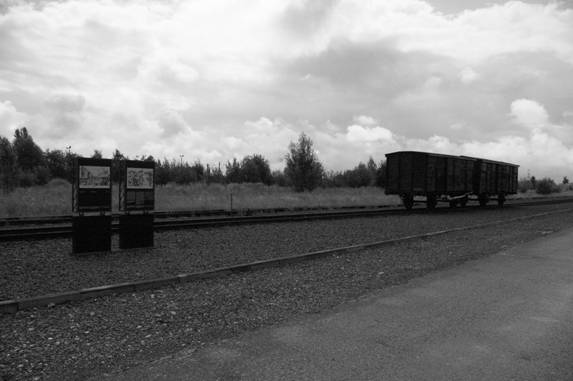
Judenrampe 2009

The ‘Alte Judenrampe’ between Auschwitz I and Auschwitz II-Birkenau: used between 1942 and 1944, hundreds of thousands of deportees arrived here. Photo: author, 2009.

As an academic, my research is concerned with the questions of representation associated with the Holocaust and its aftermath. To do so, I employ the term mythology in the Barthesian sense of ‘a language in which other things are spoken.’ In other words, seeing the representation of the Holocaust as more and more a prism through which other stories and concerns are addressed. Speaking of the Holocaust in Israel is to engage with the foundation of the state; in Britain, the Holocaust and World War II are important signifiers in an ongoing search for a post-imperial role between the United States and Europe; in Poland, the difficulty and controversy in talking about the Holocaust illustrate the ongoing search for an articulation of Polish wartime history that reconciles the facts with the sensibilities of those involved. In all three cases, the Holocaust is a major component of the search for a ‘usable’ past. As Robert Eaglestone observed in The Holocaust and the Postmodern (Oxford 2004) the Holocaust is ‘something wider, more significant, and, precisely because it is so all-pervasive, very much harder to pin down: [part of] a sense of “who we are” and “how the world is for us”’

But focusing exclusively on this sense of the Holocaust’s historical importance and cultural centrality – Holocaust Memorial Day is the only pan-European memorial day, for example – is to (potentially) miss an important truth. In a short and trenchant analysis of Postmodernism and Holocaust Denial (Duxford 2001), Eaglestone interrupts his characteristic eloquence to remind us that ‘writing and reading about the Holocaust is, and ought to be, distressing.’ He develops a comparison to bring home to the reader what we are talking about – mass murder – and its victims and perpetrators, reminding the reader of accounts of killings in which uniforms were described as ‘saturated with blood’.

So, compare: think about getting blood on your clothes from a nosebleed: think how much, much more blood – the blood of the victims – would ‘saturate with blood’ a thick military uniform. On one day. And the killings, of all sorts, lasted years. (p. 29)

Holocaust Memorial Day serves for me a similar purpose to Eaglestone’s comparison – which he immediately concedes is ‘not even really a comparison.’ It reminds me that fundamentally in researching and teaching about the Holocaust we are remembering the dead and asking that such things never happen again – even if the latter half of the twentieth century and opening decade of the twenty-first suggest that this lesson has been only imperfectly heard and hardly learnt at all. The knowledge that seeing this as a failure is in itself a kind of progress is a hollow sort of satisfaction, though it is better than none at all.

I use ‘mythology’ for a variety of reasons, some of which are set out above. In addition, though, it attracted me because it addressed the kind of incomprehension and sadness I feel when I engage with testimony or images that move or disturb me. To term the Holocaust a modern mythology allows me to reconcile the paradoxes inherent in trying to explain that which will not be explained, and removing any possibility that it might be explained away. Myths are not there to be explained, but instead to be heard: as an early collection of Holocaust literature put it, ‘A whirlwind cannot be taught, it must be experienced.’ And we are left with the knowledge that since we have not (for the most part, thank goodness) experienced it all we can do is try to teach it.

But there are different kinds of teaching. The following excerpt from an eyewitness account of a mass killing in Ukraine in 1942 has made me wonder – still makes me wonder – how we face the apocalypse and if there is a meaning to be found.

 The father held the ten-year-old boy by the hand speaking softly to him. The boy was struggling to hold back his tears. The father pointed a finger at the sky and seemed to be explaining something to him.

More than once, while teaching groups of first-year undergraduates with this and other documents, students began to cry and apologised. It is important to remember that in the face of such things tears need no apology: we should be upset, we should cry, we should mourn. And then we should make sure that we do what we can to make the world better. God willing.

Newer posts →

Recent Posts

  • The Holocaust and its Perpetrators: A Response to Douglas Murray and Andrew Roberts
  • Cracked Mirror: Holocaust Unconsciousness
  • The Price of Memory
  • Simulated Horror: AI and the Holocaust
  • Through the glass, darkly: a warning against Holocaust Distortion

Archives

  • September 2025
  • July 2025
  • June 2025
  • February 2025
  • January 2025
  • November 2024
  • February 2024
  • January 2023
  • January 2022
  • October 2021
  • September 2021
  • June 2021
  • August 2020
  • July 2020
  • March 2020
  • January 2020
  • January 2019
  • November 2018
  • January 2018
  • September 2017
  • August 2017
  • February 2017
  • January 2017
  • August 2016
  • March 2016
  • August 2015
  • August 2014
  • June 2013
  • May 2013
  • April 2013
  • February 2013
  • January 2013

Categories

  • Book Reviews
  • Culture and Politics
  • Heritage Politics
  • missinghistories
  • Photography and Visual Culture
  • The Holocaust: Representations and Meanings
  • Uncategorized

Meta

  • Create account
  • Log in
  • Entries feed
  • Comments feed
  • WordPress.com

Blog at WordPress.com.

  • Subscribe Subscribed
    • framingthequestion
    • Already have a WordPress.com account? Log in now.
    • framingthequestion
    • Subscribe Subscribed
    • Sign up
    • Log in
    • Report this content
    • View site in Reader
    • Manage subscriptions
    • Collapse this bar
 

Loading Comments...