• Coursework and Dissertation Help
  • About the author…
    • #missinghistories
    • Independent Educator: Research-driven Education and Training
    • Writing and Research
    • Independent Researcher

framingthequestion

~ Reflections on memory, history, photography and culture

framingthequestion

Tag Archives: Holocaust

The Holocaust and its Perpetrators: A Response to Douglas Murray and Andrew Roberts

Featured

Posted by jaimeashworth in The Holocaust: Representations and Meanings

≈ 2 Comments

Tags

7 October, Bring them Home, Gaza, Holocaust, Holocaust memory, Israel, representation

Posters of those kidnapped on 7 October 2023 on a postbox in Golders Green, North London, November 2023. Photo: Jaime Ashworth.

I never thought that I would have to rebut the idea that the Nazis weren’t that bad, at least not in the pages of the Jewish Chronicle. But the article by Douglas Murray published on 9 November did exactly that, and generated considerable attention. While many Holocaust historians and educators have categorically rejected Murray’s argument, it has, as is the way of social media, also attracted a lot of praise, including from within the Jewish community. But then, if the first casualty of war is truth, then nuance is surely the second.

Murray’s piece in the JC was followed by an article by Andrew Roberts on the Free Beacon website last Friday. Its argument was substantially similar to that of Murray, and was predictably promoted by Murray as “a very important piece by a leading British historian and peer”. I’m not sure what relevance the peerage has, but presumably Murray thought it would appeal to his audience.

Before we go any further, I need to make clear that I am in no way minimising or relativising the atrocities of 7 October 2023. It was carnage. Those responsible need to feel the consequences, and of course, the hostages need to come home. All of them, as quickly as possible.

But we also need to recognise that an event does not have to be the Holocaust to be awful. There is an argument that the effort to make Hamas into greater villains than the Nazis in fact cheapens the actual facts of 7 October, as though they were not horrible enough. The dying on that day, and the suffering after, is awful in its own terms. Every side-dispute distracts from the priority of getting the people on the posters in the header image back to their homes (if they still stand) and families (if they still live).

Also last week, an open letter was published in the New York Review of Books. Signed by eminent scholars in the field of Holocaust and Genocide Studies, I did not agree with every word or emphasis. But the statement that “as academics, we have a duty to uphold the intellectual integrity of our profession and support others around the world in making sense of this moment” is inarguable. Holocaust education, if it is to be meaningful, must start from the facts. Murray and Roberts are both guilty of twisting facts to suit an agenda. It is not entirely clear what that agenda is, but I suspect Murray’s description of the Holocaust earlier this year as when Hitler “mucked up” should be considered when reading anything else he says on the subject.

This will not be easy, because those facts are uncomfortable. None of what follows is appropriate for school audiences, and it is challenging for adults. But as the historian Alex J. Kay wrote in his superb (and harrowing) Empire of Destruction it is important to remember that “…writing a sanitised version of these events would only succeed in making them appear more abstract; realism and accuracy would be sacrificed in favour of palatability. […] If this book is hard to read, let us for a moment imagine how difficult it must have been for the victims to suffer the events described here.” (Kay, Empire of Destruction, p.15)

In fact, it is only by hiding behind our sensibilities that Murray and Roberts can engage in what is, in my opinion, very close to outright Holocaust revisionism. It also suggests (by the by) that neither of these men have really confronted how terrible some of the crimes of the Holocaust actually were. Unfortunately, rebutting them requires that we do, however reluctantly. But first, what have they persuaded some people of?

Firstly, that the Nazis (if we allow, in the face of contemporary scholarship, that such a reductive defintion of the perpetrators is useful) were ashamed of their conduct. The “evidence” for this is the examples of psychosomatic reactions to violence (for example, stomach pain or vomiting) and the use of alcohol “to forget”. The psychosomatic point, incidentally, is useless. Disgust and bodily reactions are not correlated straightforwardly, and in any case do not seem to have actually incapacitated perpetrators in many cases. If they had caused the perpetrators to stop, that would be one thing. But they didn’t – they carried on.

From this starting point of a lack of shame, the following conclusions are drawn: the Nazis were ashamed, therefore they didn’t show enjoyment of what they were doing; therefore they did not publicise their crimes or worked to keep them secret; and therefore they covered up their crimes – though the possibility that erasing the traces of their actions had more to do with avoiding punishment once the war was lost is not really explored. On this basis, they reach the conclusion that “Hamas were worse than the Nazis” like two drunk men wondering why the whole bar is looking funny at their borrowed Nazi uniforms. Not that I am in any way suggesting that either of these men would do such a thing. The speed with which with one lawyer received a threat of libel action from Murray for terming his argument “Nazi apologia” suggests he may be sensitive to that.

It could be argued that this is a storm in a social media teacup. But that is to ignore the lasting damage done by glib comparison and badly thought-through allusion. Even if Murray or Roberts disputes my characterisation, it is certainly true that their words are being understood in this way.This was the basis for the castigation of Gary Lineker earlier this year, by the way, and I am deafened by the silence of some of those who shouted very loudly that the Holocaust could not be compared.

A final warning: the next section is very challenging. To minimise the trauma, I have mostly used the written word rather than images. I have also highlighted key parts of texts to minimise the need to linger. The texts are sourced and attributed to a number of volumes.

Source 1: Report from Major Rosler to Infantry General Schniewindt, January 1942 (Ernst Klee, Willi Dressen, and Volker Riess (trans. Deborah Burnstone), Those Were the Days: The Holocaust as Seen by the Perpetrators and Bystanders. London: Hamish Hamilton, 1993 (1991), p. 118.)

“The pit itself was filled with innumerable human bodies of all types, both male and female. It was hard to make out all the bodies clearly, so it was not possible to estimate how deep the pit was. Behind the piles of earth dug from it stood a squad of police under the command of a police officer. There were traces of blood on their uniforms. In a wide circle around the pit stood scores of soldiers from the troops detachments stationed there, some of them in bathing trunks, watching the proceedings. There were also an equal number of civilians, including women and children.”

This clearly challenges the idea that the Holocaust was not seen as entertainment. It clearly was: why else would people be standing around in bathing trunks? Why bring children?

Source 2: Witold Pilecki’s report from Auschwitz (Alex Kay, Empire of Destruction: A History of Nazi Mass Killing. Yale University Press, 2021. p. 217)

“The penal company was working in the square, transporting the gravel that was dug out of a pit. Apart from that, some commando was freezing while carrying out ‘exercises’. Next to the pit, three SS men […] came up with a game. They were making bets, with each one of them putting a banknote on a brick. Then they would bury a prisoner alive, upside down, covering his upper body in the pit. They would look at their watches, and time how long the prisoner kicked his legs up in the air. […] The one able to most accurately predict how much time a prisoner buried alive would kick his legs before he died – was the one who collected the money.”

Both Murray and Roberts suggest that the concentration camps and gas chambers were developed as a “civilised” alternative to mass shooting. But as we see here, the camps were the scene of killing as entertainment just as callous as anywhere else. We additionally need to recognise that the camps did not replace shooting: fully a third of the Holocaust’s victims were killed by bullets, among small and remote communities where the logistics of deportation were inefficient. These killings continued long into the war.

Source 3: Letter from SS Obersturmführer Karl Kretschmer to his family, October 1942 (Ernst Klee, Willi Dressen, and Volker Riess (trans. Deborah Burnstone), Those Were the Days: The Holocaust as Seen by the Perpetrators and Bystanders. London: Hamish Hamilton, 1993 (1991), p. 171)

“Since, as I already wrote to you, I consider the last Einsatz to be justified and indeed approve of the consequences it had, the phrase: “stupid thoughts” is not strictly accurate. Rather it is a weakness not to be able to stand the sight of dead people; the best way of overcoming it is to do it often. Then it becomes a habit. […] the more one thinks about the whole business the more one comes to the conclusion that it’s the only thing one can do to safeguard unconditionally the security of our people and our future.”

Kretschmer was writing to his whole family: he addressed his children by name and signed off “Your Papa”. He was clearly not ashamed of what he was doing but of his “weakness” in not enjoying it. But this did not stop him. As he sternly reminded his children, “the best way of overcoming it is to do it often. Then it becomes a habit.”

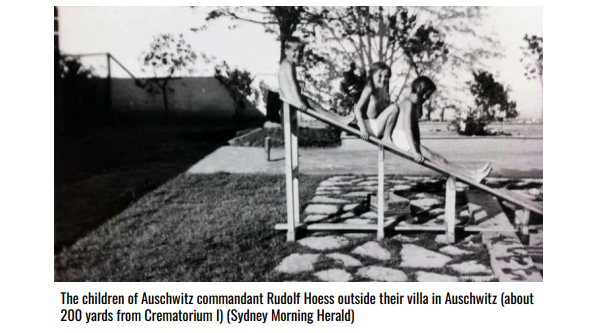
But then, not all children of perpetrators were kept far away from their fathers’ actions: these are the children of Auschwitz commandant Rudolf Hoess in the garden of their villa in the camp – about 200 yards from Crematorium and Gas Chamber I.
Source 4: the wife of a perpetrator recalls breakfast with her husband near the unit’s operations. (Christopher R. Browning, Ordinary Men: Reserve Police Battalion 101 and the Final Solution in Poland. London: Penguin 2001 (1992), p.127)

“I was sitting at breakfast one morning with my husband in the garden of our lodgings when an ordinary policeman of my husband’s platoon came up to us, stood stiffly at attention, and declared, ‘Herr Leutnant, I have not yet had breakfast.’ When my husband looked at him quizzically, he declared further, ‘I have not yet killed any Jews.’”

Since this is a deposition from the 1950s in an investigation deciding whether or not the woman’s husband should be put on trial or not, one can assume that she was trying to put her husband in a positive light. But that doesn’t change the fact that she was having breakfast with him in this location: why, following Murray or Roberts, was her husband not ashamed of what he was doing? Why did he ask her to visit? There is neither shame nor secrecy in evidence. Indeed, one might speculate that treating her to accommodation and catering was a kind of, well, boasting.

But what about the bodycams, asked one person on X, demonstrating that access to technology does not guarantee insight. Why didn’t they have bodycams? Well, it was the 1940s and they hadn’t been invented yet. But – as I pointed out in fact – the visual record of the Holocaust is mostly images taken by the perpetrators. Yes, theoretically there were restricted areas. But there were also tours of the Warsaw Ghetto which toured the site like a safari park. And many of those images are the ones around which we often frame commemoration. There is film footage of shootings. There are whole albums of photos taken and collected by the perpetrators. Including the images which follow, which are the hardest and most harrowing ones I can justify reproducing.
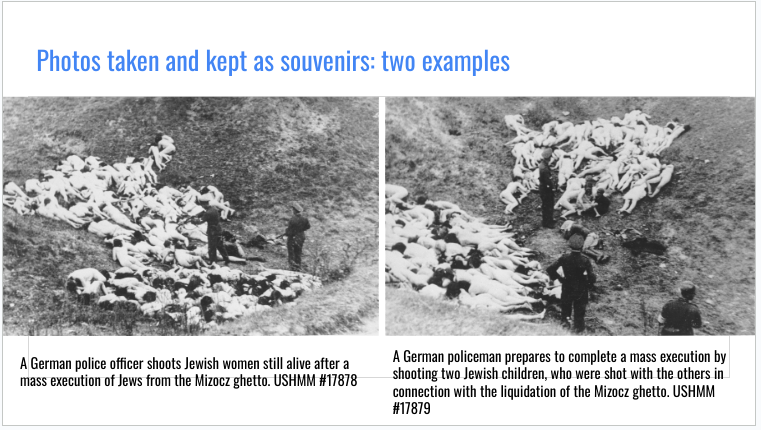
These images have no use. They do not do anything but allow the perpetrator to relive the moment. They came to light because they were given away by their creator after the war. He clearly felt no shame in having them nor did he fear retribution afterward. These are trophies, like jaded businessmen who shoot elephants for their “Kodak moment”, or men posing with drugged tigers on their dating profiles.

Finally, we have the issue of alcohol. It was certainly in plentiful supply in all parts of the Holocaust. It was a lubricant and a lowerer of inhibitions. But the diary of Johann Paul Kremer, one of the doctors who conducted “selections” of newly arrived prisoners wrote a diary (again, not concerned about discovery) full of references to drinking and dining.

Source 5: Dr. Johann Paul Kremer in Auschwitz (Ernst Klee, Willi Dressen, and Volker Riess (trans. Deborah Burnstone), Those Were the Days: The Holocaust as Seen by the Perpetrators and Bystanders. London: Hamish Hamilton, 1993 (1991), p. 261)

27 September 1942: Today, Sunday evening, 4-8 o’clock, Community House social evening with supper, free beer and tobacco. Speech from Commandant Hoess and musical, as well as theatrical presentations.

28 September 1942: Tonight attended eighth Sonderaktion. Hauptsturmführer Aumeier told me that Auschwitz concentration camp is 12km long, 8km wide and 22,000 [acres] in area. […]

Kremer does not seem to have drunk “to forget”, like some legionnaire in a black and white B-movie. He couldn’t forget – Kremer was running medical experiments and justaposes references to food and drink with “fixing” his “samples” of tissue. Conducting selections was a relatively bloodless part of his day. In a further blow to the “secrecy” claim, he wrote in November 1942: “Sent off a packet of soft soap (about 12 pounds) worth 300RM to Maria and Gretchen.” The goods of the murdered, when they weren’t furnishing the tables of their killers, were being sent to their families. How else did they get hold of the “wonderful-tasting Bulgarian red wine which put [Kremer] in a wonderful mood” the night before he left Auschwitz?

I have deliberately avoided reference to the atrocities of 7 October in this piece. There is no question that the attackers of Hamas committed horrendous and bloody crimes, which will no doubt continue to be documented. But one does not have to engage in this kind of comparison, which cheapens and debases both sides of the equation. The crimes of Hamas are the crimes of Hamas. One does not need to engage in a tawdry devaluing of previous crimes to do that. And one should be extremely suspicious of why Murray and Roberts have gone to such lengths to do so. All their disingenuous misreadings do is add fuel to a fire of outrage that needs no boosting.

With thanks to Dr Waitman Beorn of Northumbria University, whose comments on a version of this piece for another context emboldened me to make it public. All responsibility for any errors, of course, lies with the author.

Cracked Mirror: Holocaust Unconsciousness

Featured

Posted by jaimeashworth in Culture and Politics, Photography and Visual Culture, The Holocaust: Representations and Meanings

≈ 1 Comment

Tags

Auschwitz, Holocaust, Holocaust Education, Holocaust memory, Infodemic, representation

My post the other week about the use of AI to generate images purportedly of the Holocaust has had quite a lot of attention. Some of this has been derived from my posting a link alongside critiques of the images as they’ve appeared (and re-appeared) in my social media. I’ve had three basic responses to these comments:

Firstly, responses by people who are what used to be called “hard” Holocaust deniers. These claim that the images are no more fake than any other image of the Holocaust. This recalls David Irving’s rallying cry to fellow deniers to “Sink the Auschwitz!” Irving said that they had to “make it tasteless” to get attention: a strategy developed by the late (and unlamented) Ernst Zündel, who used publications such as  “Secret Nazi Polar Expeditions” (1978) and “Hitler at the South Pole” (1979) to get himself invited into television studios to “defend” his views. He also doubtless tapped into the subculture of what we might term today credulous edgelords, many of whom probably went on to buy turquoise shell suits in emulation of David Icke. 

(Icke, by the way, has dropped his New Age pretence of trying to create world peace in favour of screaming “Rothschild Zionist!” at pictures of people he disagrees with. No more shell suits either.) 

Secondly, there have been comments espousing “soft” denial, especially minimisation.  One response ran: “the reason they were running low on food was because the allies uS Great Britain Etc [sic.] were bombing the railways. Otherwise it was typhus killing those Jews.” 

Both of these types of comment are to be expected. The effort to distort and deny the scale of the Holocaust started while the Holocaust was still happening, and hasn’t let up since. As Tony Kushner has described, this went alongside a “liberal” suspicion that Jews had brought their fate upon themselves – that there was (and this was an actual phrase used) “no smoke without fire”. Nothing has tortured a certain kind of antisemitic fantasist more than actual Jewish victimhood, often recorded by its perpetrators. That such people seek to muddy the historical waters is not surprising. 

But other kinds of indignation have been less expected, and are much more worrying in strategic terms. I expect to draw the ire of deniers, but the people who’ve rejected my challenges to these fakes as an attack on Holocaust memory have been a shock. Particularly when they claim that the fakes reflect realities they’ve read about or even seen on site visits.

Mostly, those kinds of objections can be met with facts. Since the responder accepts the Holocaust as an item of knowledge, they are usually able to accept arguments based on factual information and evidence (even if this is time-consuming, especially as a volunteer.) 

But the last kind of objection is the most difficult. These claim that any kind of Holocaust remembrance, however divorced from facts, is worthy of reverence. Since I treat fake images of real events (even if rarely referenced or even employing names) as fakes, I am guilty of (at best) carping or (at worst) challenging the reality of the Holocaust. Challenging Holocaust distortion is now (for some people) on a par with (or worse than) Holocaust distortion itself. We are not so much through the looking glass as picking the shards of critical discourse out of our eyes. 

The use of these images is already blurring the boundaries between real and imagined. If it is allowed to go unchallenged it will rapidly become impossible to restrict their use. As we know from the success of The Boy in the Striped Pyjamas, the inadequacy of Holocaust representations is not disqualifying – in fact, it can even be a reason for their success. And there are -as Baudrillard warned – no originals to correct, no negatives to destroy. All we have is experience and expertise, challenges, and the exercise of choice.

The scholar Andy Pearce has done a lot of work on what he terms “Holocaust consciousness” – where the object is simply to create a rather numinous sense of the Holocaust’s reality rather than engage in rigorous education or discussion. We are reaping the fruit of this direction of work, and we need to ask ourselves if we can change course. It is not enough to be aware of the Holocaust; we must ensure that it is known.

Note: I’m now registered with Buy Me a Coffee: if you found this post useful or interesting, please consider sending me a small amount to help me do more. Thank you! https://coff.ee/jaimeashworth

Simulated Horror: AI and the Holocaust

29 Sunday Jun 2025

Posted by jaimeashworth in Culture and Politics, Photography and Visual Culture, The Holocaust: Representations and Meanings

≈ 2 Comments

Tags

Artificial Intelligence, Auschwitz, Holocaust, Holocaust Denial, Holocaust memory, Holocaust Photography, Never Again, NotoAI

Images In Spite of All, or Images in Spite of the Facts?

Above: Mendel Grossman (1913-1945) takes a self-portrait. He chronicled the Lodz Ghetto until his deportation to Auschwitz; he is reported to have died on a death march. Many of the negatives of his images were held in Israel and lost in the 1967 war. (Image from Wikipedia)

The ubiquity of the Holocaust in popular culture has always had costs. The saccharine American version of Anne Frank in the 1959 film; and the blockbuster Schindler’s List both received criticism for their simplification of a complex reality. In an age in which we are forced to surrender more and more of our creative and intellectual autonomy to AI, they are a starting-point for reflection.

Anne was a complicated, contradictory personality whose development into a woman was (among other things) chronicled in what her father determined would be The Diary of a Young Girl. Her reflections on adolescence, religion, sexuality and identity were excised, and her control of our understanding of what happened in the Secret Annexe has made it difficult to actually think through the challenges for all concerned in her predicament: being in close confinement under threat of death with a teenager must have been a challenge. (The BBC adaptation of the diary, starring Ellie Kendrick as Anne, does a particularly good job of bringing out this aspect.) The 1959 film turned Anne (ironically played by an actress in her twenties just six years Anne’s junior) into a simpering and rather pathetic figure, with (as many have observed) her Jewishness pushed into the background.

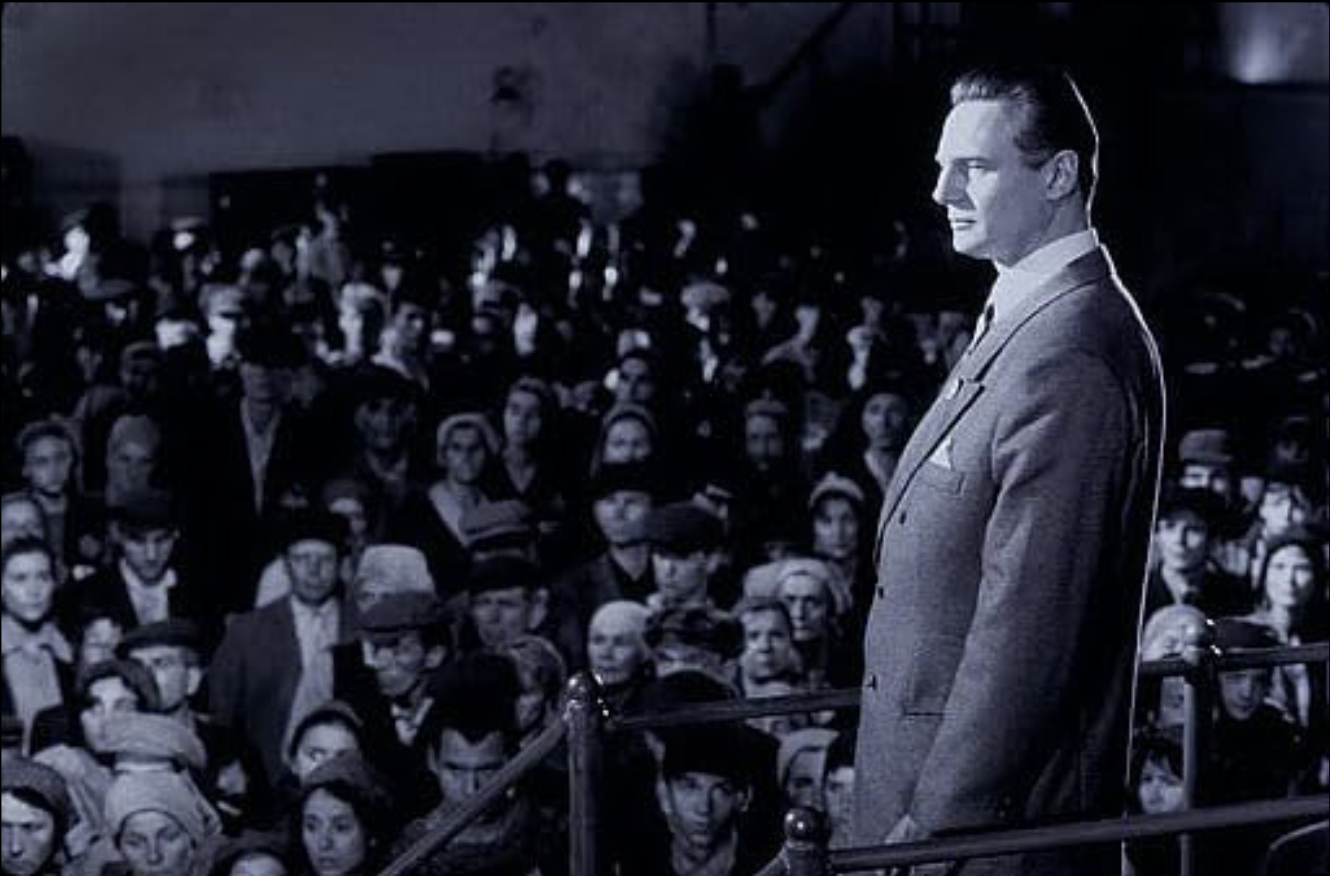
In 1993, Steven Spielberg turned an untrustworthy and feckless chancer (who did a lot of good) into a tragic hero in opposition to a bottomlessly corrupt and evil opposite: the commandant of KL Plaszow, Amon Goeth, played by Ralph Fiennes. It prompted widespread calls for Holocaust education and coincided with the opening of the United States Holocaust Memorial Museum. But many people have pointed out the film’s flaws. Fundamentally, it is still a Spielberg movie, with a clear moral arc (focused on a man who initially saw Jews as a resource to be exploited) and a redemptive ending. It popularised the Talmudic adage that “He who saves a life, it is as if he saved the world entire”, but the film is actually quite uncurious about what those lives meant. “The list is good; the list is life”, but how was it made? And who was not included? The arresting image of Schindler addressing the factory makes clear the relative status of rescuer and rescued. 

Liam Neeson as Oskar Schindler announces the forthcoming liberation in Spielberg’s 1993 film (IMDB)

The 1990s also saw instrumental use of the Holocaust as a rhetorical weapon for unlikely causes. Perhaps most egregiously, the claim by the NRA that the Jews should have had guns to defend themselves. This not only reduced the tragedy of European Jewry to the Gunfight at the OK Corral, it also implied that gun owners were a persecuted minority on a par with the victims of genocide. The consequences of such disingenous faux-victimhood is visible in every news item from the contemporary United States.

But at least these claims were rooted in an agreement about what was real. In the last few days, my social media has been subjected to a slew of AI-generated “images of the Holocaust” by the “90s History” feed: not my choice, but a result of the algorithms’ ability to present the virtual world without discussion. 

These images are disturbing. Based on stories which even I (with thirty years of reading on the subject) can’t easily identify as fact or fiction. The accompanying images take elements of the Holocaust and build a parallel universe of images which could not have been. 

Another 90s blockbuster, The Matrix, is useful to consider here. Amid the hysterical, cartoonish violence, a serious point is raised. In a simulation, how can we know what, if anything, is real? The movie says the trick is to know “that there is no spoon”: thus, Neo (Keanu Reeves) can make the world behave as he sees fit. 

The philosophical depth of The Matrix is a matter for debate. But at one point a glimpse is given of Jean Baudrillard’s Simulacra and Simulation (1981; English 1983). Baudrillard argued that simulacra – copies for which there are no originals – were a burgeoning feature of the postmodern condition. Art Spiegelman’s MAUS, which reproduces his father’s Auschwitz testimony in graphic novel form, with Jews ”played” by mice, poses something of this challenge. But so too does Schindler’s List, in that it is arguably more faithful to Thomas Keneally’s novelisation of the story than to the facts themselves. But in each case, we can find solid ground under our feet. Plaszow existed, so did Goeth. Władek Spiegelman existed, as did Art’s brother Rysio, murdered by the person hiding him. It is essential to remember that these were real.

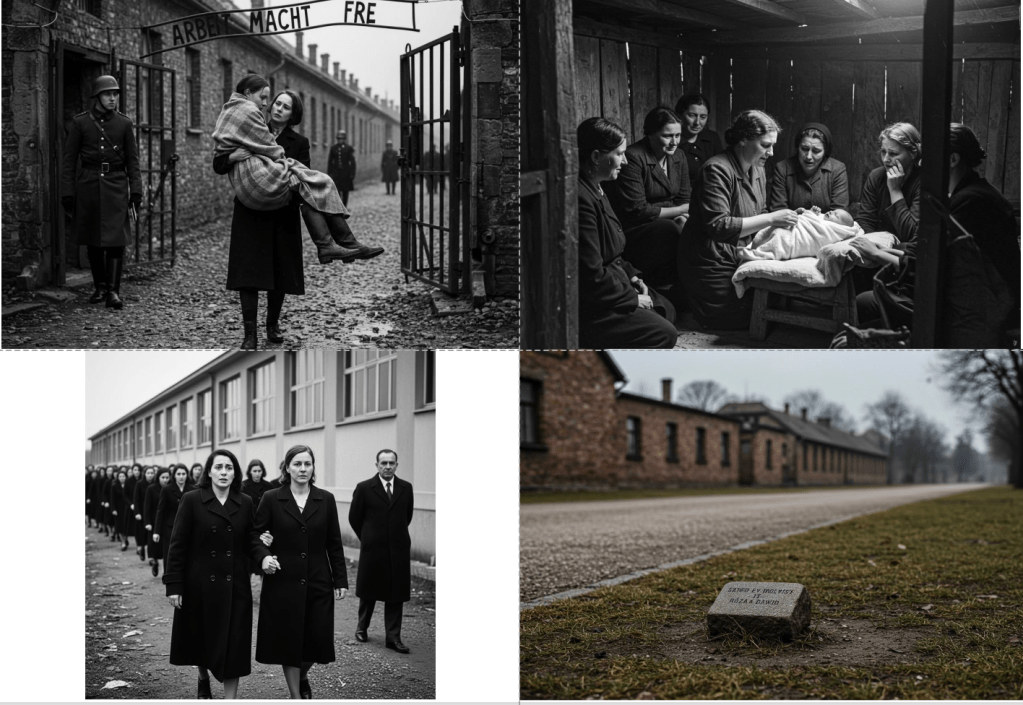
But the woman holding a child as she walks through a simulated “Arbeit Macht Frei” gate? The woman delivering a baby in what appears to be a wooden barracks allegedly in the Lodz Ghetto? The women proceeding through “Auschwitz” in identical woollen overcoats rather than the rags such prisoners were given? The nonexistent memorial tablet in a part of the Auschwitz camp that does not exist? 

It might be argued that these are uses of technology to fill in gaps. But the historical record is evidence and gaps, in the same way that music is sound and silence. Both are needed: one for aesthetic purposes and the other for epistemological and ontological reasons. A Holocaust in which everything was saved, all is known, is much less of a Holocaust. It is the implied gap in the vast Book of Names held at Auschwitz – for which two million names will never be known – that provides the impact. 

FAKES

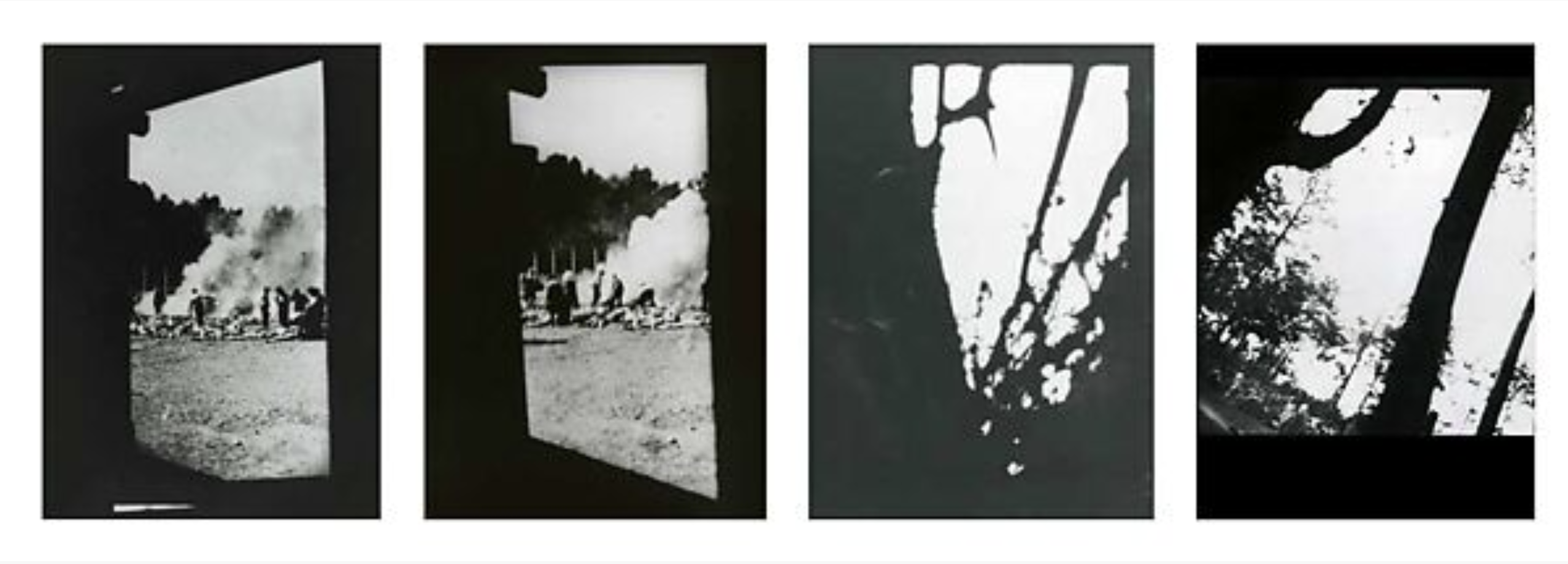
The smooth glossy surfaces of AI are infinitely easier than the real thing. The gritty, hastily taken “images in spite of all” (Didi Hubermann) taken by the Sonderkommando in summer 1944, as prototype gas chambers and burning pits had to be used to cope with the endless stream of deportations, are blurry, badly framed, at odd angles. But this is testimony to the reality of the situation: taken with a camera stolen from luggage brought by the victims, fearful of discovery. The author John D’Agata and fact-checker Jim Fingal begin their fascinating The Lifespan of a Fact with two epigrams from Lao Tze: “True words are not beautiful” and “Beautiful words are not true.” The flaw in the lens, the smudge in the record, the gap in the tape: this is the texture of evidence.

Above: the photographs taken by the Sonderkommando at Auschwitz II-Birkenau, Summer 1944 (Metropolitan Museum of Art digital copy)

It is possible that critics of this view might call me a Luddite. I wrote in 2017 of the risks I believed were posed by the efforts to create interactive holograms of survivors. I feared what they might be able to say in the future, uncanny purveyors of algorithmic “wisdom“. In the age of deepfakes I’m only surprised (and dismayed) that the world has changed so fast. But this confusion will only favour those who continue to deny, distort and denigrate the memory of the Holocaust: against such duplicitous and mendacious fakery, the best historian will flounder. We do not need to make their jobs easier in the quest for clicks: to do so is to cheapen the event we sigh wistfully over before scrolling onward.

And what to do? The director of Shoah, Claude Lanzmann, once said that if he encountered film of the gas chambers he would be compelled to destroy it. While I am unsure whether I could watch such a film, my instinct as a historian is that preservation is generally preferable. As a record of the insanities of the 2020s, these images may be valuable in the future. But these images are also, in my opinion, the historical equivalent of littering. So for now, I suggest two established technologies are most useful: the delete key, and the off switch. 

For the follow up piece on reactions: click here.

Note: I’m now registered with Buy Me a Coffee: if you found this post useful or interesting, please consider sending me a small amount to help me do more. Thank you! https://coff.ee/jaimeashworth

On HMD 2025: For a Better Future

21 Tuesday Jan 2025

Posted by jaimeashworth in The Holocaust: Representations and Meanings

≈ 1 Comment

Tags

Elon Musk, faith, For a Better Future, HMD, HMD2025, Holocaust, Holocaust Education, Holocaust Memorial Day, Holocaust memory, hope, Survivors

I can only assume that whoever chose the theme for HMD this year, For a Better Future, had money on the US election. “Surely,” they must have said to themselves, “Harris will win. Educators and others can talk about the ways in which the world is and can be a better place, just a week after the inauguration.” Or perhaps, since I found myself addressing a school yesterday on this theme, this is more evidence that if history teaches us anything, it’s that historians don’t learn from history.

I realised in preparing the talk that honesty was essential. You can’t pretend that (for example) unprecedented wildfires are just the warm glow of the fire in the college library. They know things are bad; you know things are bad. So admit it. 

As to culpability, if there’s any event that can be safely laid at the door of white European men, it’s the Holocaust. I didn’t expect Elon Musk to so quickly acknowledge the role of the Nazis in his intellectual hinterland (perhaps the Afrikaans veld would be more accurate), but making the Nazi salute twice just hours after the swearing in was nothing if not confirmation that I was right to suggest that insecure men of limited intelligence and even more limited scruples can’t be trusted. Aimé Cesaire would have immediately recognised the “cruelty, mendacity, baseness, and corruption” that have been the hallmarks of his project, and that of his permatanned puppet. 

But, while interesting, the dead weight of European patriarchal intellectual history doesn’t provide a great deal of uplift. Nor, to be frank, does describing the mixture of emotions with which most survivors seem to have greeted liberation: numbness, doubt, and fear of the very future that the theme valorises. Primo Levi’s account of the numb incomprehension of his liberators does, however, resonate with the sense of helplessness that many have felt since November.

“They did not greet us, nor smile; they seemed oppressed, not only by pity but also by a confused restraint which sealed their mouths, and kept their eyes fastened on the funereal scene. It was the same shame which we knew so well, which submerged us after the selections, and every time we had to undergo or witness an outrage: the shame the Germans never knew, the shame which the just man experiences when confronted by a crime committed by another, and he feels remorse by its existence, because of its having been introduced into the world of existing things, and because his will has proven nonexistent or feeble and was incapable of putting up a good defence.” 

Moreover, even the little bit of good news at the moment, the fragile ceasefire in Israel/Gaza, came very late in the preparations. And I couldn’t bring myself to hold it up as an example, both because it comes after such horror and, superstitiously, I didn’t want to jinx it. 

But as in the Greek myth, after the horrors had emptied out of the box, something remained. Not hope, but its more resilient cousin, faith. 

Why more resilient? Because hope requires something to be grounded in, and accordingly can be disappointed or even crushed. Faith, however, is consciously not knowing and moving forward anyway. I’m always wary of quoting St. Paul (an antisemite as only a former Jew could be) but “The promise of things hoped for, and the evidence of things not seen” is a very good summary of faith. 

As for the obvious question of what we put our faith in, I closed with one of the most basic and common prayers in Judaism: Shehecheyanu, the prayer for this moment. It translates as follows:

Blessed are You, Lord our G‑d, King of the
Universe, who has granted us life, sustained us and
brought us to this moment.

The whole talk is here as a download, but I leave you with my closing paragraph: please let it come to pass: 

“I say this prayer with groups in Auschwitz, as a reminder that whatever may have happened in the past, we are here. Whatever the challenges, we shall overcome, given time, given faith. And whatever the future may hold, we will face it together.”

Note: I’m now registered with Buy Me a Coffee: if you found this post useful or interesting, please consider sending me a small amount to help me do more. Thank you! https://coff.ee/jaimeashworth

A response to Jan Grabowski’s ‘Whitewash: Poland and the Jews’

25 Monday Nov 2024

Posted by jaimeashworth in Heritage Politics, The Holocaust: Representations and Meanings

≈ 1 Comment

Tags

Anne Frank, European Holocaust memory, Grabowski, Holocaust, Holocaust memory, Jewish Quarterly, Poland, Whitewash

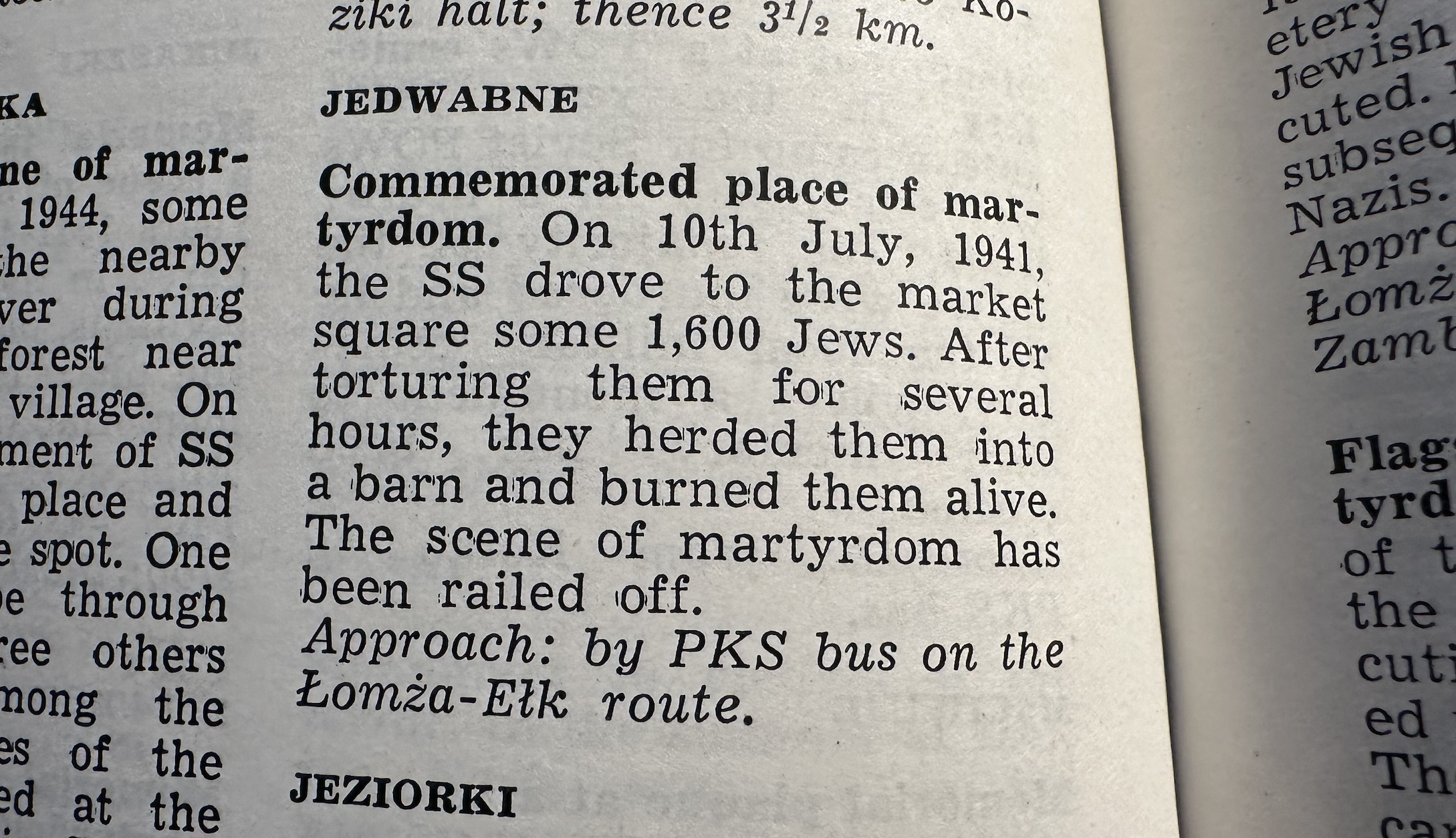
Above: Entry for the Polish town of Jedwabne in a 1968 Polish government tourist guidebook. Contemporary research has, in the face of current Polish government institutions, found that Jews were murdered by townspeople, with little (if any) involvement of the SS.

The Polish scholar Jan Grabowski has been treated with enormous disrespect and even cruelty by the Polish government and Polish society. The legal action in which he and Barbara Engelking were bound up in at the behest of a government-proxy thinktank/pressure group was unjust, persecutory, and ill-founded. The chilling effect this treatment may have on Polish academia in general, and Holocaust studies in particular, may be long-lasting. He has earned, many times over, the right to complain loudly about his treatment and warn against further abuses. Even if this were not the case, the depth and breadth of his research over decades would be reason enough to listen.

At the same time, his special issue of Jewish Quarterly, Whitewash, raises some questions. I hope Professor Grabowski will read this, and in the spirit in which it is intended; to get to the bottom not just of what happened, but why. For there is a gap in explanation as to why Poland, the recipient of huge resources for Holocaust education and commemoration since the early 1990s, should have gone down this route. My answer to this question structures my response.

Firstly, there is a strange gap in this publication where the years 1945-1990 should be. Many Polish voices, along with others in Central and Eastern Europe, have been vocal in arguing that it is time to treat this region beyond its postcommunist legacy. I couldn’t agree more on one level: the history of Poland did not begin in 1939, or 1945, and it will not end today. Jeszcze Polska nie zginęła/Kiedy my żyjemy (Poland has not perished as long as we still live). In discussing the legacy of the Holocaust, it seems slightly odd not to give more focused consideration to the social, political and ideological parameters within which memory developed. The 1968 anti-Jewish campaign appears, as do the pogroms in Rzeszów, Kraków, and Kielce. But the way in which the communist regime insisted on obscuring the identity of the victims as “citizens of occupied Europe” is important to understand, as are the links between Holocaust history and Polish history in general. Grabowski is right to complain about the arbitrary claim that three million non-Jewish Poles died, but he does not talk about the difficulties posed by those victims who were defined by the Nazis as Jews despite strong Polish and Catholic identities. The numbers are fuzzy in both directions, though the version Grabowski cites is certainly the stronger.

But the reader of the diaries by Adam Czerniaków (the Chairman of the Warsaw Ghetto) and the historian Emanuel Ringelblum will notice frequent references to the Christians of the ghetto, just as surely as readers of Lucy Dawidowicz’s The War Against the Jews will notice her invective against “apostates” and their role in the administration of ghettos. These were not homogenous and pre-existing communities trying to simply carry on the shtetl, but complex and heterogenous sites where people who often had little in common except their designation under Nazi ideology were forced to survive. In the camps, there were Jews who were “hidden” by assuming Polish identities, sometimes with the connivance of prisoner functionaries. Dividing a complex and interrelated past into two makes understanding the whole harder.

It is also important to explain to the casual reader that Polish nationalism evolved in a particular place and time. The messianic fervour of nineteenth century nationalism, asserting its particular suffering as a “Christ among nations” is an inheritance that cannot be ignored (especially in the Polish diaspora, where much older visions of Polishness have sometimes held sway). That the Polish answer to building national consciousness while enduring territorial dispossession resembles that of Jewish history is probably not a coincidence. It took a Polish Jew, Alfred Korzybski, to state succinctly that “the map is not the territory” in the 1930s. The Polish lament by Mickiewicz – “Lithuania, my country, thou art like health; how much thou shouldst be prized only he can learn who has lost thee. To-day thy beauty in all its splendour I see and describe, for I yearn for thee” – has a clear relationship to and resonance with the lament of Jeremiah:

If I forget thee, O Jerusalem, may my right hand forget its skill, [6] May my tongue cling to the roof of my mouth if I do not remember you, if I do not set Jerusalem above my highest joy. [7] Remember, O LORD, against the sons of Edom the day of Jerusalem’s fall, those who said: “Tear it down! (Psalm 137)

It is similarly significant that one particularly quixotic response to nineteenth century nationalism – the language of Esperanto – should be the invention of Ludwik Zamenhof (1859-1917) whose grave can be found in the Jewish cemetery in Warsaw. The street that bears his name was part of the Warsaw Ghetto. The predicament of being Polish and Jewish was an extremely complex one, informed by a very long history that Grabowski does not really explain. The leader of the Oneg Shabbat archive, Emanuel Ringelblum, was a product of both societies and cultures, though he died (and was betrayed) as a Jew. Other famous contributors to the archive also wrote in Polish. Henryka Łazowertówna (1909-1942) wrote her famous poem describing children struggling to survive, ‘The Little Smuggler’, in Polish, in which its relentless, searching rhythm can be truly understood:

Przez mury, przez dziury, przez warty
Przez druty, przez gruzy, przez płot
Zgłodniały, zuchwały, uparty
Przemykam, przebiegam jak kot.
(Virtual Shtetl)

At Yad Vashem, and in many places besides, however, the source language is frequently omitted. There is a universal version in English, and a Hebrew text, but the source text does not appear – or at least it did not when I last looked. As James Young has written, all memory is local, but the complexity of locality needs to be fully understood.

This leads to the most sensitive part of my disagreement with Grabowski, that he has to some extent dismissed a legitimate narrative of Polish wartime suffering, as well as a submersion of the Polish experience in both communist-era and post-communist formations of memory.

To be clear, I agree that the “Righteous Defence” is overused, and that “Anti-polonism” is an accusation with a rather problematic theoretical basis. Grabowski’s point that the reasons why so few Poles (relative to population) engaged in rescue activity is both trenchant and important: “In Poland, during the war, hiding Jews was so dangerous precisely because there was no social permission to engage in it.” (p.84) If you’ve seen the residents of Jedwabne who did provide help to their friends and neighbours explain in Agnieszka Arnold’s film Sąsiedzi (2001) how they were ostracised after the war, this will come as no surprise.

As for the question of anti-Polonism, I have been in receipt of emails and messages from Poles with offended amour propre which have barely concealed their prejudice under indignation. I think many fellow researchers will understand this point without further argument. The use of the phrase “Polish death camps”, however, which in many ways is the fons et origio of this argument, is both factually inaccurate (they were not Polish-run or built on Polish advice) and insensitive to the fact that there are many Poles alive today whose ancestors endured the camps or who were killed by the occupier and collaborators. The Auschwitz tattoo, etched on the arms of those selected for forced labour in the camp, is a symbol of both Polish and Jewish suffering. That there is a much higher number of Jews who were so marked should not blind us to this.

The historian Alex Kay, in his pathbreaking Empire of Destruction (Yale, 2021) has identified seven campaigns of mass killing engaged in by the Nazi/German regime. He argues that his definition of mass killing (“the intentional killing of a significant number of the members of any group (as defined by the perpetrator) of non-combatants” p.4) is “less emotive, less politically contentious, and less dependent on specific legal interpretations” than the term genocide. As we have seen repeatedly (and continue to see) wrangling over the definition of genocide can prevent us from addressing the reality of mass killing. Genocide is a historical term which has been crowbarred into serving as a legal one, and for this reason is most useful after the fact – the least useful moment for victims.

Kay includes the murders of 100,000 members of the “Polish ruling classes and elites” and 185,000 civilians in Warsaw in his (empirical and conservative) tabulation of the number of victims of Nazi mass killing, which he puts at 12,885,000. As Kay, with David Stahel, has written, the focus on the murder of Jews has pushed the consideration of other kinds of criminality into the background. The challenge is twofold: firstly, to recognise that the massacre of European Jews was part of a “wider process of demographic reconstruction and racial purification pursued by the Nazi regime […] in each and every one of the territories occupied by German forces.” (Kay, p.3) But, secondly, we have to remember that the campaign against the Jews was the most completely realised and the second (after the disabled) to be put on a “systematic” basis. In short, the tragedy of the Jews deserves to be remembered as the priority for Nazi murderousness. As I often comment to students, 140,000 non-Jewish Poles were registered in Auschwitz, and half of them perished: in any other context, these are large numbers. That the Polish suffering is dwarfed by the huge preponderance of Jewish suffering should engender a certain humility in anyone who seeks to put them side by side.

There is a final aspect to the idea of legitimate grievance. The Nuremberg Tribunal of the “major perpetrators” began in November 1945, just six months after the end of WW2. Though it was inadequate, the indictment identified that “Since 1 September 1939, the persecution of the Jews was redoubled: millions of Jews from Germany and from the occupied Western Countries were sent to the Eastern Countries for extermination.” Simultaneously, on the insistence of the Soviet Union, the same indictment charged the that “In September 1941, 11,000 Polish officers who were prisoners of war were killed in the Katyn Forest near Smolensk” – though all present were aware that they had been killed by the NKVD, not the SS. Eighty years later, the present Russian government still insists that this was not a Russian crime, despite a guarded admission to the contrary in the 1990s. The struggle for Poles to talk sensibly about their past has been – and continues to be – difficult: it is not surprising (though not excusable) that Polish antisemitism in this era should be difficult to frame. The Russian position is gaslighting of an order comparable to the triumphant British claim to have “abolished slavery”, rather than having cashed out a failing concern in human suffering to the benefit of its perpetrators.

Finally, there is the issue of context. Grabowski talks about other nations which experienced Nazi occupation briefly and in passing. This is understandable, since the essay’s focus is on Poland and the Jews. Grabowski describes the Polish reaction to remarks by James Comey in 2015 when he observed that “In their minds, the murderers and accomplices of Germany, and Poland, and Hungary, and so many, many other places didn’t do something evil.” Grabowski’s commentary on the response by Polish museums notes that “Comey could have extended the list of culprits further, adding to it the French, Belgians, Dutch, Ukrainians, Belorussians and Balts” and that nothing was taken away from the validity of the argument by their absence. I accept this, but it needs to be pointed out that Comey didn’t: because the nations of western Europe are generally understood as helpless victims or Résistants, while the nations in the east are dismissed as primitive, bloodthirsty, and antisemitic. That I know many people in Poland who have spent considerable time and energy teaching their fellow countrymen the facts perhaps colours my response: this is not, and has not been, easy. Nor will it be in the future.

But the past is never simple, however we might wish otherwise. A few weeks ago, the violence surrounding the football match between Ajax and Maccabi Tel Aviv had many commentators making earnest noises about “the city of Anne Frank”, as though an offence to the memory of her diary were the ultimate transgression.

But Amsterdam was the city of Anne Frank in a very complex way. She was forced into hiding by German occupation and then helped by a group which was bound together by allegiance to the family rather than national ideals. Miep Gies, the primary individual remembered in this context, was born in Austria. If this was the city where the Franks hid it was also the city where they were betrayed, arrested, and deported – like a third of Jews in hiding in the Netherlands. There were 325,000 Dutch citizens in hiding, just 25,000 of them were Jews: the majority were evading recruitment for forced labour, and historians see the real crystallisation of the Dutch resistance around forced labour, not the Holocaust. Jewish deaths in the Holocaust comprise 40% of all Dutch loss of life in WW2. And accounts from those rescued often put their rescuers in a very critical light, with attempts at conversion, as well as exploitation and abuse, commonplace. Andre Stein interviewed many Dutch rescuers living in Canada in the 1980s in his book Quiet Heroes (1988), and found that social pressure on those who rescued was very hard to manage. Dienke Hondius and Conny Kristel have described the appalling ways in which returning Jews were deceived and abused on their return, leading many to leave by the 1950s. And Dutch claims of ignorance or misunderstanding of events during the war are powerfully challenged by Anne Frank herself, who wrote on 9 October 1942 that “We assume that most of them are being murdered. The English radio says they’re being gassed.” The resistance veterans’ celebration of the Radio Oranje call sign in The World at War sits (retrospectively) uncomfortably with their equivocation about what they knew: were they not listening to the same broadcasts as Anne? The Dutch historian Bart van den Boom has tried to shift the goalposts toward “subjective certainty” being required before Dutch citizens could be expected to act, in a manner that is as archly problematic as the efforts of many Polish historians and pressure groups.

Grabowski is of course right: nothing Comey said is changed or invalidated by his not mentioning the Dutch experience. But as social scientists and historians we can also acknowledge that it is significant that he did not mention them, while bracketing Poland and Hungary with the Germans as shorthand. Europe has dealt very incompletely with wartime collaboration, particularly as it concerns the persecution of the Jews. To an extent, Poland has carried the can for other nations with histories just as questionable or damming, and that is an important site of future research. It would be another whitewash for that not to be the case, in fact.

As I said at the beginning of this piece, Jan Grabowski is a superb scholar who has been treated very unjustly for trying to tell the truth – however complex and challenging it may be. He has done so at significant personal cost, and he deserves our admiration and our thanks for sticking to his insistence that academic research cannot be challenged on the grounds of sentiment or offended pride. I hope tonight, in his lecture in London, to hear a fuller account of his thinking.

The Fragility of Freedom: After HMD 2024

Featured

Posted by jaimeashworth in The Holocaust: Representations and Meanings

≈ 1 Comment

Tags

HMD 2024, Holocaust, Holocaust Memorial Day, Holocaust memory, The Fragility of Freedom

Peace Doves (Peter Walker) at St Albans Cathedral. Photo: Jaime Ashworth, January 2024.

The task of selecting a theme to accompany Holocaust Memorial Day must be daunting. As this blog reflects, they are very different, year by year. Like any annual event requiring fresh perspectives, they also vary in accessibility. The theme for 2023, Ordinary People, for example, was a godsend, daunting only in that people had to choose from the myriad possibilities for reflection and education it offered.

I will confess, therefore, that The Fragility of Freedom did not initially catch my imagination. It seemed forced, and actually difficult to map onto the history of the Holocaust in a concrete way. It seemed to suggest the road not taken. For in many ways, the very fragility it sought to identify and commemorate means it is hard to identify historically. It also offered the potential to revive dated models of thought about the Nazi past, suggesting a totalitarian terror-driven state in which obedience was mandated and heavily regulated. More recent scholarship has tended to emphasise the consensual, in what Neil Gregor termed “the voluntarist turn” in his typically coruscating prose: “…the Nazi campaign of genocide was, in many respects, a far more de-centered process, or set of processes, involving mutually reinforcing interactions between the leadership and its often quite autonomous agents on the ground, than an older historiography, with its one-sided focus on decision-making in Berlin and on implementation at a few, major killing sites, led us to believe.”

In short, the Nazi regime in Germany and in the occupied countries of Europe in WW2, offered far more scope for freedom of action than is commonly supposed. Most teachers have, I suspect, encountered references to “brainwashing” or the threat of punishment for non-compliance with killing. The belief that killers only killed when threatened or forced is a staple of discourse, as I explored a few months ago. And my concern was that The Fragility of Freedom might reinforce some of those ideas.

But then 7 October happened, along with the subsequent military reprisal in Gaza. I am not going to comment on that situation here, because I am not an expert, and I have no influence over anyone who might be able to really change things. But the theme of The Fragility of Freedom has come to be terribly significant, as the anxieties, fears, anger and grief at what is happening there have been acted out here. I was privileged to be asked to deliver a 30-minute presentation on the theme at a London school on behalf of the Holocaust Educational Trust. I share it here as a download. But its final paragraph is important:

My suggestion is this. At every moment, however demanding it is, however angry, worried, or desperate we are, we stop and remember that we are a community that lives in freedom. But that freedom can only exist safely if we first make a space for peace: if we put our common humanity ahead of hatreds. If we listen to each other in our pain, distress and confusion as closely as I hope you will listen to the survivor who will speak to you. Do not do to others that which is repugnant to you. The rest indeed is commentary. Now live its meaning.

The problem with The Fragility of Freedom is that it divorces us from the responsibility to maintain it. Freedom is only as fragile as we make it. Hatred and prejudice on our streets and in our politics will not change anything for the better there, and will corrode our society here. Freedom is fragile like candle flame in a high wind: the challenge is not to light it, but to keep it burning.

On Holocaust Memorial Day, 2023: Ordinary People

Featured

Posted by jaimeashworth in The Holocaust: Representations and Meanings

≈ 2 Comments

Tags

#OrdinaryPeople, Auschwitz, HMD2023, Holocaust, Holocaust Education, Holocaust Memorial Day, Holocaust memory, Primo Levi, representation, Shoah

A visitor looks at a wall full of portraits of Holocaust survivors in the Imperial War Museum London, 2021. Photo: Jaime Ashworth.
A visitor to the Imperial War Museum London looks at portraits of Holocaust survivors, November 2021. Photo: Jaime Ashworth.

The theme for this year’s Holocaust Memorial Day is a vast one, going to the core of what is important about what happened in the Holocaust, and offering a sharp analytical tool to cut through what can sometimes be inaccurate, inappropriate, or simply inauthentic in Holocaust memorialisation. It also, if we choose, could be a rallying cry of hope for the world, but for the moment let me stick to what I know.

Like any historical event, the Holocaust has to be understood from the specifics up, and “lessons” must be drawn advisedly. If, in the solemn words of a 1968 anthology of Holocaust literature, we claim that “A whirlwind cannot be taught; it must be experienced” we cut ourselves off from what is important. Because if it cannot be taught, nor can it be learned from. For the learning to be done from a storm is limited, and we know there will be others: at some point, all we can do is take shelter and pray to be spared. But the Holocaust was not a natural disaster. It was the product of human actions on the basis of human decisions. We do violence to history if we paint its victims automatically as saints or its perpetrators as monsters.

Adam Czerniaków was an engineer and a Senator in the interwar Polish parliament. After occupation of the city, he was appointed Chairman of the Jewish council, responsible for the second-largest community of Jews in the world. The 300,000 Jews of Warsaw were outnumbered only by the Jews of New York, and during the twenty months Czerniaków was Chairman, Warsaw Jewry swelled to 450,000. In his endless attempts to square the demands of the Germans with the meagre resources the community had to help itself he won few friends, though his diaries show little of either the ego or subservience his critics accused him of. In July 1942, confronted with the request to organise the deportation of children from the ghetto, he committed suicide. Was this a final act of cowardice (as the great Polish-Jewish historian Emanuel Ringelblum claimed) or just the exhausted response of a man who had on more than one occasion gone from being beaten to a meeting to discuss how the ghetto managed its affairs? And who had endured both the hatred of those he tried to protect and the contempt of those he tried to placate. While the order sealing the ghetto came from the German governor of Warsaw, the final orders for the destruction of the ghetto were delivered by a junior officer. The final notice required no more explanation or debate; nothing more than a delivery man.

In Łódź, the Chairman of the Council – the self-styled “Elder of the Jews” – was Mordechai Chaim Rumkowski. A not very successful and not very well known businessman, he was appointed at around the same time as Czerniakow. When confronted in 1942 with the order to deport the children and the elderly, he complied, haranguing the ghetto that he would cut off the limbs to save the body, and making clear that only those who worked would survive. His ego, love of the limelight, and disturbing claims about his behaviour with the ghetto’s children, all fit him for the villain’s costume. And yet, as Yehuda Bauer has pointed out, the Łódź ghetto was finally liquidated in August 1944: had the Russian army advanced just a little quicker, we might now be talking of him as a pragmatic survivor.

The survivors knew – and, in their ever-smaller numbers, know – how frail and difficult such judgments are. Primo Levi, in his most heartfelt (and final) book, The Drowned and the Saved, acknowledged that “We, the survivors, are an anomalous minority. Those who saw the Gorgon, have not returned to tell about it or have returned mute, but they are […] the submerged, the complete witnesses, the ones whose depositions would have general significance. They are the rule, we are the exception.”

There comes a moment in every testimony, however professionally delivered, where the survivor once again encounters the slimness of the margin that brought them through their experiences safely but not others. Considerable scholarly energy has been directed at this. Initially survivors were thought to be racked by guilt. But guilt implies a charge which can be reversed or appealed in light of evidence. If we believe ourselves to be guilty, we usually have a basis for this, rightly or wrongly. We are ashamed, however, if we feel ourselves helpless in the face of wrongdoing. As Levi wrote of his liberators, arriving out of the mist 78 years ago today:

“They did not greet us, nor smile; they seemed oppressed, not only by pity but also by a confused restraint which sealed their mouths, and kept their eyes fastened on the funereal scene. It was the same shame which we knew so well, which submerged us after the selections, and every time we had to undergo or witness an outrage: the shame the Germans never knew, the shame which the just man experiences when confronted by a crime committed by another, and he feels remorse by its existence, because of its having been introduced into the world of existing things, and because his will has proven nonexistent or feeble and was incapable of putting up a good defence.”

Tadeusz Borowski, a Polish survivor of Auschwitz whose narrative persona in his Auschwitz stories was at odds with the generous and kind man his contemporaries remembered, observed that the key to the Nazi system was in reducing everyone and everything to its level.

“The first duty of Auschwitzers is to make clear just what a camp is…but let them not forget that the reader will unfalteringly ask: But how did it happen that you survived? […] Tell, then, how you bought places in the hospital, easy posts, how you shoved [them] into the oven, how you bought women, men, what you did in the barracks, unloading the transports, at the gypsy camp; tell about the daily life of the camp, about the hierarchy of fear, about the loneliness of every man. But write that you, you were the ones that did this. That a portion of the sad fame of Auschwitz belongs to you as well.“

You could not survive without being implicated in the death of another. Another survivor, Jean Amery, argued that “a man, once tortured, remains tortured” – perhaps chiefly by Amery’s own awareness that the only way to fully communicate pain is to inflict it. Levi’s first book was called “If this is a man”: I suspect the key to understanding all of these men, and other survivors besides, is to see that title as a question: directed firstly and most uncompromisingly at themselves. In undermining their core belief in their personhood – that they were and remained ordinary people – we see the evil of the totalitarian mindset which divides us all: into important or not, deserving or not, ordinary or not, and ultimately alive or not.

It is those categories which drove the killers. Demanding first that the individual be quantified, held to some fantastic genetic account was the first step. In the first years of the Nazi regime, the individual became required – by custom rather than laws in most cases – to give an account of their family history. A thriving industry sprang up, with genealogical researchers advertising their services, and different companies offering easy-to-carry versions of the Ahnenpass (ancestors’ record) detailing ancestry as far back as a given institution or organisation wished. It was partly to help resolve the myriad complications thrown up by this process that the Nuremberg Laws were introduced in 1935. First came the elimination of doubt and then came the elimination of the people who embodied those doubts.

It is comforting at this point to imagine that the killers believed their victims to be something other than ordinary people. There were certainly efforts to portray Jews as vermin, and the degraded communities of the ghettos seemed to confirm the propaganda. For some, by the time they encountered actual Jews, they saw only the phantasm of “The Jew”. Alfred Rosenberg, the ideologue of the Third Reich, commented after visiting Warsaw: “If there are any people left who still somehow have sympathy with the Jews then they ought to be recommended to have a look at such a ghetto. Seeing this race en masse, which is decaying, decomposing, and rotten to the core will banish any sentimental humanitarianism.” A Polish government report in May 1942 described how “Every day large coaches come to the ghetto; they take soldiers through as if it was a zoo. It is the thing to do to provoke the wild animals.”

For others, however, there is a more disturbing picture. The men of Reserve Police Battalion 101 were not impressionable youths whose views had been moulded by Nazi propaganda since childhood. They were middle-aged, and stolid. Nor, from Protestant North Germany, were they entirely typical Nazi voters in 1933. And yet, when offered the chance in July 1942 to be excused the actual killing if they wished, just one man stepped out of line. The battalion went on to be prolific and proficient – but only in a relatively few cases enthusiastic – killers. They were neither the supernatural horror of a B-movie special effects department nor the rigid-armed automata of early textbooks. They were, far more terrifyingly, ordinary people too. And they killed just like the others, whose extremity makes them more accommodating fixtures in the mental landscape. Once, while teaching a session, I asked the very wise man Steven Frank, whose childhood in Terezin I have heard him describe many times, how many monsters he met. He hesitated and I could see his genial nature strip back for a moment, before conceding, “Not many, actually.”

Of course there were monsters. Josef Mengele and Carl Clauberg, in their blank disregard for those on whom they performed medical “experiments” in Auschwitz. Heinrich Himmler, with his prim insistence that carrying out the extermination had made the SS hard but at no moral cost as long as they did not enrich themselves. The men around the table at Wannsee, calmly discussing the progress, scope, and implementation of mass murder before proceeding to lunch. There were sadists, sociopaths, and others. But even here we cannot know for sure that they were born wanting to do these things.

These challenges are the tests of the efforts this week to memorialise the Holocaust. Do they ask you to find complex and challenging answers to uncomfortable questions? Or do they you offer you reassurance that no, it could not happen here, not now, not by us.

Because it could. The full complexity of the debate on trans rights is not my field of expertise, nor is the plight of refugees. As ever, find a voice of experience, and listen, taking as your starting-point the idea that the person you encounter is ordinary, like you. But when a small minority becomes enlarged into an omnipresent and omnipotent threat out of all proportion to its size? That is my field. What happens when the self-identification of individuals becomes the business of everyone with half an opinion, that is my field. And what happens when the demand to police an illusory certainty acquires lethal momentum, that is very much my field. The elimination of doubt about what people are will always end in the elimination of people themselves if it is not checked by rigour, by empathy, and by compassion. Otherwise, the only way to eliminate the doubt is to eliminate the people. And that happens symbolically first, as we move them from those we deem “ordinary” and entitled to consideration and rights, and into another category, where maybe the rules of humanity do not fully apply. Every other step is a commentary on that first one.

Primo Levi died shortly after completing The Drowned and the Saved. He fell down a lift shaft in his Turin apartment building. Some have argued that it was not suicide since there was no note. But a cursory reading of his work reveals a man only desperately kept from the final discharge of his life by the writing of its explanation. In his essay ‘The Gray Zone’ in which he discussed Rumkowski among others, he concluded that “we are all in the ghetto, that the ghetto is walled in, that outside the ghetto reign the lords of death, and that close by the train is waiting.”

On one level, it is a tragic measure of how far this good, wise, brave man felt trapped by his experience. On another, it is a warning: of how far we may fall when we are not prepared to face the consequences of knowing the Holocaust was perpetrated by and on ordinary people. Before you call for the walls to be higher, for the lords of death to be more particular in their judgment, ask for whom the train is waiting. It could be you, it could be me: we are, after all, ordinary people.

On Holocaust Memorial Day 2022: One Day

27 Thursday Jan 2022

Posted by jaimeashworth in The Holocaust: Representations and Meanings, Uncategorized

≈ 2 Comments

Tags

Antsemitism, Freddy Berdach, HMD2022, Holocaust, Holocaust Education, Holocaust Memorial Day, One Day, The German Catechism, Uyghur

The Book of Lamentations inscribed on the Holocaust Memorial in Hyde Park. Photo: Jaime Ashworth

How we connect the history and meaning of the Holocaust to other events and processes is in many ways the defining argument in the field today. Whether in academic circles – witness the German Catechism debate last year – or in the hurly-burly of Twitter, how far the Holocaust can act as a comparison or analogue to other things is constantly under review. In the latter environment, amid a stream of careless allusion and under-considered rhetoric, the devaluation of Holocaust imagery and symbols by those opposed to vaccinations and lockdowns has led many people to the adamantine belief that the only thing to which the Holocaust can be compared to is itself. Others meanwhile insist that the Holocaust is losing relevance or significance and should be spoken of in relation to other things: for example, to the crimes committed by colonial empires.

When working with students on dissertation projects, I often compare the process of research to selecting a lens in photography. Do I wish to look at the Holocaust in the fine grain of detail, requiring a narrow and intense focus? Or do I wish to situate the Holocaust in the context of other genocides and abuses of human rights, requiring a wide-angle lens? The problem of course being that either course has advantages and disadvantages. We might speak of a kind of uncertainty principle, in which the specific quality of the Holocaust appears most clearly when it occludes the broader significance, and vice versa: some of the texture of the Holocaust’s singularity is smoothed out by distance when thinking about how it relates to other things.

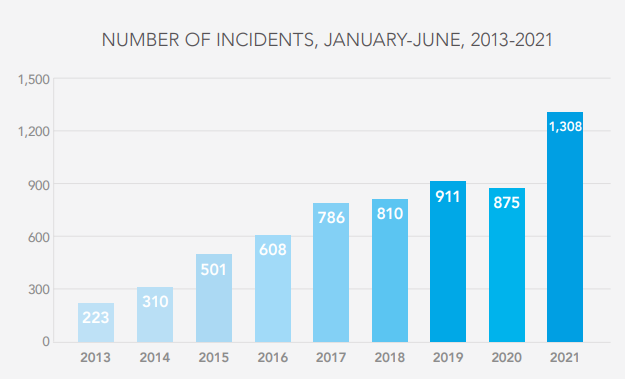
Keeping these things in balance is a constant challenge, and a worthy kind of memorial in itself. An event as complex and challenging should not be reduced to bromides or platitudes. Passionate argument and discussion about the best and most fitting way to remember this event indicates that it is still relevant. The challenge of relating it to the terrible colonial legacies of European civilisation in a way that preserves the significance of both. The challenge of recognising how ways of thinking about gender and sexuality were part of the poisonous brew of festering assumptions that boiled over in 1930s Germany. The challenge of recognising that attitudes to Roma and Travellers have barely evolved since the 1930s. Above all, perhaps, the challenge of seeing that the Holocaust was only possible because the countries of Europe all, to varying degrees, facilitated, encouraged, or even just tolerated the persecution of Jews because of an underlying antisemitism that seems less dormant with each passing day. The attack on Congregation Beth El in Colleyville, Texas, remember, was carried out by a man from Britain. Just last night, two Jewish men in Stamford Hill were attacked, out of the blue. The Community Security Trust recorded more antisemitic incidents in the first six months of 2021 than in any comparable period since 2013.

From CST “Antisemitic Incidents, January-June 2021” https://cst.org.uk/data/file/f/c/Incidents%20Report%20Jan-Jun%202021.1627901074.pdf

Wiseacres on social media might suggest that it’s a little churlish of me to raise this kind of argument on Holocaust Memorial Day. They might disingenuously imply that Holocaust Memorial Day places the genocide of Jews on a pedestal, drawing the gaze from present-day situations that they see as equivalent. Of course, they would have to ignore the way in which from its inception HMD has sought to provide knowledge and understanding of subsequent genocides. Across the country, survivors from Rwanda, Yugoslavia, Darfur and many other places share their stories and experiences with those who will listen. There are events tonight with representatives of the Uyghur, who are being persecuted in terrible ways in China.

And the survivors of the Holocaust know that their lesson is general, not particular. I had the privilege today to facilitate (on behalf of the Holocaust Educational Trust) the testimony of Freddy Berdach, who escaped Austria in 1938 with his parents. He spoke of how the atmosphere was filled with fear after the Anschluss as crowds of jeering, laughing, spitting Viennese dragged men and women onto the streets. He described how, aged just eight, he became expert in the intricacies of immigration to particular countries – though he still believed that they were safe the moment they stepped on a train to Switzerland, an impression corrected when a fellow passenger revealed his party badge and insisted on strip-searching him. Yet he ended on a note of hope, with an appeal to the general, not the particular. “The Holocaust,” he said, “must become a cultural code for education towards human rights and democracy, for tolerance, and opposition to racism.” It was decided in 2000 to call the day Holocaust Memorial Day over the objections of survivors, who were concerned that they might be accused of demanding special consideration: organsisers argued that the popular recognition of the Holocaust as a paradigmatic genocide would ensure that audiences were given an accessible cognitive framework for learning about other events, in different places and at different times. For survivors, it is always a balance between telling their story – as Lamentations puts it, “[to] weep streams of tears […] because of the destruction of my people” and the knowledge that there is nothing to be done about the past, only the future. As Primo Levi said, “It happened, therefore it can happen again. This is the essence of what we have to say.”

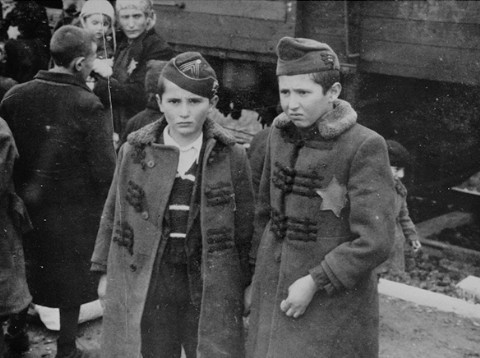
The theme for HMD 2022, “One Day” is a challenging one in this regard, since it seems to draw the gaze to the particular. For the Holocaust was so much more than one day. Taking place across Europe and North Africa and over a period of twelve years, it encompassed days and moments beyond counting. The crux of the problem is that no “One Day” was quite like another, even for those who shared it. For some it was a day of survival, for others it was the end. To return to the metaphor of the camera, however; by thinking about one person on one day we can bring the meaning of the destruction into focus more clearly. For me, it will always be the faces of Israel and Zelig Jacob, photographed on their arrival in Birkenau, which will encapsulate the tragedy more sharply than any other. That one day was their last day – this photograph the only known image of them.

Israel and Zelig Jacob, on the ramp in Birkenau, May 1944. USHMM #77218

The real danger of memorial days is that they do all the work. Jacob Rees-Mogg today told the Commons that there would be no statement today on the report into Downing Street parties during lockdown since the government wanted to “devote the whole time to debating Holocaust Memorial Day.” I am sure I speak for many others when I say that while the memory of the Holocaust is something MPs should be concerned with, it should not be used as a way of blocking MPs from doing their jobs by holding the government to account. To use the memory of the Holocaust as a filibuster cheapens the democracy Freddy Berdach prizes so highly, as well as the experiences of those who survived.

This is because Holocaust Memorial Day is not – or should not be – a moment for navel-gazing. The Year 10 students listening to Freddy Berdach asked how they and others can continue to remember the Holocaust. As I explained to them, I chose not to ask Freddy this question. Not because I don’t think he would have an answer – I’m sure his remarkable mind and soul would have something to say – but because I don’t think the question of what the Holocaust will mean is really his problem any more – it’s ours. The students spent the last half hour before the end of the day writing to Freddy about how they are going to take what they have heard forward. For it is not today that is most important, nor yesterday, but tomorrow. That is the one day that really counts. For joy cometh in the morning, if only we are there to see it.

Languages of the Holocaust

Featured

Posted by jaimeashworth in Heritage Politics, The Holocaust: Representations and Meanings

≈ Leave a comment

Tags

AJR, Child Refugees, Commemoration, Gathering the Voices, Generation2Generation, Holocaust, Holocaust Education, Holocaust memory, Holocaust Second Generation, Intergenerational trauma, Memorialisation, Memory Studies, NHEG, Postmemory, Refugees, representation

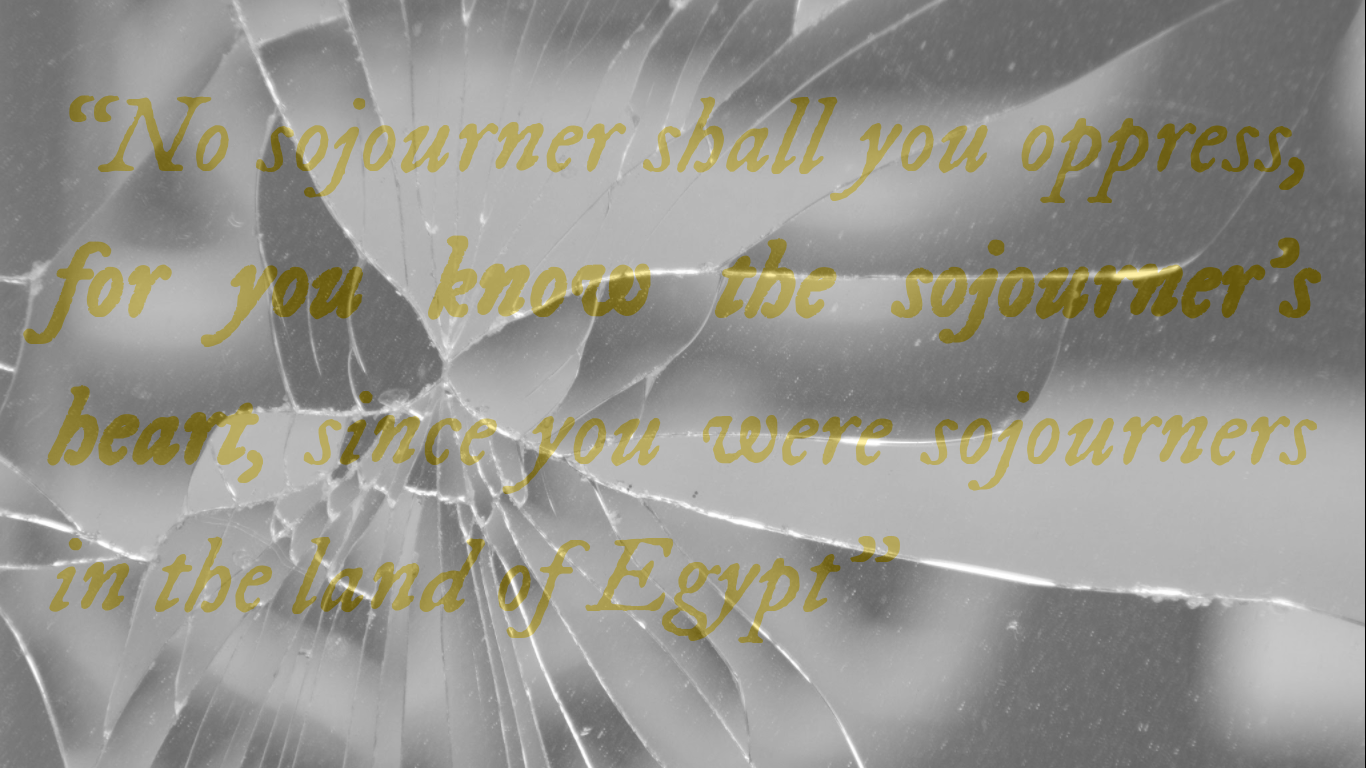
Exodus 23:9, ““No sojourner shall you oppress, for you know the sojourner’s heart, since you were sojourners in the land of Egypt” Photo and montage, Jaime Ashworth, 2021.

I’ve spent the last two days at a conference organised by the Association of Jewish Refugees (AJR), exploring the challenges of generational relationships to the events of the Nazi era. I’ve spent a lot of time in the last couple of years working with Generation2Generation, which trains speakers from the  second and third generations to present their family stories, and the experience has been extremely thought-provoking. I was hoping for a space in which I would be able to think three-dimensionally about the work I do with G2g and how that relates to the broader scope of Holocaust Studies and especially Holocaust Education. In an intriguing hybrid format (Day 1 online and Day 2 both online and in person at Chelsea Football Club), it did not disappoint.

Firstly, it made clear why it is so important to work with subsequent generations. AJR Chief Executive Michael Newman opened Day 2 by noting that the organisation has recently reached the point where the numbers of “first generation” members is matched by second- and third-generations. The conference was a part of a shift in orientation to ensure that the organisation remained relevant to all of its membership. 

A number of organisations are either making that shift or have been established to meet that need. G2g is joined by the Manchester-based Northern Holocaust Education Group (NHEG) and the Scottish organisation Gathering the Voices. The ‘45 Aid Society, established around the postwar child refugees known as ‘The Boys’ has also developed its generational offering with a fascinating website describing these remarkable life stories: as their video emphasised, in many cases produced by their descendants. The presentations by representatives made clear how busy all these bodies are. The post-survivor era is not here yet – though there is broad acceptance that it is nearing – but when it comes they can rest assured that their descendants (and allies) will carry their legacy forward bravely.

Rabbi Jonathan Wittenberg addresses the conference. Photo: Jaime Ashworth, 2021.

What that will look like, however, is very much in flux – and should remain so. Rabbi Jonathan Wittenberg spoke movingly of how he realised that his upbringing was an unusual one: “I thought I grew up in North London. I didn’t: I grew up in a German-Jewish enclave in North London.” He spoke of his wife’s hilarity when they first met that he couldn’t name the Beatles, so used was he to the sophisticated, cultured milieu of the family dinner table. But he underlined that this led him to look outward, remembering the Biblical admonition “No sojourner shall you oppress, for you know the sojourner’s heart, since you were sojourners in the land of Egypt” (Exodus 23: 9) In a more mundane, but possibly even more powerful moment, Hannah Goldstone of NHEG spoke of taking her daughter shopping to buy sanitary supplies for refugees. Why are we doing this, her daughter asked? “Because we know refugees. Because we’re from refugees” was the answer.

Listening to many different stories of exile and rescue over the two days, I was struck by the way that the legacy is part of British society in unpredictable ways. Many of the Kindertransport passengers, like the mother and uncle of G2g speaker Tim Locke, did not identify as Jews – in fact his mother rejected that label as an imposition of the Nuremberg Laws. The legacy of the Holocaust thus stretches well beyond what is sometimes called “the Jewish world”: to the leafiest parts of the Home Counties, even. It is therefore vital to look to the next challenge, the relationship of the past to our present and future. In conversation with Stephen Smith, Elisha Wiesel noted that his father, Elie Wiesel, viewed the genocide in Rwanda as equal in importance and uniqueness to the Holocaust – or any other genocide. 

Uniqueness is a problematic word in the context of Holocaust Studies. It implies a “preferential” view of the Holocaust that seems to jockey for a spotlight. But there is no necessary contradiction: the Holocaust had its unique elements – its singularity – just as Rwanda did (just as Yugoslavia did, just as…, just as…) but it is in its belonging to a class of events – genocides – which makes it of universal relevance. To look outside and meet the eyes of other groups recovering from (or experiencing) atrocity is a route to healing, and also a way to ensure the continuing relevance of this history to the world. 

Though for many the past will never be exactly history, but who they are. The American storyteller Lisa Lipkin took listeners on an amazing inner journey through her family’s Holocaust legacy. There were a lot of good jokes, but my abiding impression was of the sadness in her eyes, and the catch in her voice as she described encountering her aunt’s blue kerchief from Auschwitz in a USHMM warehouse. I wondered if, in the many sessions she has run, that gaze has been truly held and returned. It’s a look I see at the back of the eyes of many of the second-generation, and why (I suspect) so many of them are driven to talk, and teach, and try to express that pain that is both theirs and not theirs. The search is for language above all: this may be “postmemory”, but it is not post-pain. And pain, as Jean Amery famously wrote, cannot be communicated, only inflicted.

The issue of language dominated a discussion between Bea Lewkowicz of the AJR’s Refugee Voices project and two second-generation. All the voices (some recorded) noted the way that the language of their families was a crucial marker.  The daughter of Valerie Klimt, in a recorded interview, noted that German constituted a “secret code” for the family – which prompted a ripple of knowing giggles from the audience. But equally Ed Skrein, a Game of Thrones actor, was shown saying that the Holocaust was always present in his family (his grandparents came from Vienna), but that “They would never speak of it in personal terms.” I reflected that perhaps the belief that the Holocaust is beyond representation – or Unspeakable, as an Imperial War Museum exhibition once described it – comes partly from the strained silence in many families: unable to speak of it, but unable as a result to speak of little else. 

A session with the sociologist and journalist Anne Karpf crystallised these thoughts. She described the challenges of writing and revisiting her memoir The War After, she spoke of how she resisted the task of writing initially: “Why do I have to do it?” she says she sobbed to her partner. And then she questioned the way writing the book “sort of froze me…into being the child of Holocaust survivors.” But then she spoke of how the idea of intersectionality helped her see the past as one component of a kaleidoscopic range of identities. One definition, perhaps, but not necessarily defining.

Dr Anne Karpf speaks to the conference: “I want to retain the right to contest my previous narrative.” Photo: Jaime Ashworth, 2021.

But it was her thoughts on Holocaust memory that really struck home. She raised the idea (following Dominick LaCapra) of “archival fetishism” and the sacralisation of the Holocaust – even her unease at the “second-generation” label. She suggested that there needs to be a clearer distinction between the remembered self and the remembering self, a sharper choice between the overwhelming of memory and the rootlessness of forgetting. “I want,” she said proudly but also slightly plaintively, “to retain the right to contest my previous narrative.”

At this, I remembered the value of in-person conferences: the chance to sit quietly, and listen, and think among the like-minded and curious. How do we balance the demands of remembering for the future while forgetting for the present? The answer, I suggest, lies in language. I often return to the concept of mythology as framed by Roland Barthes (the language in which we speak of other things) as a central part of my academic life and approach. What if we saw “The Holocaust” as a language? As anyone who has learned a language knows, vocabulary and grammar act to both enable and circumscribe expression, and to transmit knowledge and values – the ingredients of what might be termed “usable” remembering. And as the people around me demonstrated, languages can be moved between: we do not always have to “speak Holocaust”, any more than we have to speak French, or German, or Italian, or Polish, however useful or integral to our selves they may be at moments. We always have a choice to rewrite – or re-speak – ourselves. 

The poet Michael Rosen spoke in the morning to AJR’s Alex Maws about his journey to find and attempt to understand his family’s past – to fill in the strange gap where his great-uncles in particular should have been. As someone whose early literacy was heavily influenced by his poems, it was a treat just to be in the room: the chance to have books signed was not one I was going to miss. Looking through his volume of poems about migration, On the Move, I was struck by the importance of language: the Yiddish words his parents use are a recurring theme. “Mum can speak two languages/and sometimes mixes them up” begins one poem. And in the introduction, he notes the power of poetry – the music of language – as “a way of thinking [which gives me a space to talk about things that are personal to me, but it also lets me leave things hanging in the air… To ask questions without giving too-neat answers.” What better mode of remembrance could there be? 

Links to the various organisations mentioned are included in the text: any and all them are appreciative of support. The two-line quotation in the final paragraph is from the poem “Two Languages” in Michael Rosen, On the Move: Poems about Migration (Walker Books, 2020. RRP £9.99). The lines from Exodus are from Robert Alter, The Five Books of Moses: A Translation with Commentary (W.W. Norton & Company, 2004).

An Argument that Must Not Abate

Featured

Posted by jaimeashworth in Culture and Politics, Heritage Politics, missinghistories, The Holocaust: Representations and Meanings

≈ 1 Comment

Tags

Dirk Moses, GermanCatechism, Holocaust, Holocaust Education, Holocaust memory, The German Catechism

Anti-lockdown sticker, Camden, 2021. Photo: Jaime Ashworth.

The debate over Dirk Moses’s German Catechism has led to a vigorous and interesting debate online in the last few weeks. The New Fascism Syllabus website has hosted a range of perspectives and responses, and scholars such as Neil Gregor have posted responses on their own blog sites. Doubtless someone, somewhere, is securing a book contract for the edited volume. And of course Twitter has lent itself to pithy and witty interventions, whether or not anyone was listening.

In which spirit, this is, as billed, the intervention in the German Catechism debate for which nobody has been waiting – but that in itself perhaps undermines the argument that the “gatekeepers” which Moses talks about are as effective as he suggests. The problem with which all of the world grapples, after all, is that the right to free speech creates neither a duty to publish nor an obligation to listen. Though as Jennifer Evans and Tiffany Florvil have pointed out, the debate has been conducted largely between and among white men of a certain age and socioeconomic status, ignoring the work of women and people of colour (and often both) in establishing, maintaining and hosting the debates themselves, while also employing arguments that have been currency outside that bubble for some time. The work of Anna Hajkova and Zoe Waxman, for example, in addressing challenging areas of research to do with sexual identities and sexual violence in the Holocaust, illustrates the difficulty of overcoming (in Waxman’s words) “opposition to feminist scholarship and thus to the very study of gender and the Holocaust itself rather than on any meaningful dialogue with the content of the research.” One might perhaps suggest that the debate at least began as a scrap among the gatekeepers themselves rather than those trying to get in.

(Disclaimer: I am hardly a break from the norm in several of the personal respects listed above, though as an independent scholar I do not have the status of many interlocutors. I will however, rigorously and professionally conduct meaningful Holocaust Education for your synagogue, community centre, youth movement, wedding or bar mitzvah.)

My own position is fairly straightforward. Moses is right to call out and protest unreflexive and inauthentic commemoration and research which does not take seriously the continuities and intersectionalities in the Holocaust. The fact that the Holocaust constituted the implementation of colonial warfare and ethnic cleansing against Europeans is an important and vital part of understanding the events. David Olusoga and Casper Erichsen (in The Kaiser’s Holocaust) used the figure of Heinrich Goering (father of the more famous Hermann) to illustrate this, noting that “While the father, whose prospective victims were black Africans, fits our view of a colonialist, the son does not. Yet the Nazis’ war in the East was one of imperial expansion, settler colonialism and racial genocide.”

Hitler himself in Mein Kampf set his purpose as “[drawing] a line under the foreign policy of pre-war Germany” and “putting a stop to the colonial and trade policy of the pre-war period and passing over to the territorial policy of the future” – by which he meant “the East”. What has been missing is the voices and likeness of the victims from which Hitler turned away. David Olusoga further illustrated – through the figure of Paul von Lettow-Vorbeck – in The World’s War (2014) how the First World War in Africa “far from being a meaningless side show in Europe’s war […] became the last phase of the Scramble for Africa.”

Nonetheless, Michael Berkowitz, in his introductions to the recently republished pamphlets by Alfred Wiener, The Fatherland and the Jews, passes over reference to “the Educational Service of the Lettow-Vorbeck Brigade”, noting that they “expressly advocated pogroms and public hangings of Jews” to buttress his claim that Wiener was “completely reasonable in leaving Hitler out of the picture”. Lettow-Vorbeck was (as Olusoga puts it) a “colonial specialist” having participated in the suppression of the ‘Boxer’ rebellion in China and the genocide of the Nama in South West Africa. The existence of a brigade named after him tells us much about the role of colonial mentalities in 1920s ex-soldier communities, yet here it is barely a footnote. The parallel debate about whether the recent “apology” for genocide in Namibia is sufficient or even genuine has perhaps been rather drowned out by the disputes about attitudes to memorialising the Holocaust.

At the same time, the fact that this debate is even taking place represents progress. A characteristically trenchant and engaging intervention from Neil Gregor is also right to remind readers that progress has been made, a point reinforced by Bill Niven. Historical understanding, by its nature, has to proceed at its own pace. There was, after all, a time in which Raul Hilberg was marginalised for pursuing research into the “machinery of destruction” which was set up to annihilate European Jewry. That European scholars have preferred to research topics in which they could retain some clear moral standing is understandable, though the work of scholars to recover and link this to the repression of colonial peoples and patriarchal attitudes to the history of gender and sexual identity should of course be encouraged. There is in some quarters possibly a desire to keep the debate on territory which the interlocutors are comfortable – though both Gregor and Niven have clear track records in both conducting and encouraging research “against the grain”.

The core problem here is the acceptance that time moves in one direction and that historical understanding is highly contingent. The literary scholar Lawrence Langer has recently published a collection of articles under the title The Afterdeath of the Holocaust. As well as commenting on core texts in Holocaust Studies, the articles also explore Langer’s own engagement with the subject of the Holocaust since the 1950s. He returns frequently – one might say almost obsessively – to his desire to avoid “redemptive” memory of the Holocaust. He insists that the Holocaust must be “a landscape of the imagination we never inhabited where solace perished along with the victims whose remnants lie scattered beneath its surface” and reiterates his opposition to “misguided” attempts “to find ways of coping with such desolation by striving to wrest some minimal meaning from the atrocity of mass murder.”

I am set to review Langer in more detail elsewhere, and I will use that space to detail the contradictions he entangles himself in there. But what comes through his writing is twofold: firstly, a profound sense of the lasting shock he experienced in his first encounters with the Holocaust; and secondly his clear frustration that the Holocaust has become normalised, in some important regards through his own work. The influence of his work on Holocaust testimony has been profound, as described by Noah Shenker in Reframing Holocaust Testimony (2015). Shenker notes that the Fortunoff Archive (informed in large part by Langer) has an “aversion to redemptive closure in testimonies” which means it can “miss those moments when a witness actually expresses some semblance of redemption.” It feels a lot like Langer is opposed to any kind of recovery or coping. Which is a heavy burden to live with, if true, for both survivors and subsequent generations.

Art Spiegelman, MAUS.

In Art Spiegelman’s MAUS, “Artie” asks his survivor therapist to explain how Auschwitz was. “BOO!” he replies “It felt a little like that. But ALWAYS.” For the individual encountering the Holocaust for the first time, it is still a lot like that, but it is also part of a “Holocaust metanarrative”. As Donald Bloxham and Tony Kushner put it, “the bundle of ideas and preconceptions handed down under the label ‘Holocaust’ that shapes the contours and parameters of our understanding of the subject.” There is no going back – and as Robert Jan van Pelt realised when starting his expert report in defence of Deborah Lipstadt against David Irving, that is a good thing. Deniers have to work against the Holocaust as historical and social fact: nobody really comes to it with an open mind in the sense of doubting it happened. As can be seen from the COVID conspiracy theory sticker which illustrates this post, the premise of the Holocaust has been very widely accepted. But this must not be allowed to solidify completely into slogans and parrot-like repetitions of formulaic ideas. As Moses reminds us, there is a duty on us to ensure that the contours and parameters of the subject mentioned by Bloxham and Kushner are debated, expanded and made more complex by the arrival of new and challenging research, and in a complex and diverse social milieu.

Ultimately, however, the tendency will always be to simplicity. Jay Winter and Antoine Prost have described how in the aftermath of World War 1, there was a conviction that the experience of combat could not be communicated, and could only be understood by those who were there. Yet a century later, the memory of the conflict is conducted largely through symbols which are easily recognised and understood: the poppy, some key photographs, pieces of poetry and other writing. If we tried to remember every crime committed by Europe in the modern age, we would have no space for any other activity, so we create ways of accessing the appropriate feeling when it is appropriate. Following Barthes, events become languages in which we speak of other things as well as themselves. Yet, as the work of David Olusoga, Santanu Das and many others illustrates, these moments of accessing the symbols of memory can also be occasions on which fresh thinking and energy can invest them with new meaning. In 2014-15 I was teaching an A-level class about India in the First World War and was able to use Olusoga and Das to talk about the conflict in a way which empowered students as agents of memory and change. The challenge of doing so for the Holocaust is the next stage: arguments such as these will recur, cynics may wonder (as Ian Kershaw noted of the 1980s Historikerstreit) whether they generate more heat than light. But as long as we strive to include as many voices as we can, and incorporate as many conflicting and challenging histories as possible, they will not abate – thank goodness.

← Older posts

Recent Posts

  • The Holocaust and its Perpetrators: A Response to Douglas Murray and Andrew Roberts
  • Cracked Mirror: Holocaust Unconsciousness
  • The Price of Memory
  • Simulated Horror: AI and the Holocaust
  • Through the glass, darkly: a warning against Holocaust Distortion

Archives

  • September 2025
  • July 2025
  • June 2025
  • February 2025
  • January 2025
  • November 2024
  • February 2024
  • January 2023
  • January 2022
  • October 2021
  • September 2021
  • June 2021
  • August 2020
  • July 2020
  • March 2020
  • January 2020
  • January 2019
  • November 2018
  • January 2018
  • September 2017
  • August 2017
  • February 2017
  • January 2017
  • August 2016
  • March 2016
  • August 2015
  • August 2014
  • June 2013
  • May 2013
  • April 2013
  • February 2013
  • January 2013

Categories

  • Book Reviews
  • Culture and Politics
  • Heritage Politics
  • missinghistories
  • Photography and Visual Culture
  • The Holocaust: Representations and Meanings
  • Uncategorized

Meta

  • Create account
  • Log in
  • Entries feed
  • Comments feed
  • WordPress.com

Blog at WordPress.com.

  • Subscribe Subscribed
    • framingthequestion
    • Already have a WordPress.com account? Log in now.
    • framingthequestion
    • Subscribe Subscribed
    • Sign up
    • Log in
    • Report this content
    • View site in Reader
    • Manage subscriptions
    • Collapse this bar
 

Loading Comments...