My post the other week about the use of AI to generate images purportedly of the Holocaust has had quite a lot of attention. Some of this has been derived from my posting a link alongside critiques of the images as they’ve appeared (and re-appeared) in my social media. I’ve had three basic responses to these comments:
Firstly, responses by people who are what used to be called “hard” Holocaust deniers. These claim that the images are no more fake than any other image of the Holocaust. This recalls David Irving’s rallying cry to fellow deniers to “Sink the Auschwitz!” Irving said that they had to “make it tasteless” to get attention: a strategy developed by the late (and unlamented) Ernst Zündel, who used publications such as “Secret Nazi Polar Expeditions” (1978) and “Hitler at the South Pole” (1979) to get himself invited into television studios to “defend” his views. He also doubtless tapped into the subculture of what we might term today credulous edgelords, many of whom probably went on to buy turquoise shell suits in emulation of David Icke.
(Icke, by the way, has dropped his New Age pretence of trying to create world peace in favour of screaming “Rothschild Zionist!” at pictures of people he disagrees with. No more shell suits either.)
Secondly, there have been comments espousing “soft” denial, especially minimisation. One response ran: “the reason they were running low on food was because the allies uS Great Britain Etc [sic.] were bombing the railways. Otherwise it was typhus killing those Jews.”
Both of these types of comment are to be expected. The effort to distort and deny the scale of the Holocaust started while the Holocaust was still happening, and hasn’t let up since. As Tony Kushner has described, this went alongside a “liberal” suspicion that Jews had brought their fate upon themselves – that there was (and this was an actual phrase used) “no smoke without fire”. Nothing has tortured a certain kind of antisemitic fantasist more than actual Jewish victimhood, often recorded by its perpetrators. That such people seek to muddy the historical waters is not surprising.
But other kinds of indignation have been less expected, and are much more worrying in strategic terms. I expect to draw the ire of deniers, but the people who’ve rejected my challenges to these fakes as an attack on Holocaust memory have been a shock. Particularly when they claim that the fakes reflect realities they’ve read about or even seen on site visits.
Mostly, those kinds of objections can be met with facts. Since the responder accepts the Holocaust as an item of knowledge, they are usually able to accept arguments based on factual information and evidence (even if this is time-consuming, especially as a volunteer.)
But the last kind of objection is the most difficult. These claim that any kind of Holocaust remembrance, however divorced from facts, is worthy of reverence. Since I treat fake images of real events (even if rarely referenced or even employing names) as fakes, I am guilty of (at best) carping or (at worst) challenging the reality of the Holocaust. Challenging Holocaust distortion is now (for some people) on a par with (or worse than) Holocaust distortion itself. We are not so much through the looking glass as picking the shards of critical discourse out of our eyes.
The use of these images is already blurring the boundaries between real and imagined. If it is allowed to go unchallenged it will rapidly become impossible to restrict their use. As we know from the success of The Boy in the Striped Pyjamas, the inadequacy of Holocaust representations is not disqualifying – in fact, it can even be a reason for their success. And there are -as Baudrillard warned – no originals to correct, no negatives to destroy. All we have is experience and expertise, challenges, and the exercise of choice.
The scholar Andy Pearce has done a lot of work on what he terms “Holocaust consciousness” – where the object is simply to create a rather numinous sense of the Holocaust’s reality rather than engage in rigorous education or discussion. We are reaping the fruit of this direction of work, and we need to ask ourselves if we can change course. It is not enough to be aware of the Holocaust; we must ensure that it is known.
Note: I’m now registered with Buy Me a Coffee: if you found this post useful or interesting, please consider sending me a small amount to help me do more. Thank you! https://coff.ee/jaimeashworth

Images In Spite of All, or Images in Spite of the Facts?
Above: Mendel Grossman (1913-1945) takes a self-portrait. He chronicled the Lodz Ghetto until his deportation to Auschwitz; he is reported to have died on a death march. Many of the negatives of his images were held in Israel and lost in the 1967 war. (Image from Wikipedia)
The ubiquity of the Holocaust in popular culture has always had costs. The saccharine American version of Anne Frank in the 1959 film; and the blockbuster Schindler’s List both received criticism for their simplification of a complex reality. In an age in which we are forced to surrender more and more of our creative and intellectual autonomy to AI, they are a starting-point for reflection.
Anne was a complicated, contradictory personality whose development into a woman was (among other things) chronicled in what her father determined would be The Diary of a Young Girl. Her reflections on adolescence, religion, sexuality and identity were excised, and her control of our understanding of what happened in the Secret Annexe has made it difficult to actually think through the challenges for all concerned in her predicament: being in close confinement under threat of death with a teenager must have been a challenge. (The BBC adaptation of the diary, starring Ellie Kendrick as Anne, does a particularly good job of bringing out this aspect.) The 1959 film turned Anne (ironically played by an actress in her twenties just six years Anne’s junior) into a simpering and rather pathetic figure, with (as many have observed) her Jewishness pushed into the background.
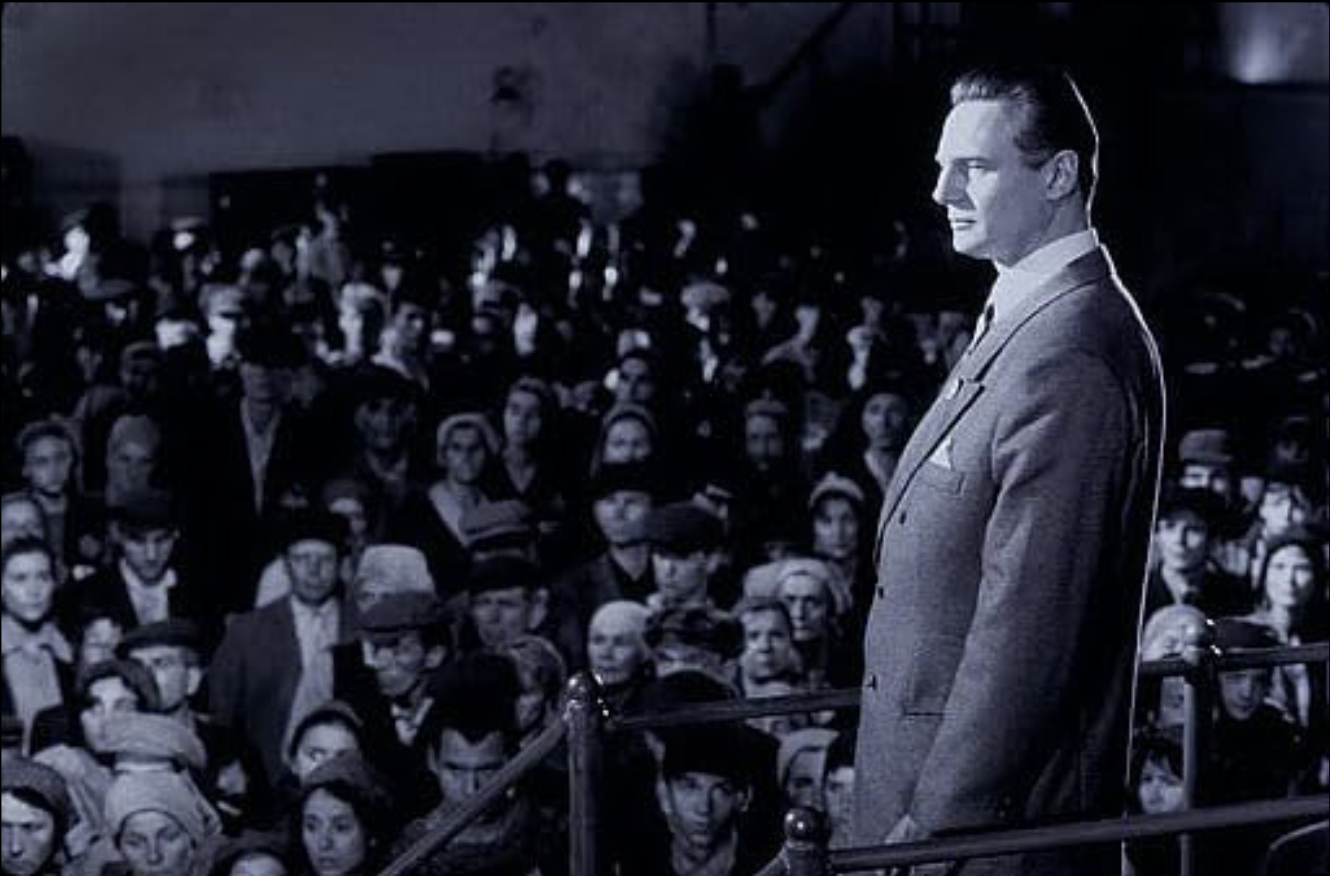
In 1993, Steven Spielberg turned an untrustworthy and feckless chancer (who did a lot of good) into a tragic hero in opposition to a bottomlessly corrupt and evil opposite: the commandant of KL Plaszow, Amon Goeth, played by Ralph Fiennes. It prompted widespread calls for Holocaust education and coincided with the opening of the United States Holocaust Memorial Museum. But many people have pointed out the film’s flaws. Fundamentally, it is still a Spielberg movie, with a clear moral arc (focused on a man who initially saw Jews as a resource to be exploited) and a redemptive ending. It popularised the Talmudic adage that “He who saves a life, it is as if he saved the world entire”, but the film is actually quite uncurious about what those lives meant. “The list is good; the list is life”, but how was it made? And who was not included? The arresting image of Schindler addressing the factory makes clear the relative status of rescuer and rescued.
Liam Neeson as Oskar Schindler announces the forthcoming liberation in Spielberg’s 1993 film (IMDB)
The 1990s also saw instrumental use of the Holocaust as a rhetorical weapon for unlikely causes. Perhaps most egregiously, the claim by the NRA that the Jews should have had guns to defend themselves. This not only reduced the tragedy of European Jewry to the Gunfight at the OK Corral, it also implied that gun owners were a persecuted minority on a par with the victims of genocide. The consequences of such disingenous faux-victimhood is visible in every news item from the contemporary United States.
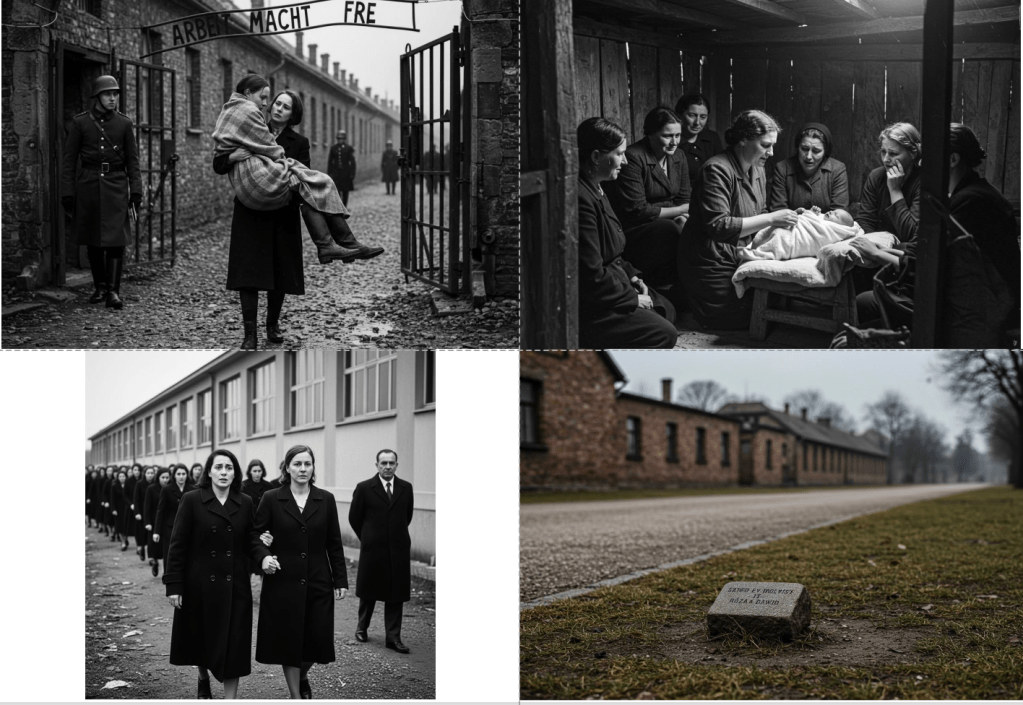
But at least these claims were rooted in an agreement about what was real. In the last few days, my social media has been subjected to a slew of AI-generated “images of the Holocaust” by the “90s History” feed: not my choice, but a result of the algorithms’ ability to present the virtual world without discussion.
These images are disturbing. Based on stories which even I (with thirty years of reading on the subject) can’t easily identify as fact or fiction. The accompanying images take elements of the Holocaust and build a parallel universe of images which could not have been.
Another 90s blockbuster, The Matrix, is useful to consider here. Amid the hysterical, cartoonish violence, a serious point is raised. In a simulation, how can we know what, if anything, is real? The movie says the trick is to know “that there is no spoon”: thus, Neo (Keanu Reeves) can make the world behave as he sees fit.
The philosophical depth of The Matrix is a matter for debate. But at one point a glimpse is given of Jean Baudrillard’s Simulacra and Simulation (1981; English 1983). Baudrillard argued that simulacra – copies for which there are no originals – were a burgeoning feature of the postmodern condition. Art Spiegelman’s MAUS, which reproduces his father’s Auschwitz testimony in graphic novel form, with Jews ”played” by mice, poses something of this challenge. But so too does Schindler’s List, in that it is arguably more faithful to Thomas Keneally’s novelisation of the story than to the facts themselves. But in each case, we can find solid ground under our feet. Plaszow existed, so did Goeth. Władek Spiegelman existed, as did Art’s brother Rysio, murdered by the person hiding him. It is essential to remember that these were real.
But the woman holding a child as she walks through a simulated “Arbeit Macht Frei” gate? The woman delivering a baby in what appears to be a wooden barracks allegedly in the Lodz Ghetto? The women proceeding through “Auschwitz” in identical woollen overcoats rather than the rags such prisoners were given? The nonexistent memorial tablet in a part of the Auschwitz camp that does not exist?
It might be argued that these are uses of technology to fill in gaps. But the historical record is evidence and gaps, in the same way that music is sound and silence. Both are needed: one for aesthetic purposes and the other for epistemological and ontological reasons. A Holocaust in which everything was saved, all is known, is much less of a Holocaust. It is the implied gap in the vast Book of Names held at Auschwitz – for which two million names will never be known – that provides the impact.
FAKES
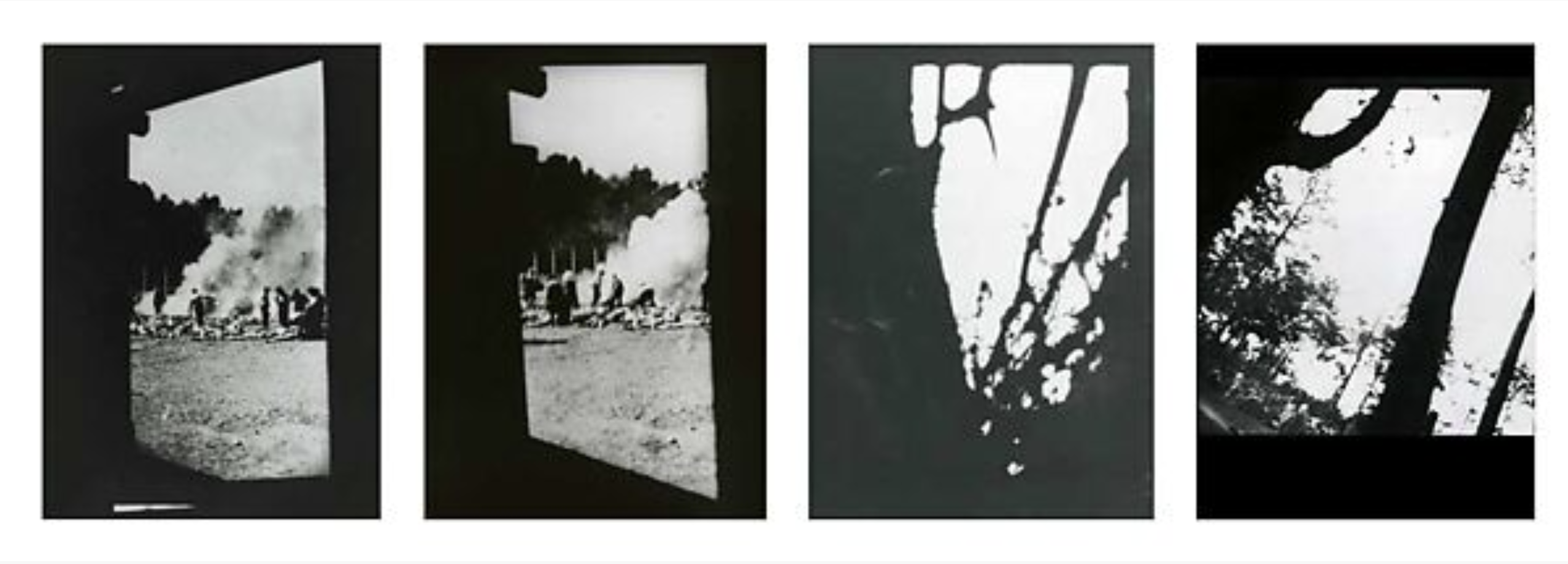
The smooth glossy surfaces of AI are infinitely easier than the real thing. The gritty, hastily taken “images in spite of all” (Didi Hubermann) taken by the Sonderkommando in summer 1944, as prototype gas chambers and burning pits had to be used to cope with the endless stream of deportations, are blurry, badly framed, at odd angles. But this is testimony to the reality of the situation: taken with a camera stolen from luggage brought by the victims, fearful of discovery. The author John D’Agata and fact-checker Jim Fingal begin their fascinating The Lifespan of a Fact with two epigrams from Lao Tze: “True words are not beautiful” and “Beautiful words are not true.” The flaw in the lens, the smudge in the record, the gap in the tape: this is the texture of evidence.
Above: the photographs taken by the Sonderkommando at Auschwitz II-Birkenau, Summer 1944 (Metropolitan Museum of Art digital copy)
It is possible that critics of this view might call me a Luddite. I wrote in 2017 of the risks I believed were posed by the efforts to create interactive holograms of survivors. I feared what they might be able to say in the future, uncanny purveyors of algorithmic “wisdom“. In the age of deepfakes I’m only surprised (and dismayed) that the world has changed so fast. But this confusion will only favour those who continue to deny, distort and denigrate the memory of the Holocaust: against such duplicitous and mendacious fakery, the best historian will flounder. We do not need to make their jobs easier in the quest for clicks: to do so is to cheapen the event we sigh wistfully over before scrolling onward.
And what to do? The director of Shoah, Claude Lanzmann, once said that if he encountered film of the gas chambers he would be compelled to destroy it. While I am unsure whether I could watch such a film, my instinct as a historian is that preservation is generally preferable. As a record of the insanities of the 2020s, these images may be valuable in the future. But these images are also, in my opinion, the historical equivalent of littering. So for now, I suggest two established technologies are most useful: the delete key, and the off switch.
Note: I’m now registered with Buy Me a Coffee: if you found this post useful or interesting, please consider sending me a small amount to help me do more. Thank you! https://coff.ee/jaimeashworth
A visitor to the Imperial War Museum London looks at portraits of Holocaust survivors, November 2021. Photo: Jaime Ashworth.
The theme for this year’s Holocaust Memorial Day is a vast one, going to the core of what is important about what happened in the Holocaust, and offering a sharp analytical tool to cut through what can sometimes be inaccurate, inappropriate, or simply inauthentic in Holocaust memorialisation. It also, if we choose, could be a rallying cry of hope for the world, but for the moment let me stick to what I know.
Like any historical event, the Holocaust has to be understood from the specifics up, and “lessons” must be drawn advisedly. If, in the solemn words of a 1968 anthology of Holocaust literature, we claim that “A whirlwind cannot be taught; it must be experienced” we cut ourselves off from what is important. Because if it cannot be taught, nor can it be learned from. For the learning to be done from a storm is limited, and we know there will be others: at some point, all we can do is take shelter and pray to be spared. But the Holocaust was not a natural disaster. It was the product of human actions on the basis of human decisions. We do violence to history if we paint its victims automatically as saints or its perpetrators as monsters.
Adam Czerniaków was an engineer and a Senator in the interwar Polish parliament. After occupation of the city, he was appointed Chairman of the Jewish council, responsible for the second-largest community of Jews in the world. The 300,000 Jews of Warsaw were outnumbered only by the Jews of New York, and during the twenty months Czerniaków was Chairman, Warsaw Jewry swelled to 450,000. In his endless attempts to square the demands of the Germans with the meagre resources the community had to help itself he won few friends, though his diaries show little of either the ego or subservience his critics accused him of. In July 1942, confronted with the request to organise the deportation of children from the ghetto, he committed suicide. Was this a final act of cowardice (as the great Polish-Jewish historian Emanuel Ringelblum claimed) or just the exhausted response of a man who had on more than one occasion gone from being beaten to a meeting to discuss how the ghetto managed its affairs? And who had endured both the hatred of those he tried to protect and the contempt of those he tried to placate. While the order sealing the ghetto came from the German governor of Warsaw, the final orders for the destruction of the ghetto were delivered by a junior officer. The final notice required no more explanation or debate; nothing more than a delivery man.
In Łódź, the Chairman of the Council – the self-styled “Elder of the Jews” – was Mordechai Chaim Rumkowski. A not very successful and not very well known businessman, he was appointed at around the same time as Czerniakow. When confronted in 1942 with the order to deport the children and the elderly, he complied, haranguing the ghetto that he would cut off the limbs to save the body, and making clear that only those who worked would survive. His ego, love of the limelight, and disturbing claims about his behaviour with the ghetto’s children, all fit him for the villain’s costume. And yet, as Yehuda Bauer has pointed out, the Łódź ghetto was finally liquidated in August 1944: had the Russian army advanced just a little quicker, we might now be talking of him as a pragmatic survivor.
The survivors knew – and, in their ever-smaller numbers, know – how frail and difficult such judgments are. Primo Levi, in his most heartfelt (and final) book, The Drowned and the Saved, acknowledged that “We, the survivors, are an anomalous minority. Those who saw the Gorgon, have not returned to tell about it or have returned mute, but they are […] the submerged, the complete witnesses, the ones whose depositions would have general significance. They are the rule, we are the exception.”
There comes a moment in every testimony, however professionally delivered, where the survivor once again encounters the slimness of the margin that brought them through their experiences safely but not others. Considerable scholarly energy has been directed at this. Initially survivors were thought to be racked by guilt. But guilt implies a charge which can be reversed or appealed in light of evidence. If we believe ourselves to be guilty, we usually have a basis for this, rightly or wrongly. We are ashamed, however, if we feel ourselves helpless in the face of wrongdoing. As Levi wrote of his liberators, arriving out of the mist 78 years ago today:
“They did not greet us, nor smile; they seemed oppressed, not only by pity but also by a confused restraint which sealed their mouths, and kept their eyes fastened on the funereal scene. It was the same shame which we knew so well, which submerged us after the selections, and every time we had to undergo or witness an outrage: the shame the Germans never knew, the shame which the just man experiences when confronted by a crime committed by another, and he feels remorse by its existence, because of its having been introduced into the world of existing things, and because his will has proven nonexistent or feeble and was incapable of putting up a good defence.”
Tadeusz Borowski, a Polish survivor of Auschwitz whose narrative persona in his Auschwitz stories was at odds with the generous and kind man his contemporaries remembered, observed that the key to the Nazi system was in reducing everyone and everything to its level.
“The first duty of Auschwitzers is to make clear just what a camp is…but let them not forget that the reader will unfalteringly ask: But how did it happen that you survived? […] Tell, then, how you bought places in the hospital, easy posts, how you shoved [them] into the oven, how you bought women, men, what you did in the barracks, unloading the transports, at the gypsy camp; tell about the daily life of the camp, about the hierarchy of fear, about the loneliness of every man. But write that you, you were the ones that did this. That a portion of the sad fame of Auschwitz belongs to you as well.“
You could not survive without being implicated in the death of another. Another survivor, Jean Amery, argued that “a man, once tortured, remains tortured” – perhaps chiefly by Amery’s own awareness that the only way to fully communicate pain is to inflict it. Levi’s first book was called “If this is a man”: I suspect the key to understanding all of these men, and other survivors besides, is to see that title as a question: directed firstly and most uncompromisingly at themselves. In undermining their core belief in their personhood – that they were and remained ordinary people – we see the evil of the totalitarian mindset which divides us all: into important or not, deserving or not, ordinary or not, and ultimately alive or not.
It is those categories which drove the killers. Demanding first that the individual be quantified, held to some fantastic genetic account was the first step. In the first years of the Nazi regime, the individual became required – by custom rather than laws in most cases – to give an account of their family history. A thriving industry sprang up, with genealogical researchers advertising their services, and different companies offering easy-to-carry versions of the Ahnenpass (ancestors’ record) detailing ancestry as far back as a given institution or organisation wished. It was partly to help resolve the myriad complications thrown up by this process that the Nuremberg Laws were introduced in 1935. First came the elimination of doubt and then came the elimination of the people who embodied those doubts.
It is comforting at this point to imagine that the killers believed their victims to be something other than ordinary people. There were certainly efforts to portray Jews as vermin, and the degraded communities of the ghettos seemed to confirm the propaganda. For some, by the time they encountered actual Jews, they saw only the phantasm of “The Jew”. Alfred Rosenberg, the ideologue of the Third Reich, commented after visiting Warsaw: “If there are any people left who still somehow have sympathy with the Jews then they ought to be recommended to have a look at such a ghetto. Seeing this race en masse, which is decaying, decomposing, and rotten to the core will banish any sentimental humanitarianism.” A Polish government report in May 1942 described how “Every day large coaches come to the ghetto; they take soldiers through as if it was a zoo. It is the thing to do to provoke the wild animals.”
For others, however, there is a more disturbing picture. The men of Reserve Police Battalion 101 were not impressionable youths whose views had been moulded by Nazi propaganda since childhood. They were middle-aged, and stolid. Nor, from Protestant North Germany, were they entirely typical Nazi voters in 1933. And yet, when offered the chance in July 1942 to be excused the actual killing if they wished, just one man stepped out of line. The battalion went on to be prolific and proficient – but only in a relatively few cases enthusiastic – killers. They were neither the supernatural horror of a B-movie special effects department nor the rigid-armed automata of early textbooks. They were, far more terrifyingly, ordinary people too. And they killed just like the others, whose extremity makes them more accommodating fixtures in the mental landscape. Once, while teaching a session, I asked the very wise man Steven Frank, whose childhood in Terezin I have heard him describe many times, how many monsters he met. He hesitated and I could see his genial nature strip back for a moment, before conceding, “Not many, actually.”
Of course there were monsters. Josef Mengele and Carl Clauberg, in their blank disregard for those on whom they performed medical “experiments” in Auschwitz. Heinrich Himmler, with his prim insistence that carrying out the extermination had made the SS hard but at no moral cost as long as they did not enrich themselves. The men around the table at Wannsee, calmly discussing the progress, scope, and implementation of mass murder before proceeding to lunch. There were sadists, sociopaths, and others. But even here we cannot know for sure that they were born wanting to do these things.
These challenges are the tests of the efforts this week to memorialise the Holocaust. Do they ask you to find complex and challenging answers to uncomfortable questions? Or do they you offer you reassurance that no, it could not happen here, not now, not by us.
Because it could. The full complexity of the debate on trans rights is not my field of expertise, nor is the plight of refugees. As ever, find a voice of experience, and listen, taking as your starting-point the idea that the person you encounter is ordinary, like you. But when a small minority becomes enlarged into an omnipresent and omnipotent threat out of all proportion to its size? That is my field. What happens when the self-identification of individuals becomes the business of everyone with half an opinion, that is my field. And what happens when the demand to police an illusory certainty acquires lethal momentum, that is very much my field. The elimination of doubt about what people are will always end in the elimination of people themselves if it is not checked by rigour, by empathy, and by compassion. Otherwise, the only way to eliminate the doubt is to eliminate the people. And that happens symbolically first, as we move them from those we deem “ordinary” and entitled to consideration and rights, and into another category, where maybe the rules of humanity do not fully apply. Every other step is a commentary on that first one.
Primo Levi died shortly after completing The Drowned and the Saved. He fell down a lift shaft in his Turin apartment building. Some have argued that it was not suicide since there was no note. But a cursory reading of his work reveals a man only desperately kept from the final discharge of his life by the writing of its explanation. In his essay ‘The Gray Zone’ in which he discussed Rumkowski among others, he concluded that “we are all in the ghetto, that the ghetto is walled in, that outside the ghetto reign the lords of death, and that close by the train is waiting.”
On one level, it is a tragic measure of how far this good, wise, brave man felt trapped by his experience. On another, it is a warning: of how far we may fall when we are not prepared to face the consequences of knowing the Holocaust was perpetrated by and on ordinary people. Before you call for the walls to be higher, for the lords of death to be more particular in their judgment, ask for whom the train is waiting. It could be you, it could be me: we are, after all, ordinary people.
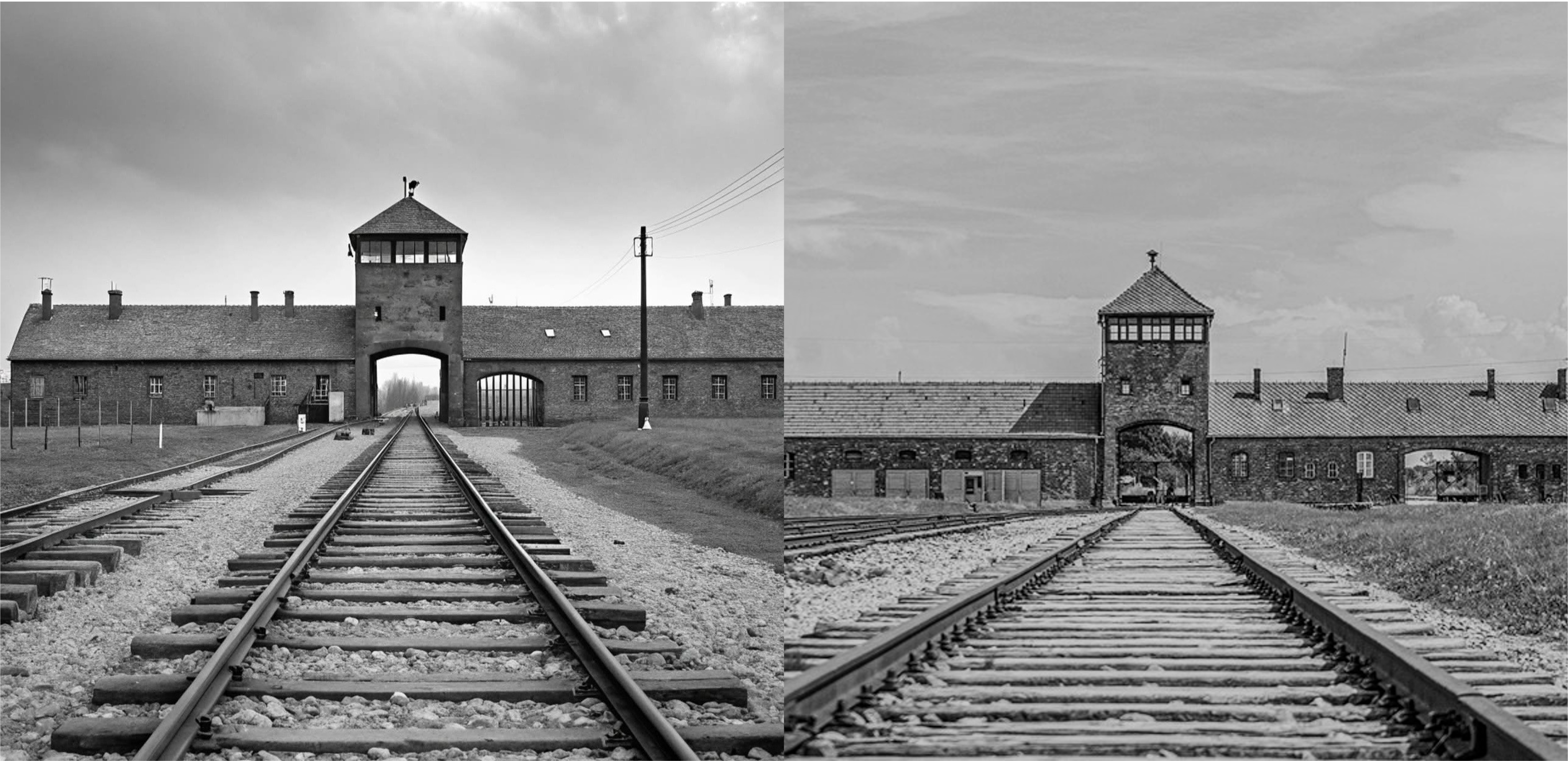
Auschwitz-II Birkenau, July 2015. Photo: Jaime Ashworth.
Among the most compelling of the exhibits at the Auschwitz Museum are the aerial photographs of the Auschwitz, Birkenau and Monowitz Camps taken by Allied reconnaissance in 1944 and early 1945. The images show the camps during some of their busiest – and bloodiest – periods of operation. If sufficiently magnified, it is possible to see groups of people walking from the trains to the crematoria and gas chambers. We can count the openings in the ceilings of the gas chambers of Crematoria II and III through which pellets of Zyklon-B were introduced. Visitors often leave, encouraged by their guides, with the sense that the world knew what was happening and remained silent.
A detail from an aerial photograph taken in August 1944. The red circle highlights the opening in the roof of the gas chamber of Crematorium II. The blue circle shows a group of deportees approaching the crematorium compound.
In fact, the truth is more complex. The images were taken using film cameras set to take constant exposures over many miles. The “target” of the surveillance was the chemical factory at Monowitz: built by prisoners in the adjoining Auschwitz III camp, the factory was built by the chemical combine IG Farben to produce synthetic rubber. At the confluence of the Vistula and Sola rivers, and located in a coal-mining region, the site was tailor-made for such a plant. The availability of cheap labour – the SS charged a fee to use prisoner labour – meant that the project could be completed relatively quickly and on a short budget. Although the Bunawerke factory never produced any Buna (synthetic rubber) it was a strategic target. In fact, it was bombed four times: twice in August 1944, once in September, and once in December.
The bombing of Monowitz is one of the most contentious episodes in the history of WW2. Why, critics ask, could the Auschwitz and Birkenau camps not have been bombed as well? In fact, stray bombs from one of the raids did fall on Birkenau, as recorded by survivor testimonies. A conference was organised at the United States Holocaust Memorial Museum in Washington in the late 1990s, with a volume of proceedings published in 2000. A short summary of a complex debate breaks down as follows:
Firstly, knowledge of Auschwitz was both plentiful and of questionable accuracy. Reports by escaped prisoners such as Rudolf Vrba and Alfred Wetzler made clear that mass murder was being carried out. But rumours of death by electrocution or burning were not accurate, and their estimates of numbers were (understandably) excessive. To prisoners caught up in hell, the constant stream of arrivals and the smoking chimneys must have made it impossible to say for certain more than that a very large number of people were being killed. Even perpetrators were unsure of the numbers. At Nuremberg, Rudolf Hoess, the commandant of Auschwitz, estimated that the dead in the camp totalled around 3,000,000. Research conducted in Poland in the early 1990s, however, demonstrated conclusively that approximately 1,500,000 people were deported to the camp, and of those around 1,100,000 were killed. But in 1944, at the closing stages of the war, the facts were unclear and resources at a premium. Auschwitz was at the very edge of operational range, and required a dangerous mission back and forth across Germany.
Secondly, there is the question of technological capability. The key idea here is Circular Error Probable: the likelihood of a given bomb hitting within a reasonable range of its target. Accustomed to footage of munitions that can virtually turn corners to match traffic lights, we forget that in 1944 a bomb was simply explosives set to blow up when it completed its vertical drop. To hit the crematoria, or the railway lines, or any other target, was difficult. The controversial Allied strategy of bombing German cities was employed because the technology made precision difficult unless flying by day – which increased the risk to aircrew. And this is before any thought is given to the likely cost in prisoner lives of any full-scale raids on the camp. Survivors may say that they would have welcomed it – but I am glad they are here to tell the story, rather than blown to smithereens by Allied bombs.
Thirdly, the intellectual framework did not exist to really comprehend what was in the images, even if someone had looked. It had not, as Primo Levi wrote, yet “been introduced irrevocably into the world of things that exist”. There was plentiful information about the Holocaust in both the popular press and the corridors of power, but it was not acted upon in the most basic way. It was not accepted as fact that the German intention was to exterminate the Jews of Europe. Assertions that it was, in the minds of decision-makers, belonged in newspaper headlines and lurid magazine articles, not the formulation of policy. A significant measure of antisemitism also contributed. Surely, some argued, this was just Jewish imagination at work, a persecution complex caught up in the war? In August 1942, Gerhart Riegner of the World Jewish Congress sent a telegram to Sidney Silverman MP, the WJC representative in London:
The Riegner Telegram (UK National Archives FO371/30917)
The ensuing five-day correspondence among officials acknowledged “numerous reports of large scale massacres of Jews” but focused on attempting to verify Riegner’s identity (“Eastern Dept. have no knowledge of Mr Riegner”) and ended with the following remark:
I do not see how we can hold up this message much longer, although I fear it may provoke embarrassing repercussions. Naturally we have no information bearing on this story.
Later in 1942, the activist Rev. James Parkes despaired that “The continued silence of the government in relation to the massacres is evidence of the strength in places of power of reactionary forces – from whom we have nothing to hope.”
But how then can we explain the pictures? Surely these images show that we knew exactly what was happening? There it is, in black and white, neatly labelled.
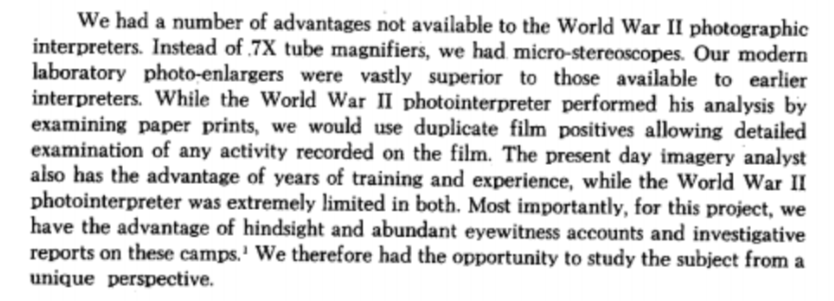
In fact, this is misleading. As I said above, the photographs were taken on huge rolls of film, covering many miles. The images of Auschwitz and Birkenau were at the end of these reels, after the “target” images of Monowitz. During the war, they were overlooked because analysts were not detailed to look. The images we are familiar with were only produced in the 1970s, when two CIA analysts named Dino A. Brugioni and Robert G. Poirier examined the images and conducted a retrospective analysis, uncovering many of the details that strike the visitor or viewer today. As they said in their report:
Extract from Dino A. Brugioni and Robert G. Poirier, “The Holocaust Revisited: A Retrospective Analysis of the Auschwitz-Birkenau Extermination Complex” (CIA, 1979)
In a variety of ways therefore, both technical and historical, not only were the images not looked at until the 1970s, they could not have been looked at earlier. The report also served another purpose than historical reconstruction. The pointed reference to the CIA’s photo-reconnaissance capability was meant to be understood most directly in Moscow: the clear message being that Russian military installations could be spotted, analysed and potentially destroyed.
Why is this important today? A BuzzFeed article prompted these reflections: an article about the treatment of the Uighurs in China. BuzzFeed used commercial technology to identify 268 sites, and was able to confirm that 92 of these are detention centres using documents, eyewitness testimony and academic research. Authorities in the region termed the claims of persecution as “a groundless lie”: “the issue concerning Xinjiang is by no means about human rights, religion or ethnicity, but about combating violent terrorism and separatism”. Some of these sites are sufficient to hold 10,000 people. The testimonies of those who have emerged from the camps to tell the tale are horrendous.
One of the detention sites identified by BuzzFeed.
This month, an open letter was sent to the government by more than 70 faith leaders, calling on the UK government “to investigate these crimes, hold those responsible to account and establish a path towards the restoration of human dignity.” The letter invoked the Holocaust, once more demanding that “Never Again” finally – this time – have some meaning.
In 1945, Primo Levi wrote that his liberators were oppressed by the evidence of the crime, “the shame the Germans did not know, that the just man feels at another man’s crime.” But this crime in many ways had only just been introduced into the “world of things that exist”. The legal measures of the late 1940s, the Genocide Convention and Universal Declaration of Human Rights, were landmarks, acknowledging for the first time that rights are human and transnational, that mass death is wrong, and that leaders cannot hide behind the state to evade responsibility. James Fawcett, one of the British contributors to these laws (and grandfather of our current Prime Minister), said in 1961 that their purpose was to ensure that “Sharpeville, Angola, Tibet, are all matters of international concern, though they happen within the jurisdiction of a particular state.” That these lessons were learnt while mired in the hypocrisy and crime of Empire does not detract from the imaginative, moral, ethical and philosophical leap they were.
But that leap was made for us. Now we know. Now, it is other words from Primo Levi that we must remember, before we once more say “Never Again”: “It happened, therefore it can happen again.” It is happening again: once more, as Levi wrote, the lords of death are waiting by the trains. It is our job to try and stop them leaving the station. Knowing is not enough: now we must act.
Working as a Freelance Educator on the Holocaust Educational Trust’s Lessons from Auschwitz project is probably the most rewarding and important thing I do. When COVID-19 interrupted all our lives, I was part of the way through an exceptionally busy term with two visits completed and two to come. While this letter is addressed to one group in particular (with whom I was hoping to do a follow-up seminar) it is also meant for all the groups I’ve worked with.
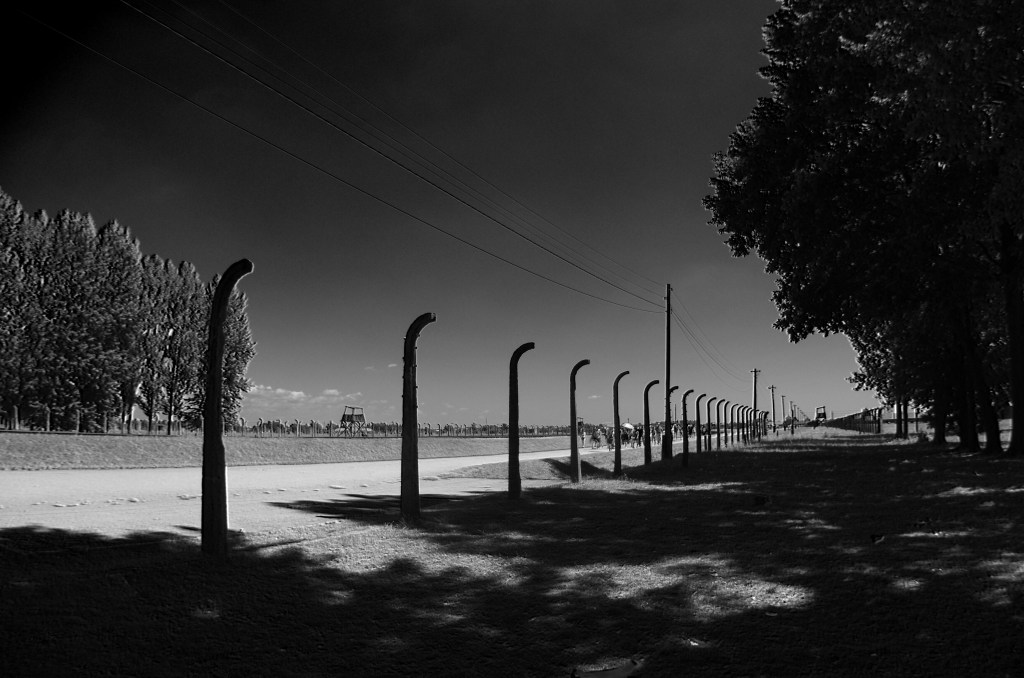
The main gate to Auschwitz II-Birkenau, March 2020. Photo: Jaime Ashworth
Dear Group Five,
First, let me say that you were lovely. Bright, curious, open to learning new things, as groups so often are. It’s just one of the reasons I love working as an Educator on the project. But you had something else in addition: an emotional grasp of what the trip meant that I’ve only rarely encountered and a willingness to share that with me and each other that was beautiful and inspiring to work with.
I am, quite simply, gutted that I haven’t been able to complete my sections of your LFA journey. I was looking forward to hearing your reflections and insights and getting a glimpse of your next steps. I don’t think anyone knows when or how that may happen – though I’m sure the logistics team that do everything to manage the seminars and trips are working to answer that question. In advance of that possibility I want to share some ideas about the possibilities and challenges that lie ahead in your next steps.
On a personal level I am wary of the idea of lessons. Michael Marrus, a distinguished scholar of the Holocaust and its history, wrote in his memoir that lessons are problematic, often telling us more about the person drawing the lesson than the past itself. I agree. But if we don’t try to draw lessons all we are left with is horror. So we have to strike a balance.
Certainly the idea that we can easily draw inspirational lessons is to be approached with caution. After hearing the testimony of Steven Frank, you identified that the most important factor in his survival was luck. Yes, he was young and healthy. Yes, he was resilient. Yes, he enjoyed the support of a parent who was also spared. But so did many others. As we are discovering, there is by definition no logic to catastrophe. Kings and beggars, villains and saints – all perished, the remainder saved only by capricious chance. As Primo Levi reminded us in his final book, The Drowned and the Saved:
We, the survivors, are not only a tiny but also an anomalous minority. We are those who, through prevarication, skill or luck, never touched bottom. Those who have, and who have seen the face of the Gorgon, did not return, or returned wordless.
Shortly after finishing the book, Levi died, falling down the lift shaft of his apartment building in Turin. There is a debate about whether he fell or jumped. I’m not sure it matters: he had spent a lifetime contesting the verdict on himself he had pronounced in the camp, convicted in his own mind by the fact of his survival. He had acted as best he could, but remained concerned that this had still been at the cost of others’ survival. As the Polish writer (and Auschwitz inmate) Tadeusz Borowski described so well, the camp experience involved everyone in the crime. One could not emerge from it without, however inadvertently, being tarnished. Because if you survived, someone else hadn’t. This is why understandings of survivors now focus more on shame than guilt. Guilt might be contested, shame enters the skin, as indelible as a tattoo.
Lessons need to be approached carefully, mindful of the facts and their complexity. Perhaps the only lesson that really matters is to see humanity and potential in everyone. That’s why the emphasis is on rehumanising the victims: because you can’t see the humanity in a statistic. But you might glimpse it in a market square or the site of a synagogue. Or in the objects brought by deportees, proclaiming their faith in the simple belief that life would go on, with prayers to be said, meals to be cooked and teeth to be brushed. And the reassurance of house keys in their pocket.
And what of the perpetrators? Should we see them as human? The Polish epigram Ludzie ludziom zgotowali ten los, coined by the writer Zofia Nałkowska while investigating Nazi crimes, is often translated as “man prepared this fate for man”. Which I suppose has a certain cadence in English. But in fact it is literally “People prepared this fate for people.” The first translation may look better carved in a stone tablet but it detaches the actors from their actions. People did this: people like you, people like me. And as Jonathan Littell notes in his novel The Kindly Ones:
If you were born in a country or at a time not only when nobody comes to kill your wife and your children, but also nobody comes to ask you to kill the wives and children of others, then render thanks to God and go in peace. But always keep this thought in mind: you might be luckier than I, but you’re not a better person.
So where do we go from here? Primo Levi wrote of the shame of the liberators as they entered the camp, their eyes downcast because this had happened, that such crimes had entered the world of existing things. A sense of shame at humanity is a common response to Auschwitz even today, 75 years later. And it is both correct and just the beginning of the story. You are it’s next step.
I often tell three stories when saying goodbye to groups.
The first is by Elie Wiesel and concerns the trial of God. A trial in the barracks of Birkenau where the inmates found God either guilty or absent. But then it was time for prayers, so they prayed. Sometimes we carry on despite our conviction that things are worthless – because sometimes that’s all there is to do.
Elie Wiesel was liberated in Buchenwald, aged sixteen. He spent a lifetime trying to explain Auschwitz but often resorted to the aphorism that “The truth of Auschwitz lies in silence”. It’s another good phrase that looks very impressive carved in stone. But here’s my question: if the truth of Auschwitz lies in silence, how do we tell it?
The final story is from the late Clive James. On a visit to Munich on assignment for the Observer in 1983, he visited Dachau. His description is characteristically both beautiful and learned.
There is a place in Virgil’s Aeneid called the broken-hearted fields. Standing in that snow-covered space I could think of no better description. Nor was there any point in reproaching oneself for being unable to shed tears: if we could truly imagine what it was like, we would die of grief.
I often think of these words when I talk to students worrying about whether their next steps will be enough or hear educators fret about whether they covered everything, whether they did justice to the facts. Of course they didn’t, because nobody can. We ask you to bear witness to Auschwitz, knowing that it’s really beyond description; because it’s the attempt that matters.
And so I suggest one final lesson from Auschwitz: it is better to speak than to remain silent. And you must trust that whatever you say will be perfect – because the alternative is saying nothing at all. The rest, as Rabbi Hillel said, is commentary: now go study.
Wishing you safe passage and a prosperous voyage in these troubled times.